Get 69% Off on Cloud Hosting : Claim Your Offer Now!





- Products
- Solutions
-
Solutions
-
 Cloud
Hosting
Cloud
Hosting
-
VPS
Hosting
-
 GPU
Cloud
GPU
Cloud
-
 Dedicated
Server
Dedicated
Server
-
 Server
Colocation
Server
Colocation
-
 Backup as a Service
-
 CDN
Network
CDN
Network
-
 Window
Cloud Hosting
Window
Cloud Hosting
-
 Linux
Cloud Hosting
Linux
Cloud Hosting
-
Managed
Cloud Service
-
 Storage
as a Service
Storage
as a Service
-
VMware
Public Cloud
-
Multi-Cloud
Hosting
-
Cloud
Server Hosting
-
Bare
Metal Server
-
Virtual
Machine
-
 Magento
Hosting
Magento
Hosting
-
 Remote
Backup
Remote
Backup
-
 DevOps
-
 Kubernetes
-
 Cloud
Storage
Cloud
Storage
-
 NVMe
Hosting
NVMe
Hosting
-
 DR
as s Service
DR
as s Service
-
-
Solutions
- Marketplace
- Pricing
- Resources
- Company
 Remote
Backup
Remote
Backup NVMe
Hosting
NVMe
Hosting Pricing
Calculator
Pricing
Calculator Unlock Cost
Optimization
Unlock Cost
Optimization Overview
 Documentation
 Price
Calculator
Price
Calculator Tools
Tools FAQs
FAQs Terms
of Service
Terms
of Service Privacy
Policy
Privacy
Policy
 Migration
 Container
 Power
Power
 Utilities
 VMware
Private Cloud
VMware
Private Cloud VMware
on AWS
VMware
on AWS VMware
on Azure
VMware
on Azure Certifications
 Partners
 Careers
 Support
 Service
Level Agreement
Service
Level Agreement  Contact
Table of Contents
The Compute Shift Enterprises Can’t Afford to Ignore
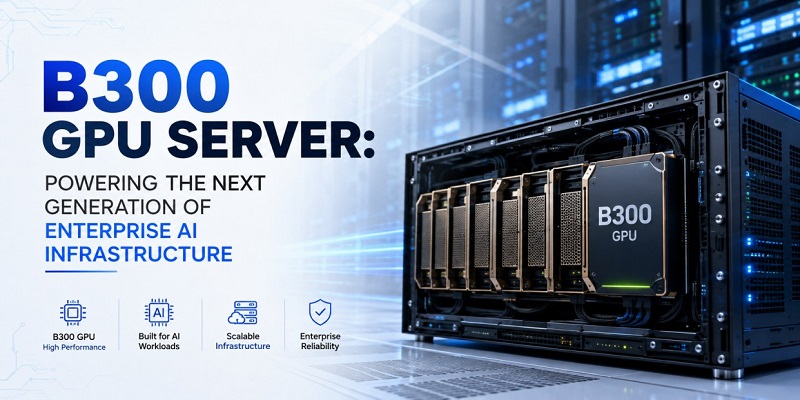
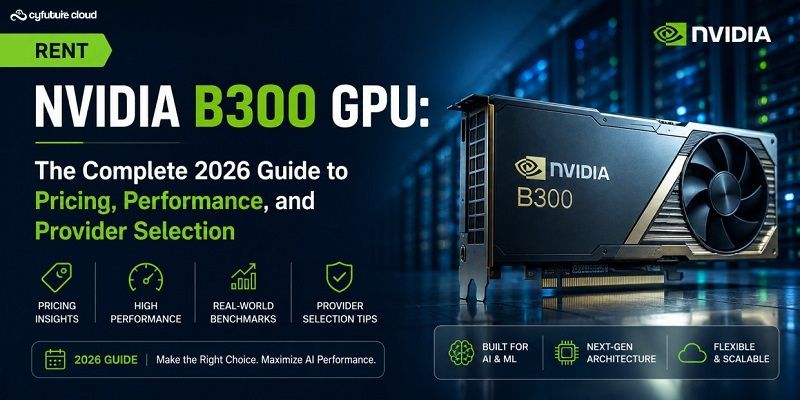
A B300 GPU server is a data center system built around NVIDIA’s Blackwell Ultra architecture, delivering 288 GB of HBM3e memory per GPU, up to 15 petaFLOPS of dense FP4 compute, and 8 TB/s of memory bandwidth per chip. Announced at GTC March 2025, Blackwell Ultra represents the next evolution beyond standard Blackwell, with the B300 GPU delivering 15 petaFLOPS dense FP4, 288 GB of HBM3e in 12-high stacks, 8 TB/s bandwidth, and a 1,400 W TDP.
For technology leaders, the shift isn’t incremental — it’s architectural. Every enterprise racing to deploy reasoning models, agentic AI pipelines, or large-scale inference is now confronting a hard truth: yesterday’s GPU memory ceilings are today’s bottlenecks.
Why the B300 Changes the Infrastructure Equation
NVIDIA DGX B300 is equipped with eight NVIDIA B300 Blackwell Ultra Tensor Core GPUs, providing 8 x 288 GB of GPU memory — approximately 2.3 TB in total — giving enterprises the capacity required for reasoning models and large language model workloads. This is a direct response to a problem every MLOps team knows well: model sharding overhead.
Each split of a model across devices introduces communication overhead, scheduling complexity, and more failure surface area. Increasing per-GPU memory lets you fit larger slices per device, reducing the number of partitions and the volume of cross-device transfers.
At the rack level, the numbers get more dramatic. In the GB300 NVL72 configuration, 72 GPUs are interconnected at 130 TB/s all-to-all, effectively creating a single exascale supercomputer inside one rack — eliminating the inter-node communication bottleneck that plagues multi-node H100 deployments. The GB300 NVL72 rack solution delivers 1.1 ExaFLOPS FP4, roughly 1.5 times the AI performance of the GB200 NVL72.
Connectivity keeps pace with compute. Eight front OSFP ports with integrated ConnectX-8 SuperNICs at 800 Gb/s enable turnkey deployment of NVIDIA Quantum-X800 InfiniBand or Spectrum-X Ethernet clusters.
The Efficiency Story: Density Without the Power Penalty
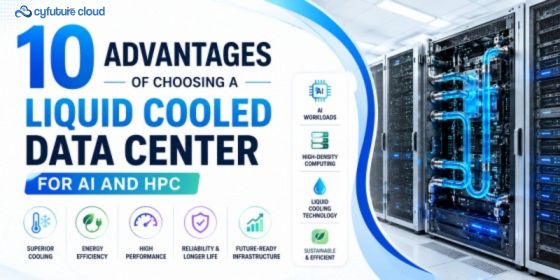
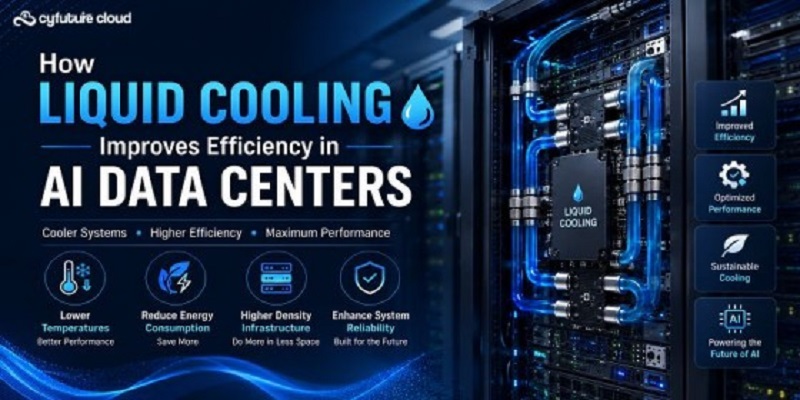
Enterprises evaluating GPU infrastructure investments care as much about operational efficiency as raw FLOPS. Built to the OCP ORV3 specification with advanced DLC-2 liquid cooling technology, each compact 8-GPU node fits 21-inch racks, enabling up to 18 nodes and 144 total GPUs per rack — while sustaining each B300 GPU at up to 1,100W TDP and dramatically reducing rack footprint and power consumption. Liquid-cooled variants push this further, capturing up to 98% of generated heat and achieving 40% data center power savings.
For CTOs modeling total cost of ownership, that translates directly into lower PUE, reduced cooling infrastructure spend, and higher rack-level compute density — three levers that matter more in 2026 than raw GPU count alone.
Choosing Between B300 and B200: A Practical Framework
Not every workload needs Blackwell Ultra’s memory headroom. As infrastructure architects increasingly frame it: choose B300 if memory is your bottleneck; choose B200 if you don’t need the extra memory headroom. Workloads that benefit most from B300’s expanded capacity include 70B+ parameter model fine-tuning, long-context inference, multi-modal pipelines, and agentic AI systems that maintain extensive KV caches across reasoning chains. Voice generator applications can also benefit from faster AI inference when generating speech at scale.
Market Reality: Availability and Pricing Trajectory
Enterprise buyers should plan around current supply dynamics. B200 and GB200 hardware is reportedly sold out through mid-2026, with a backlog of approximately 3.6 million units — a signal that B300 capacity is similarly constrained as demand accelerates.
On pricing, historical precedent offers a useful signal. The H100 followed a clear pricing curve, dropping from roughly $8/hour in early 2024 to under $3/hour by mid-2026. B300 pricing is expected to follow a similar trajectory as Vera Rubin pulls demand off Blackwell Ultra, likely in 2027, making early capacity reservation a meaningful strategic advantage for enterprises planning multi-quarter AI roadmaps.
Cyfuture Cloud’s Approach to Blackwell Ultra Infrastructure
Cyfuture Cloud has built its GPU cloud roadmap around exactly this shift — from raw compute provisioning to memory-aware, workload-matched infrastructure. Customers deploying reasoning models and agentic AI pipelines on Cyfuture Cloud’s GPU infrastructure benefit from deployment cycles measured in hours rather than weeks, backed by a technical team that has consistently delivered above 99.9% uptime across GPU-accelerated workloads. As B300-class capacity scales through 2026, Cyfuture Cloud is positioning its data center partnerships to give enterprises predictable access — without the








Stay Ahead of the Curve.
Join the Cloud Movement, today!
Send this to a friend