Get 69% Off on Cloud Hosting : Claim Your Offer Now!





- Products
- Solutions
-
Solutions
-
 Cloud
Hosting
Cloud
Hosting
-
VPS
Hosting
-
 GPU
Cloud
GPU
Cloud
-
 Dedicated
Server
Dedicated
Server
-
 Server
Colocation
Server
Colocation
-
 Backup as a Service
-
 CDN
Network
CDN
Network
-
 Window
Cloud Hosting
Window
Cloud Hosting
-
 Linux
Cloud Hosting
Linux
Cloud Hosting
-
Managed
Cloud Service
-
 Storage
as a Service
Storage
as a Service
-
VMware
Public Cloud
-
Multi-Cloud
Hosting
-
Cloud
Server Hosting
-
Bare
Metal Server
-
Virtual
Machine
-
 Magento
Hosting
Magento
Hosting
-
 Remote
Backup
Remote
Backup
-
 DevOps
-
 Kubernetes
-
 Cloud
Storage
Cloud
Storage
-
 NVMe
Hosting
NVMe
Hosting
-
 DR
as s Service
DR
as s Service
-
-
Solutions
- Marketplace
- Pricing
- Resources
- Company
 Remote
Backup
Remote
Backup NVMe
Hosting
NVMe
Hosting Pricing
Calculator
Pricing
Calculator Unlock Cost
Optimization
Unlock Cost
Optimization Overview
 Documentation
 Price
Calculator
Price
Calculator Tools
Tools FAQs
FAQs Terms
of Service
Terms
of Service Privacy
Policy
Privacy
Policy
 Migration
 Container
 Power
Power
 Utilities
 VMware
Private Cloud
VMware
Private Cloud VMware
on AWS
VMware
on AWS VMware
on Azure
VMware
on Azure Certifications
 Partners
 Careers
 Support
 Service
Level Agreement
Service
Level Agreement  Contact
Table of Contents
- What Is Server Colocation?
- What the Provider Typically Manages
- Why Is Server Colocation Growing in India?
- Key Benefits of Server Colocation in India
- Server Colocation vs. Cloud Hosting
- Who Should Consider Server Colocation?
- What to Consider Before Choosing a Colocation Provider
- Why India Is an Attractive Colocation Market
- Conclusion
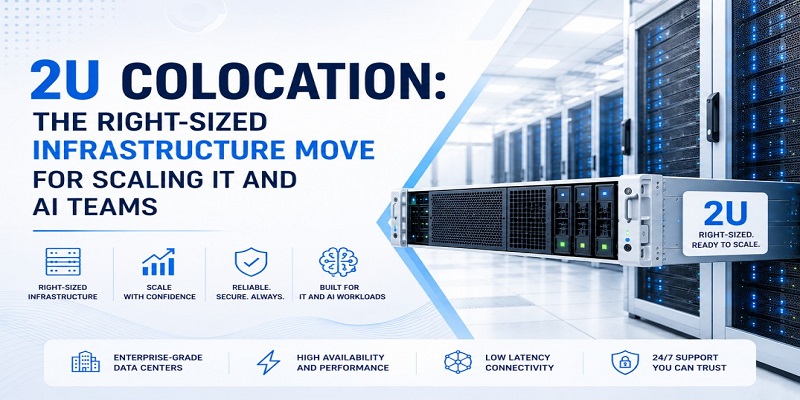
Server colocation in India has become an important infrastructure option for businesses that need reliable, secure, and scalable IT infrastructure without building their own data center. With colocation, companies place their physical servers in a professionally managed data center that provides power, cooling, network connectivity, physical security, and operational support.
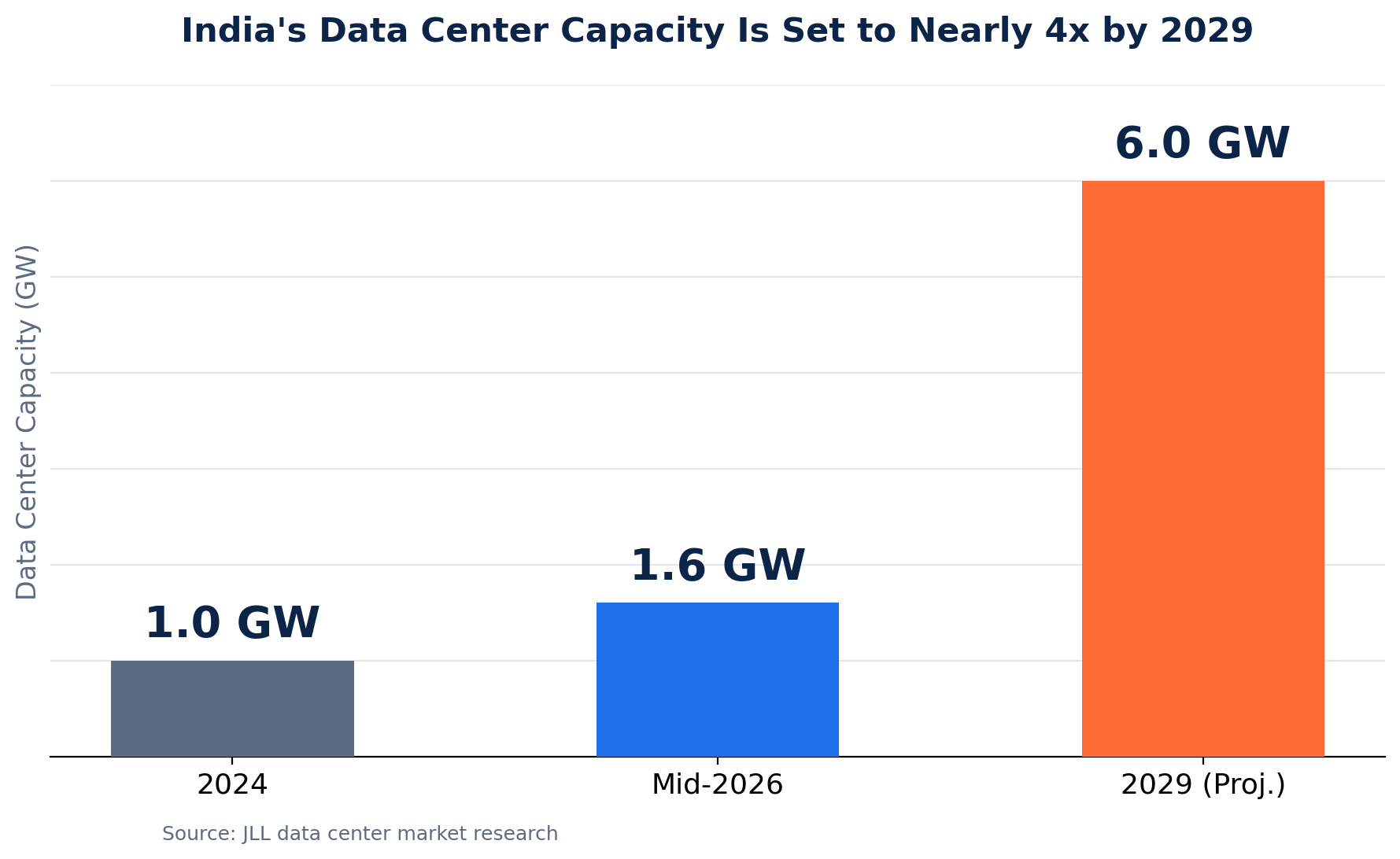
India’s data center market is expanding rapidly. According to JLL, India’s data center capacity reached around 1.6 GW in mid-2026 and is projected to reach 6 GW by 2029. The growth is being driven by cloud adoption, AI workloads, digital services, and increasing demand for local infrastructure.
This article explores the major benefits of server colocation, why India is becoming an attractive data center market, how colocation compares with cloud hosting, and what businesses should consider before selecting a colocation provider.
What Is Server Colocation?
Server colocation is a hosting model where a business owns its physical servers but places them inside a third-party data center facility. Instead of maintaining servers in an office or building a private data center, businesses rent rack space, cabinets, or dedicated cages from a colocation provider.
The business continues to control its servers, operating systems, applications, and data; the provider manages the facility around it.
What the Provider Typically Manages
|
Area |
What’s Included |
|
Power |
Power supply and backup power |
|
Environment |
Cooling and environmental control |
|
Connectivity |
Internet and network connectivity |
|
Security |
Physical security |
|
Safety systems |
Fire detection and suppression |
|
Operations |
Data center monitoring |
|
Support |
Remote hands and technical support |
|
Facility upkeep |
Physical infrastructure maintenance |
Why Is Server Colocation Growing in India?
India is experiencing rapid growth in digital infrastructure. Businesses across industries are increasing their dependence on online applications, cloud platforms, AI, digital payments, SaaS applications, and data-intensive services.
JLL reported that India’s data center industry crossed the 1 GW capacity milestone in 2024, with capacity expected to grow significantly in the following years. The expansion of AI is also increasing demand for high-performance infrastructure — AI workloads require substantial computing power, networking capacity, electricity, and advanced cooling systems.
Consequently, server colocation in India is becoming an attractive option for companies that want enterprise-grade infrastructure without investing heavily in constructing and operating their own facility.
Key Benefits of Server Colocation in India
|
Benefit |
Why It Matters |
|
1. Reduced infrastructure costs |
Avoids the capital investment of land, power systems, cooling, fire protection, networking, and security that a private data center requires. Businesses rent what they need and pay accordingly. |
|
2. Reliable power and cooling |
Redundant power infrastructure, UPS systems, backup generators, and dedicated — increasingly energy-efficient — cooling support critical, high-density workloads like AI, GPU, and database use. |
|
3. Better network connectivity |
Access to multiple network carriers and high-speed connectivity improves resilience and reduces dependency on a single connection. |
|
4. Improved physical security |
Multiple layers of protection — CCTV, controlled access, security personnel, biometric authentication, visitor management, restricted areas, environmental monitoring — exceed typical office-based hosting. |
|
5. Scalability for growing businesses |
Businesses can scale from a single rack to multiple racks, additional power, or more bandwidth as requirements grow — useful for SaaS, IT, e-commerce, and data-heavy organizations. |
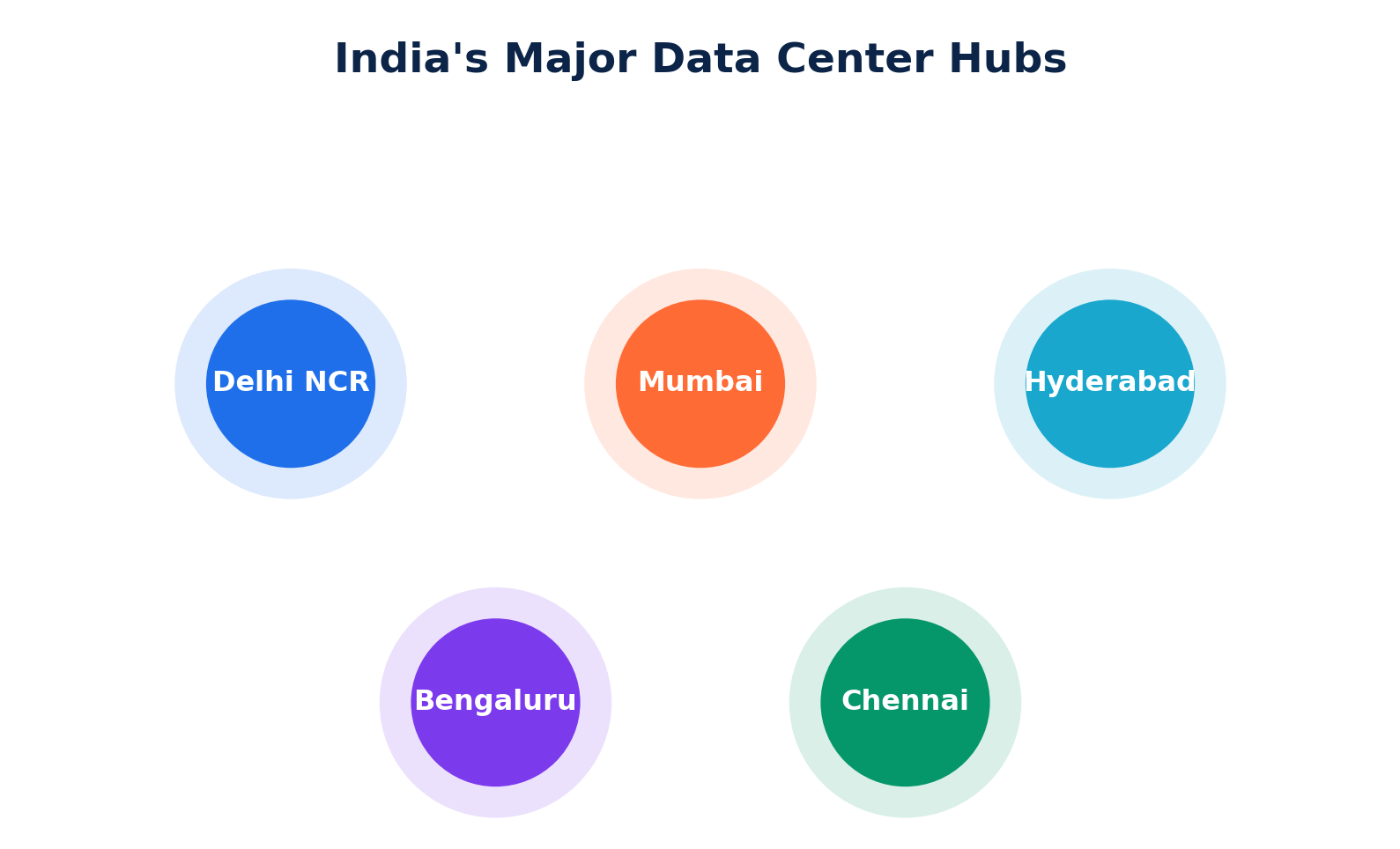
India’s major data center hubs include Mumbai, Chennai, Delhi NCR, Bengaluru, and Hyderabad. JLL’s 2026 analysis identifies Mumbai and Chennai as leading markets, while cities such as Hyderabad and Delhi NCR continue to develop their digital infrastructure.
Server Colocation vs. Cloud Hosting
Server colocation and cloud hosting provide different approaches to infrastructure management. With colocation, the business generally owns and controls the physical server hardware, and the provider supplies the facility and supporting infrastructure. With cloud hosting, the cloud provider manages the underlying infrastructure, while the customer typically rents virtual computing resources.
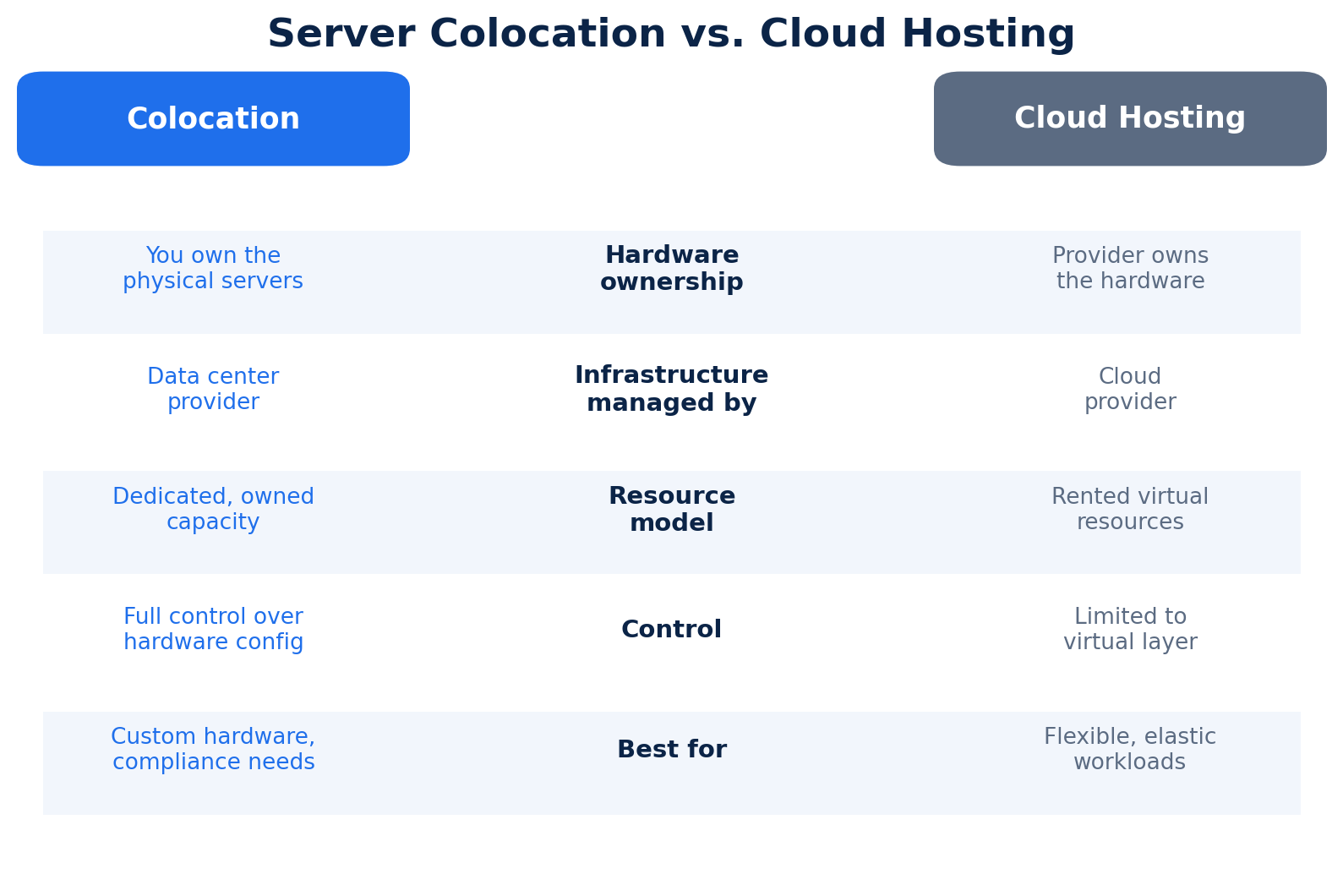 The right option depends on the business’s technical, financial, compliance, and performance requirements.
Who Should Consider Server Colocation?
|
Business Type |
Why Colocation Fits |
|
Enterprises with dedicated hardware |
Need specific server configurations, storage systems, GPUs, or networking equipment |
|
Businesses with compliance requirements |
Need greater control over physical infrastructure and data environments for sensitive information |
|
SaaS and technology companies |
Need reliable infrastructure and predictable performance for applications and customers |
|
Businesses running high-performance workloads |
AI, machine learning, analytics, and databases that require specialized hardware |
What to Consider Before Choosing a Colocation Provider
Choosing a provider requires more than comparing monthly rack prices.
|
Factor |
What to Check |
|
Data center location |
Based on your users, network requirements, disaster recovery strategy, and business operations |
|
Power availability |
Power capacity, redundancy, UPS systems, generator backup, and power allocation per rack |
|
Network options |
Bandwidth, carriers, redundancy, cross-connects, and connectivity options |
|
Security and certifications |
Physical security measures and relevant industry certifications; compliance requirements may also apply |
|
Scalability |
Whether the provider can accommodate additional racks, power, bandwidth, and equipment as you grow |
|
Technical support |
24/7 monitoring and remote-hands support for when your team can’t be on-site |
Why India Is an Attractive Colocation Market
India combines a large digital consumer base, expanding cloud adoption, increasing AI activity, and growing digital infrastructure investment.
JLL reported that India’s data center capacity is projected to increase from 1.6 GW in mid-2026 to 6 GW by 2029. It also reported that H1 2026 data center absorption reached 101 MW, with AI workloads contributing significantly to demand. This expansion creates more options for businesses seeking professional infrastructure across major Indian locations.
Conclusion
Server colocation in India offers businesses a practical way to deploy physical servers inside professional data center facilities without building their own infrastructure. It combines greater hardware control with reliable power, cooling, security, connectivity, and scalability.
As India’s data center ecosystem continues to expand, colocation can be particularly valuable for enterprises, technology companies, SaaS businesses, and organizations running demanding workloads.
However, businesses should evaluate location, power redundancy, network connectivity, security, scalability, technical support, and total cost before selecting a provider. When these factors align with business requirements, server colocation can provide a reliable foundation for long-term digital infrastructure growth.











Stay Ahead of the Curve.
Join the Cloud Movement, today!
Send this to a friend