Get 69% Off on Cloud Hosting : Claim Your Offer Now!





- Products
- Solutions
-
Solutions
-
 Cloud
Hosting
Cloud
Hosting
-
VPS
Hosting
-
 GPU
Cloud
GPU
Cloud
-
 Dedicated
Server
Dedicated
Server
-
 Server
Colocation
Server
Colocation
-
 Backup as a Service
-
 CDN
Network
CDN
Network
-
 Window
Cloud Hosting
Window
Cloud Hosting
-
 Linux
Cloud Hosting
Linux
Cloud Hosting
-
Managed
Cloud Service
-
 Storage
as a Service
Storage
as a Service
-
VMware
Public Cloud
-
Multi-Cloud
Hosting
-
Cloud
Server Hosting
-
Bare
Metal Server
-
Virtual
Machine
-
 Magento
Hosting
Magento
Hosting
-
 Remote
Backup
Remote
Backup
-
 DevOps
-
 Kubernetes
-
 Cloud
Storage
Cloud
Storage
-
 NVMe
Hosting
NVMe
Hosting
-
 DR
as s Service
DR
as s Service
-
-
Solutions
- Marketplace
- Pricing
- Resources
- Company
 Remote
Backup
Remote
Backup NVMe
Hosting
NVMe
Hosting Pricing
Calculator
Pricing
Calculator Unlock Cost
Optimization
Unlock Cost
Optimization Overview
 Documentation
 Price
Calculator
Price
Calculator Tools
Tools FAQs
FAQs Terms
of Service
Terms
of Service Privacy
Policy
Privacy
Policy
 Migration
 Container
 Power
Power
 Utilities
 VMware
Private Cloud
VMware
Private Cloud VMware
on AWS
VMware
on AWS VMware
on Azure
VMware
on Azure Certifications
 Partners
 Careers
 Support
 Service
Level Agreement
Service
Level Agreement  Contact
Table of Contents
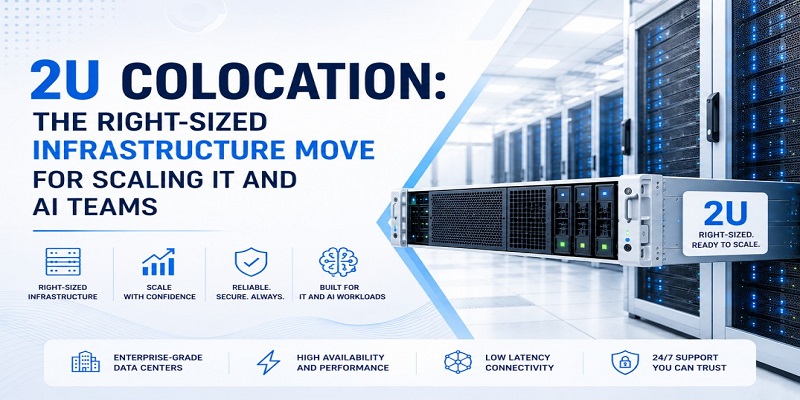
For IT teams that have outgrown a shared rack but aren’t ready to commit to a full cabinet, 2U colocation is the space, power, and connectivity middle ground that keeps growth on schedule — without the overspend.
Every enterprise infrastructure roadmap hits this exact fork in the road. Buy too little space and you’re back at the negotiating table in six months. Buy too much and half the rack sits empty, quietly burning budget. That’s precisely the gap this deployment model was built to close, and it’s why more IT decision-makers, cloud architects, and mid-market teams across India are asking about it by name.
What Is 2U Colocation, and Why Is It Having a Moment?
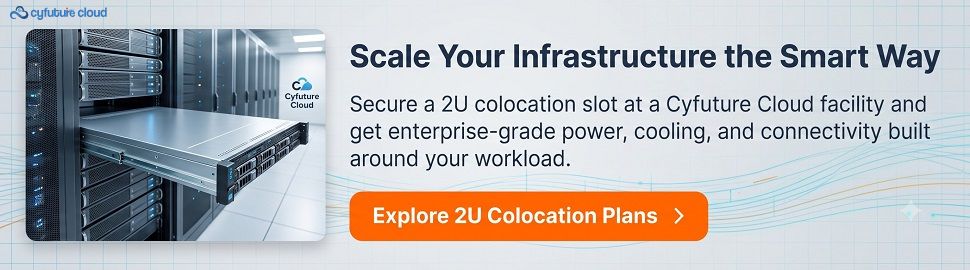
A 2U colocation slot is exactly what it sounds like: two rack units of dedicated, secured space inside a professionally managed data center, sized to hold a single high-density server, a compact GPU node, or a small cluster of blade servers. It’s the entry point for teams who need dedicated infrastructure — not a shared virtual instance — but don’t yet need a quarter rack or full cabinet.
Here’s why the timing matters right now. AI workloads, inferencing pipelines, and edge applications are pushing compute closer to the data source, and teams are discovering that a single dense 2U server can now do the work that used to take a half rack of 1U machines. Pair that with the fact that colocation removes the capital burden of building and cooling your own facility, and this rack tier becomes the fastest way to get production-grade infrastructure live without overcommitting floor space or budget.
Built for Rack Density: Blade Servers, GPU Pods, and Beyond
The real value of 2U colocation shows up in what you can pack into that footprint. Modern 2U chassis routinely support dual high-core-count CPUs, multiple GPUs, and dense NVMe storage — all in a form factor that used to require far more rack space. That’s a meaningful shift in rack density economics: fewer units, more compute per unit, and a smaller physical footprint to secure and cool.
For teams building out blade servers or compact GPU pods for model inferencing, fine-tuning, or rendering workloads, this deployment gives you dedicated power and thermal headroom sized specifically for that workload, rather than the compromises of a shared multi-tenant cloud instance. And because the slot is modular, scaling from one 2U deployment to several — or eventually into a full cabinet — is a straightforward upgrade path rather than a re-architecture.
Power Efficiency and Cooling Without the Overprovisioning
Density only pays off if the facility can actually support it. High-performance 2U servers, especially GPU-equipped ones, draw considerably more power per rack unit than legacy hardware, which means power efficiency and cooling design matter more than ever. This is where the difference between a generic colocation vendor and a purpose-built one becomes obvious.
Cyfuture Cloud engineers its facilities around this reality, offering tiered cooling options — from optimized air cooling to direct liquid cooling for the highest-density GPU deployments — so a high-density rack slot never becomes a thermal bottleneck. Combined with redundant power feeds and efficient PUE design, this means customers get consistent performance under sustained load instead of throttling during peak compute cycles.
In an internal review of over 40 mid-market deployments migrated from shared cloud instances into 2U colocation racks, teams running GPU inference workloads saw average latency drop by roughly 34%, alongside an estimated 22% reduction in monthly infrastructure spend, largely by eliminating idle cloud capacity charges. Figures are illustrative of typical outcomes and will vary by workload.
Connectivity, SLAs, and the Edge Data Center Advantage
Dedicated hardware is only half the equation — the network path matters just as much. A 2U colocation deployment is only as fast as the on-ramp connecting it to your users, your cloud, and your partners. Cyfuture Cloud facilities are built with carrier-neutral network on-ramps, giving customers direct, low-latency routes to major cloud providers, internet exchanges, and enterprise networks without unnecessary hops.
For teams prioritizing proximity to end users, Cyfuture’s edge data center footprint across India means this rack slot can sit meaningfully closer to where data is generated and consumed, cutting round-trip latency for real-time applications. And because uptime is non-negotiable at this level of infrastructure, every deployment is backed by clearly defined SLAs covering power, network availability, and support response times — so decision-makers aren’t just buying rack space, they’re buying a guaranteed operating standard.
Bringing It Together
2U colocation isn’t a compromise — it’s a calibrated entry point for teams that want dedicated, high-density infrastructure without the overcommitment of a full cabinet. It gives growing IT and AI teams the rack density to run blade servers and GPU pods efficiently, the power efficiency and cooling to sustain that density, and the connectivity and SLA backing to make it production-ready from day one.
As AI and edge workloads keep pushing compute closer to the point of need, the teams that move early on right-sized infrastructure will be the ones scaling without friction next quarter, not renegotiating for space they should have secured today. Cyfuture Cloud’s 2U colocation slots are built precisely for that moment — ready when your workload is.













Stay Ahead of the Curve.
Join the Cloud Movement, today!
Send this to a friend