Get 69% Off on Cloud Hosting : Claim Your Offer Now!





- Products
- Solutions
-
Solutions
-
 Cloud
Hosting
Cloud
Hosting
-
VPS
Hosting
-
 GPU
Cloud
GPU
Cloud
-
 Dedicated
Server
Dedicated
Server
-
 Server
Colocation
Server
Colocation
-
 Backup as a Service
-
 CDN
Network
CDN
Network
-
 Window
Cloud Hosting
Window
Cloud Hosting
-
 Linux
Cloud Hosting
Linux
Cloud Hosting
-
Managed
Cloud Service
-
 Storage
as a Service
Storage
as a Service
-
VMware
Public Cloud
-
Multi-Cloud
Hosting
-
Cloud
Server Hosting
-
Bare
Metal Server
-
Virtual
Machine
-
 Magento
Hosting
Magento
Hosting
-
 Remote
Backup
Remote
Backup
-
 DevOps
-
 Kubernetes
-
 Cloud
Storage
Cloud
Storage
-
 NVMe
Hosting
NVMe
Hosting
-
 DR
as s Service
DR
as s Service
-
-
Solutions
- Marketplace
- Pricing
- Resources
- Company
 Remote
Backup
Remote
Backup NVMe
Hosting
NVMe
Hosting Pricing
Calculator
Pricing
Calculator Unlock Cost
Optimization
Unlock Cost
Optimization Overview
 Documentation
 Price
Calculator
Price
Calculator Tools
Tools FAQs
FAQs Terms
of Service
Terms
of Service Privacy
Policy
Privacy
Policy
 Migration
 Container
 Power
Power
 Utilities
 VMware
Private Cloud
VMware
Private Cloud VMware
on AWS
VMware
on AWS VMware
on Azure
VMware
on Azure Certifications
 Partners
 Careers
 Support
 Service
Level Agreement
Service
Level Agreement  Contact
Table of Contents
- The Downtime Economy Has a Price Tag — And It’s Brutal
- What Is Disaster Recovery Colocation, Technically Speaking?
- Why the Market Is Scaling So Fast in 2026
- The Technical Case: Why Cloud-Only DR Falls Short
- Geographic Diversity: The Non-Negotiable Design Principle
- High-Density Workloads Are Reshaping DR Requirements
- Where Cyfuture Cloud Fits In
- Building Your DR Colocation Roadmap
The Downtime Economy Has a Price Tag — And It’s Brutal
For more than 90% of large enterprises in 2026, a single hour of downtime costs upwards of USD 300,000, and for 41% of organizations that figure surges to between USD 1 million and USD 5 million per hour. Current 2026 data shows that for over 90% of mid-sized and large enterprises, one hour of downtime costs at least $300,000, with 41% of these organizations facing costs between $1 million and $5 million per hour.
That statistic alone explains why Disaster Recovery Colocation has shifted from a checkbox IT expense to a board-level resilience strategy. When every minute of an outage carries a five-figure price tag, recovery speed becomes the metric that matters most — and that’s precisely where colocation outperforms cloud-only or tape-based backup models.
What Is Disaster Recovery Colocation, Technically Speaking?
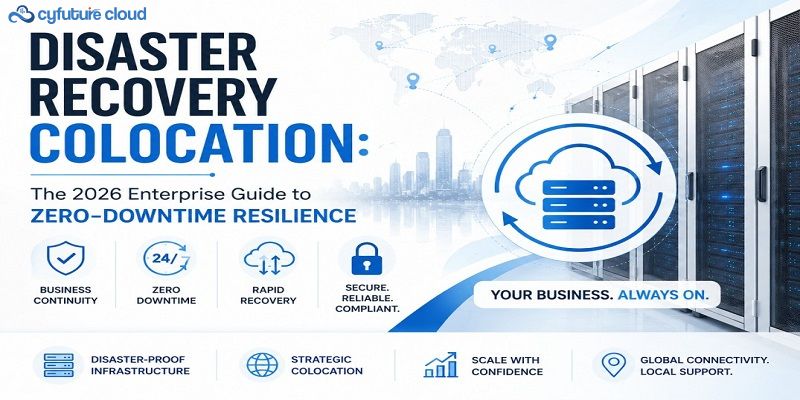
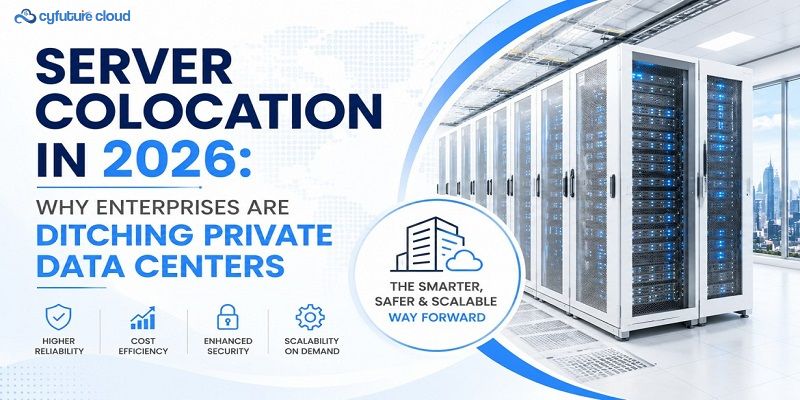
At a technical level, Disaster Recovery Colocation involves securing off-site physical data center space to house redundant IT infrastructure — it’s no longer just about storing tapes in a vault. In 2026, the strategy has shifted toward active hardware redundancy, ensuring that if the primary site fails, the secondary environment is already powered, connected, and ready to take the load.
This is a meaningful departure from legacy DR thinking. Traditional backup strategies tolerate hours or days of recovery time. Modern Disaster Recovery Colocation architectures are built around Recovery Time Objective (RTO) and Recovery Point Objective (RPO) targets measured in seconds or minutes, not days.
Why the Market Is Scaling So Fast in 2026
The numbers back up the urgency. The Data Center Colocation market was valued at USD 94.7 billion in 2025 and is expected to grow to USD 108.3 billion in 2026, reaching USD 231.3 billion by 2032 at a CAGR of 13.6%. Within that broader colocation growth story, disaster recovery has become a core driver, as organizations increasingly rely on colocation facilities to safeguard critical data against natural disasters, cyberattacks, and system failures.
Meanwhile, the specialized remote DR software and services layer is also expanding, with the remote data center disaster recovery market valued at USD 131.83 million in 2025, projected to reach USD 141.29 million in 2026 and USD 187.48 million by 2032 at a 5.15% CAGR — evidence that enterprises are pairing physical colocation with sophisticated replication and orchestration tooling.
The Technical Case: Why Cloud-Only DR Falls Short
Here’s the uncomfortable truth many technical leaders discover mid-crisis: regional cloud outages aren’t just theoretical — they happen. When they do, demand for resources in neighboring regions spikes, often leading to performance throttling or failed deployments. A failover plan that depends on the same cloud provider ecosystem that just failed isn’t really a failover plan.
Disaster Recovery Colocation solves this by providing pre-provisioned, dedicated hardware that’s ready to take the load the moment the primary environment fails, giving teams a stable baseline unaffected by the volatility of public cloud availability. This architecture also helps sidestep unpredictable egress fees and supports compliance with frameworks like ISO/IEC 27001:2022 and DORA.
Geographic Diversity: The Non-Negotiable Design Principle
A resilient Disaster Recovery Colocation strategy is only as strong as its geographic separation. Placing recovery hardware in a facility located on a different power grid or weather zone insulates operations from regional disasters — this physical separation is the core requirement for a genuine business continuity posture, not an optional enhancement.
High-Density Workloads Are Reshaping DR Requirements
DR colocation isn’t just about redundancy anymore — it’s also about capacity for modern workloads. Providers are increasingly expected to handle high-density deployments including AI, ML, and GPU workloads alongside the exponential growth of data volumes, while helping enterprises refresh aging infrastructure and increase IT agility.
Where Cyfuture Cloud Fits In
Cyfuture Cloud has built its colocation and disaster recovery offering around exactly this shift — combining Tier III-grade facility redundancy with rapid failover orchestration designed for enterprise RTO/RPO targets. Customer deployments on Cyfuture Cloud’s colocation infrastructure have reported deployment turnarounds averaging under 72 hours, alongside uptime commitments of 99.995%, giving technical teams the confidence to anchor mission-critical DR environments without the unpredictability of pure hyperscaler dependency.

Building Your DR Colocation Roadmap
For enterprises evaluating Disaster Recovery Colocation in 2026, the practical checklist looks like this: define RTO/RPO targets against actual downtime cost, select a secondary site on a distinct power grid and weather zone, validate active-active replication rather than cold backup, and confirm compliance alignment (ISO 22301, DORA, ISO/IEC 27001:2022). Students and developers entering infrastructure roles should note this is increasingly where cloud architecture careers are heading — hybrid resilience design, not single-cloud deployment.












Stay Ahead of the Curve.
Join the Cloud Movement, today!
Send this to a friend