Get 69% Off on Cloud Hosting : Claim Your Offer Now!





- Products
- Solutions
-
Solutions
-
 Cloud
Hosting
Cloud
Hosting
-
VPS
Hosting
-
 GPU
Cloud
GPU
Cloud
-
 Dedicated
Server
Dedicated
Server
-
 Server
Colocation
Server
Colocation
-
 Backup as a Service
-
 CDN
Network
CDN
Network
-
 Window
Cloud Hosting
Window
Cloud Hosting
-
 Linux
Cloud Hosting
Linux
Cloud Hosting
-
Managed
Cloud Service
-
 Storage
as a Service
Storage
as a Service
-
VMware
Public Cloud
-
Multi-Cloud
Hosting
-
Cloud
Server Hosting
-
Bare
Metal Server
-
Virtual
Machine
-
 Magento
Hosting
Magento
Hosting
-
 Remote
Backup
Remote
Backup
-
 DevOps
-
 Kubernetes
-
 Cloud
Storage
Cloud
Storage
-
 NVMe
Hosting
NVMe
Hosting
-
 DR
as s Service
DR
as s Service
-
-
Solutions
- Marketplace
- Pricing
- Resources
- Company
 Remote
Backup
Remote
Backup NVMe
Hosting
NVMe
Hosting Pricing
Calculator
Pricing
Calculator Unlock Cost
Optimization
Unlock Cost
Optimization Overview
 Documentation
 Price
Calculator
Price
Calculator Tools
Tools FAQs
FAQs Terms
of Service
Terms
of Service Privacy
Policy
Privacy
Policy
 Migration
 Container
 Power
Power
 Utilities
 VMware
Private Cloud
VMware
Private Cloud VMware
on AWS
VMware
on AWS VMware
on Azure
VMware
on Azure Certifications
 Partners
 Careers
 Support
 Service
Level Agreement
Service
Level Agreement  Contact
Table of Contents
Are you evaluating where to host your next-generation infrastructure in South India?
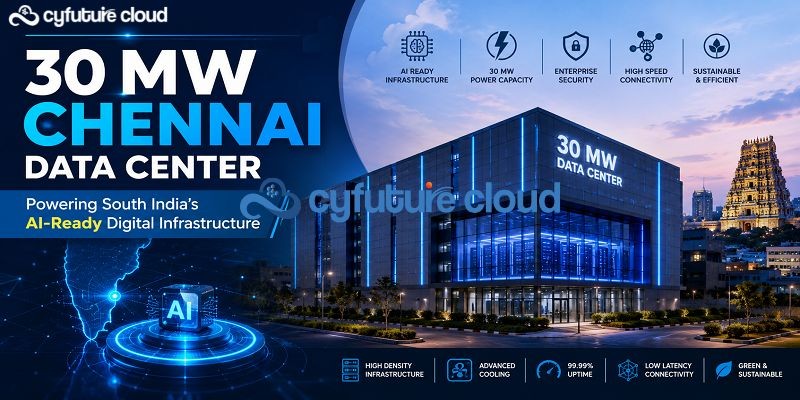
A 30 MW Chennai Data Center represents a mid-to-large scale facility capable of supporting thousands of server racks, dense hyperscale workloads, and mission-critical enterprise applications, positioned in a city that has emerged as India’s second-most-strategic data center hub after Mumbai. Cyfuture Cloud’s 30 MW Chennai Data Center adds meaningful capacity to a market that’s scaling faster than almost anywhere else in the country.
Here’s why this matters right now:
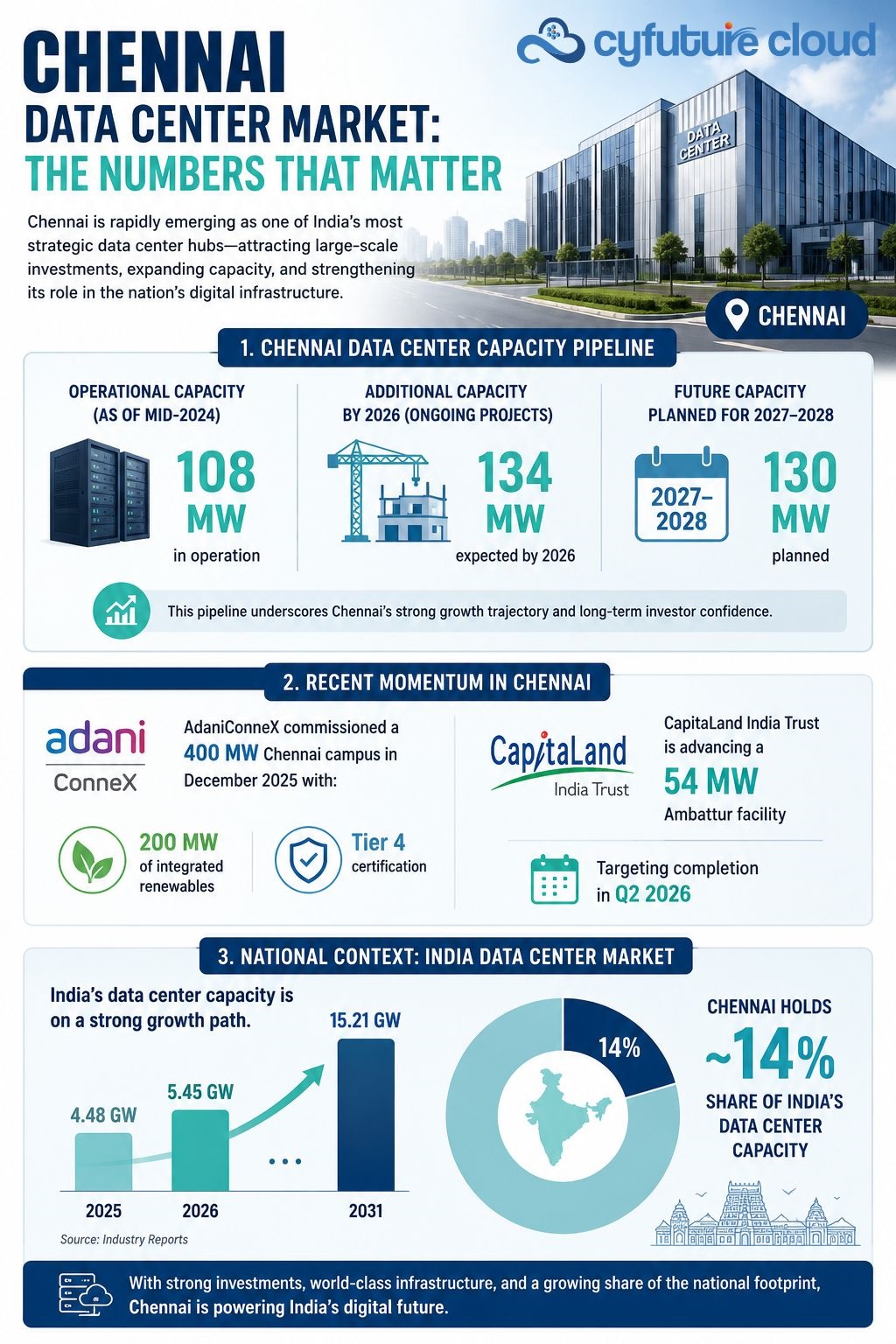
Chennai’s operational data center capacity is projected to reach roughly 670 MW in 2026, growing at a striking 21% CAGR toward 2,110 MW by 2032. Every new facility—including Cyfuture Cloud’s 30 MW Chennai Data Center—adds to a supply chain racing to keep pace with AI, cloud, and BFSI demand.
What Makes Chennai India’s Next Hyperscale Capital?
Chennai isn’t a newcomer to data infrastructure—it’s a coastal advantage the rest of India can’t easily replicate.
The city hosts a dense cluster of subsea fiber-optic cable landings, including SEA-ME-WE 5, SEA-ME-WE 6, MIST, the Bay of Bengal Gateway, and the newer India-Asia-Express and India-Europe-Express systems. This concentration gives Chennai ultra-low latency connectivity to Southeast Asia, Europe, and the United States that inland cities simply cannot match.
Three forces are converging to fuel Chennai’s growth:
1. Government Policy Support
The Tamil Nadu Data Centre Policy offers a 100% electricity tax waiver for five years, concessional open-access charges, and dual power supply from two separate grids for facilities with sanctioned loads of 50 MW or more. This directly reduces operational costs for large-scale deployments like a 30 MW Chennai Data Center.
2. Talent Pipeline
Chennai’s data center workforce is expected to grow 1.4x by 2030, exceeding 320,000 skilled professionals, backed by strong engineering institutions and AI/robotics expertise.
3. Cost Efficiency
Chennai remains one of the world’s most affordable locations for data center construction, with South Indian lease rates averaging ₹6,650-8,500 per kW per month—a meaningful discount compared to Mumbai.
Why a 30 MW Chennai Data Center Fits Enterprise & AI Workloads
At 30 MW, a facility sits comfortably in the “large” enterprise-hyperscale bracket—big enough for serious colocation density, GPU clusters, and disaster recovery deployments, while remaining nimble compared to 100+ MW hyperscale megacampuses.
This scale supports:
- BFSI compliance workloads, where RBI mandates increasingly require Tier III+ facilities
- AI/ML training and inference clusters, benefiting from rising rack densities driven by GPU adoption
- CDN and OTT caching, leveraging Chennai’s sub-25ms latency advantage from coastal cable landings
- Disaster recovery and business continuity, positioning South India as a resilient secondary region to Mumbai and Delhi-NCR
Advanced facilities compatible with AI-driven workloads are increasingly the differentiator hyperscalers and enterprises look for—not just raw MW capacity.
Cyfuture Cloud’s Position in the Chennai Market
Cyfuture Cloud has been steadily expanding its data center footprint across India, and the Chennai facility strengthens its multi-region strategy alongside existing campuses. Cyfuture Cloud’s infrastructure consistently delivers 99.99%+ uptime SLAs, and its facilities are engineered for rack densities that support modern AI and HPC workloads—not just legacy enterprise hosting.
For enterprises weighing Chennai against Mumbai or Delhi-NCR, Cyfuture Cloud’s approach combines the region’s inherent cost and latency advantages with hands-on managed services, giving mid-market and enterprise customers hyperscaler-grade infrastructure without hyperscaler complexity.
Frequently Asked Questions
Q1: How much power does a 30 MW data center actually support?
A 30 MW facility typically powers 3,000-6,000+ server racks depending on density (5-15kW standard racks vs. 20-40kW AI-optimized racks), making it suitable for large enterprise colocation and moderate hyperscale deployments.
Q2: Why is Chennai considered better than other Indian cities for data centers?
Chennai’s coastal location provides direct access to major submarine cable systems, delivering the lowest latency routes to Southeast Asia and international destinations, combined with Tamil Nadu’s favorable data center policy and lower construction costs versus Mumbai.
Q3: What tier certification should enterprises expect from a 30 MW facility?
Most large-scale Chennai facilities target Tier III (99.982% uptime) at minimum, with newer campuses increasingly pursuing Tier IV certification for financial services and AI workloads requiring 99.995% uptime.
Q4: Is Chennai’s data center capacity growing faster than other Indian cities?
Yes—Chennai is forecast to grow at approximately 21% CAGR through 2032, among the fastest rates nationally, driven by submarine cable expansion and hyperscaler investment.
Q5: What industries benefit most from Chennai colocation facilities?
BFSI, manufacturing, OTT/media streaming, CDN providers, and increasingly AI/ML enterprises benefit from Chennai’s connectivity, compliance-ready infrastructure, and cost efficiency.
Q6: How does the Tamil Nadu Data Centre Policy benefit operators?
It provides a 100% electricity tax waiver for five years, dual-grid power supply for 50MW+ loads, concessional open-access charges, and single-window clearance—significantly reducing time-to-operation and OpEx.
Q7: What’s driving India’s overall data center growth in 2026?
Data localization mandates under the DPDPA 2023, hyperscale commitments exceeding USD 30 billion from Microsoft and Google, and surging AI/ML workload demand are the primary growth catalysts.
Build Your South India Strategy on Solid Ground
Chennai’s trajectory as a data center hub isn’t speculative—it’s backed by submarine cable investment, state policy support, and hyperscaler capital flowing in at unprecedented rates.
Here’s what matters most:
A 30 MW Chennai Data Center gives enterprises meaningful scale without the complexity of navigating hyperscale-only providers, while still delivering the latency, compliance, and reliability that AI-era workloads demand.
Position your infrastructure strategically. Leverage Cyfuture Cloud’s Chennai facility to combine cost efficiency, coastal connectivity, and enterprise-grade reliability—right where India’s digital economy is scaling fastest.








Stay Ahead of the Curve.
Join the Cloud Movement, today!
Send this to a friend