Get 69% Off on Cloud Hosting : Claim Your Offer Now!





- Products
- Solutions
-
Solutions
-
 Cloud
Hosting
Cloud
Hosting
-
VPS
Hosting
-
 GPU
Cloud
GPU
Cloud
-
 Dedicated
Server
Dedicated
Server
-
 Server
Colocation
Server
Colocation
-
 Backup as a Service
-
 CDN
Network
CDN
Network
-
 Window
Cloud Hosting
Window
Cloud Hosting
-
 Linux
Cloud Hosting
Linux
Cloud Hosting
-
Managed
Cloud Service
-
 Storage
as a Service
Storage
as a Service
-
VMware
Public Cloud
-
Multi-Cloud
Hosting
-
Cloud
Server Hosting
-
Bare
Metal Server
-
Virtual
Machine
-
 Magento
Hosting
Magento
Hosting
-
 Remote
Backup
Remote
Backup
-
 DevOps
-
 Kubernetes
-
 Cloud
Storage
Cloud
Storage
-
 NVMe
Hosting
NVMe
Hosting
-
 DR
as s Service
DR
as s Service
-
-
Solutions
- Marketplace
- Pricing
- Resources
- Company
 Remote
Backup
Remote
Backup NVMe
Hosting
NVMe
Hosting Pricing
Calculator
Pricing
Calculator Unlock Cost
Optimization
Unlock Cost
Optimization Overview
 Documentation
 Price
Calculator
Price
Calculator Tools
Tools FAQs
FAQs Terms
of Service
Terms
of Service Privacy
Policy
Privacy
Policy
 Migration
 Container
 Power
Power
 Utilities
 VMware
Private Cloud
VMware
Private Cloud VMware
on AWS
VMware
on AWS VMware
on Azure
VMware
on Azure Certifications
 Partners
 Careers
 Support
 Service
Level Agreement
Service
Level Agreement  Contact
Table of Contents
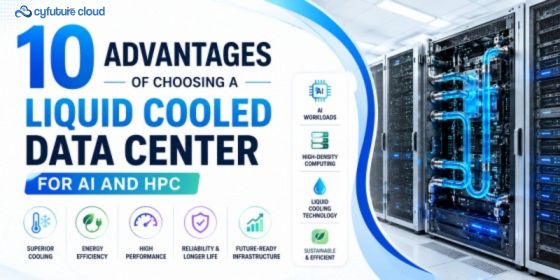
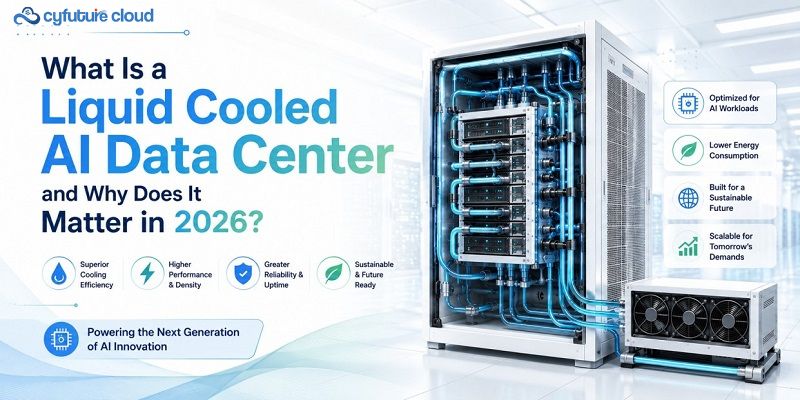
Liquid cooled AI data center: A data center designed to remove heat from high-density AI and GPU workloads using liquid-based thermal systems such as direct-to-chip cooling, cold plates, warm-water loops, or immersion cooling instead of relying mainly on air. This approach helps maintain performance, reduce energy waste, and support the rising power density of modern AI infrastructure.cyfuture+1
AI is no longer just changing software. It is reshaping the physical infrastructure beneath it. In 2026, the conversation around AI data centers is increasingly about one question: how do you cool massive compute density without wasting energy or throttling performance?
The answer, for many operators, is liquid cooling.

Why Air Cooling Is Reaching Its Limit
Traditional air cooling was built for an older era of IT. It works well for standard enterprise servers, but AI training and inference workloads now create far more heat per rack than conventional systems were designed to handle. According to recent 2026 reporting, next-generation AI racks may reach 370 kW, making liquid cooling and advanced power architectures essential rather than optional.
Here’s the reality:
- AI chips are drawing more power.
- Rack density is rising sharply.
- Air cooling consumes more space, more fan power, and more energy.
- Thermal throttling can reduce GPU performance and lengthen training cycles.
And that’s where liquid cooling changes the game.
How Liquid Cooling Works
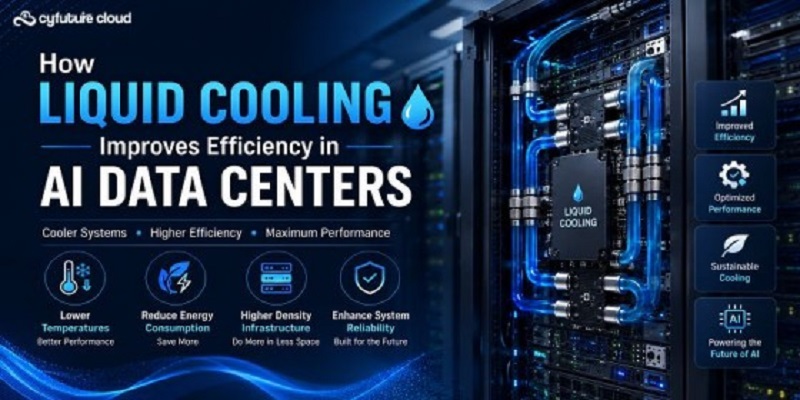
Liquid cooling transfers heat far more efficiently than air because liquid has a much higher heat capacity. In practice, this means the system can pull heat directly from the hottest components and move it away before performance drops. Common approaches include direct-to-chip cooling, cold-plate systems, rear-door heat exchangers, hybrid air-liquid systems, and immersion cooling.
For AI workloads, the most important advantage is consistent thermal control. When GPUs stay cooler, they can sustain higher clock speeds for longer periods without throttling. Cyfuture Cloud’s published GPU guidance notes that liquid cooling can reduce GPU temperatures by 10–20°C compared with air alone and improve throughput by 17% in some deployments.
Why It Matters in 2026
This is not just a hardware trend. It is an operational shift.
The liquid cooling market itself is expanding quickly. A 2026 market estimate placed the global AI data center liquid cooling market at about $3.7 billion in 2026, with projections to exceed $11.2 billion by 2033 and reach around $18.1 billion by 2036. Dell’Oro Group also reported in January 2026 that the worldwide data center liquid cooling market is expected to approach $7 billion in manufacturer revenue by 2029.
According to an Analytics Insight explainer, those numbers point to something bigger than adoption. They show urgency.
Performance, Efficiency, and Sustainability
Liquid cooling is often discussed as a sustainability upgrade, but it is also a performance strategy. One 2026 source notes that direct-to-chip liquid cooling can be up to 3,000 times more effective than air, while also cutting energy use by 30–60% and reducing water consumption. Cyfuture Cloud also states that its liquid-hybrid systems can deliver 16–17% efficiency gains and reduce power use by 16% at the node level.
That matters because energy savings compound at scale.
|
Area |
Air Cooling |
Liquid Cooling |
|
Heat removal efficiency |
Lower |
|
|
GPU temperature control |
More variable |
More stable |
|
Rack density support |
Limited |
Better for high-density AI racks |
|
Energy use |
Higher fan and HVAC overhead |
Lower cooling overhead |
|
AI workload stability |
More throttling risk |
For enterprises, that can translate into lower operational cost, better space utilization, and more predictable AI performance.
What Tech Teams Should Plan For
If you are a developer, CTO, enterprise architect, or student studying AI infrastructure, the shift to liquid cooling changes your assumptions.
Plan for:
- Higher rack power density.
- More strict facility design requirements.
- Cooling strategy as part of AI procurement.
- Better monitoring for thermal and power telemetry.
- Future-ready architectures that support GPU generations with greater heat output.
Bucket brigade: Now here’s the key point. Liquid cooling is not replacing AI compute. It is making AI compute practical at scale.
Bucket brigade: And that changes everything. The organizations that treat cooling as a strategic layer will scale faster and more efficiently than those that treat it as an afterthought.
The 2026 Takeaway
In 2026, a liquid cooled AI data center is no longer a niche engineering concept. It is becoming the infrastructure baseline for dense AI deployments. As racks climb toward hundreds of kilowatts and energy efficiency becomes a board-level concern, liquid cooling is emerging as a decisive advantage.
For enterprises, the message is clear: if AI performance matters, cooling architecture matters too. For developers and students, this is a reminder that modern AI is not only about algorithms and models. It is also about the physical systems that keep them running.











Stay Ahead of the Curve.
Join the Cloud Movement, today!
Send this to a friend