Get 69% Off on Cloud Hosting : Claim Your Offer Now!





- Products
- Solutions
-
Solutions
-
 Cloud
Hosting
Cloud
Hosting
-
VPS
Hosting
-
 GPU
Cloud
GPU
Cloud
-
 Dedicated
Server
Dedicated
Server
-
 Server
Colocation
Server
Colocation
-
 Backup as a Service
-
 CDN
Network
CDN
Network
-
 Window
Cloud Hosting
Window
Cloud Hosting
-
 Linux
Cloud Hosting
Linux
Cloud Hosting
-
Managed
Cloud Service
-
 Storage
as a Service
Storage
as a Service
-
VMware
Public Cloud
-
Multi-Cloud
Hosting
-
Cloud
Server Hosting
-
Bare
Metal Server
-
Virtual
Machine
-
 Magento
Hosting
Magento
Hosting
-
 Remote
Backup
Remote
Backup
-
 DevOps
-
 Kubernetes
-
 Cloud
Storage
Cloud
Storage
-
 NVMe
Hosting
NVMe
Hosting
-
 DR
as s Service
DR
as s Service
-
-
Solutions
- Marketplace
- Pricing
- Resources
- Company
 Remote
Backup
Remote
Backup NVMe
Hosting
NVMe
Hosting Pricing
Calculator
Pricing
Calculator Unlock Cost
Optimization
Unlock Cost
Optimization Overview
 Documentation
 Price
Calculator
Price
Calculator Tools
Tools FAQs
FAQs Terms
of Service
Terms
of Service Privacy
Policy
Privacy
Policy
 Migration
 Container
 Power
Power
 Utilities
 VMware
Private Cloud
VMware
Private Cloud VMware
on AWS
VMware
on AWS VMware
on Azure
VMware
on Azure Certifications
 Partners
 Careers
 Support
 Service
Level Agreement
Service
Level Agreement  Contact
Table of Contents
- What Is GPU Infrastructure?
- Key Components of Modern GPU Infrastructure
- GPU Infrastructure for AI and Data Science
- GPU Rental as a Flexible Infrastructure Option
- Server Colocation for GPU Infrastructure
- GPU Infrastructure: Cloud vs. Dedicated vs. Colocation
- How to Choose the Right GPU Infrastructure
- Future of GPU Infrastructure
- Conclusion
AI and data science workloads are becoming more computationally demanding. Organizations now need powerful infrastructure to train machine learning models, process large datasets, run AI inference, and support advanced analytics. GPU infrastructure provides the parallel processing power required for these workloads. Instead of relying only on traditional CPUs, businesses can use high-performance GPUs to accelerate complex computations and reduce processing time.
The rapid growth of AI is also increasing investment in infrastructure. Gartner forecast worldwide AI spending at nearly $1.5 trillion in 2025, highlighting the growing demand for AI-optimized hardware and data centers. Modern GPUs are also becoming more capable. For example, NVIDIA Blackwell Ultra GPUs can offer up to 288 GB of HBM3e memory and up to 8 TB/s of memory bandwidth, supporting demanding AI and data-intensive workloads.
This article explains the key components of modern GPU infrastructure, its benefits for AI and data science, and the different deployment options available. It also explores GPU rental, dedicated infrastructure, networking, storage, and Server Colocation. Additionally, we will look at why solutions such as Rent NVIDIA B300 GPU can help organizations access advanced computing power without building an entire GPU environment from scratch.
What Is GPU Infrastructure?
GPU infrastructure refers to the complete computing environment built around graphics processing units for accelerated workloads. It includes GPUs, servers, networking equipment, storage, software, power systems, cooling, and management tools.
Unlike CPUs, GPUs contain many processing cores designed to perform large numbers of operations simultaneously. This architecture makes them particularly effective for workloads that can run in parallel.
Modern GPU infrastructure can support:
- Artificial intelligence and machine learning
- Deep learning model training
- Large language model inference
- Generative AI applications
- Data analytics
- Scientific computing
- High-performance computing (HPC)
- 3D rendering and visualization
- Computer vision
- Natural language processing
Therefore, GPU infrastructure has become an important foundation for organizations developing and deploying modern AI applications.
Key Components of Modern GPU Infrastructure
1. High-Performance GPUs
The GPU is the primary compute component. Different workloads require different GPU configurations based on memory capacity, processing performance, and interconnect requirements.
For example, NVIDIA Blackwell Ultra GPUs provide up to 288 GB of HBM3e memory per GPU. Their high memory bandwidth helps process large models and data-intensive workloads efficiently.
Organizations can select GPUs based on:
- Model size
- Dataset size
- Training requirements
- Inference volume
- Required precision
- Budget
- Scalability requirements
2. GPU Servers
GPU servers combine multiple GPUs with CPUs, RAM, local storage, and high-speed networking. Multi-GPU servers allow organizations to run larger workloads and distribute computational tasks across several accelerators.
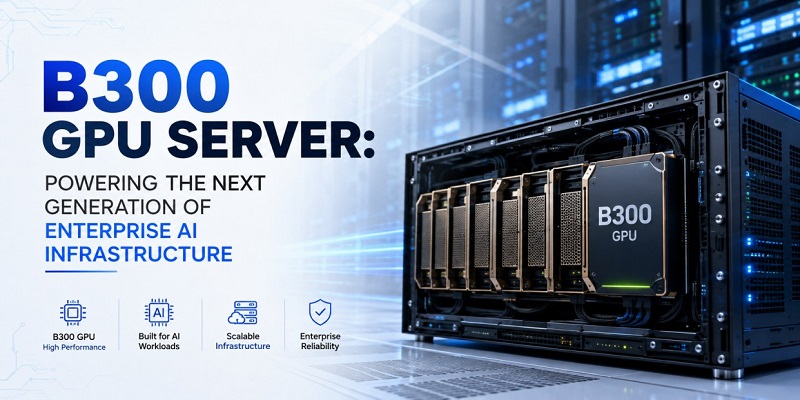
For example, NVIDIA DGX B300 incorporates eight Blackwell Ultra GPUs with a combined GPU memory capacity of more than 2 TB. NVIDIA lists up to 144 PFLOPS of FP4 Tensor Core performance for the system.
Such systems are suitable for demanding AI training, inference, and data science environments.
3. High-Speed Networking
GPU infrastructure needs fast networking because multiple GPUs and servers often exchange large amounts of data.
Technologies such as NVIDIA NVLink, NVSwitch, InfiniBand, and high-speed Ethernet help connect GPUs and systems. This reduces communication bottlenecks and allows workloads to scale across multiple GPUs.
For example, NVIDIA’s GB300 NVL72 connects 72 Blackwell Ultra GPUs within a rack-scale system and uses high-bandwidth networking to support large-scale AI workloads.
4. Storage Infrastructure
AI applications can process huge datasets. Consequently, fast storage is essential.
Modern GPU infrastructure may use:
- NVMe SSDs
- Parallel file systems
- Object storage
- High-speed network storage
- Distributed storage systems
Fast storage helps GPUs receive data quickly and prevents compute resources from remaining idle while waiting for datasets.
GPU Infrastructure for AI and Data Science
AI Model Training
Training large AI models requires significant computational resources. GPUs can execute matrix and tensor operations in parallel, making them well suited for deep learning.
Organizations can use GPU clusters to train models faster and experiment with larger datasets.
AI Inference
After training, models need infrastructure to serve predictions or generate responses. Inference infrastructure must deliver both performance and predictable latency.
Modern GPU architectures increasingly focus on inference efficiency. NVIDIA Blackwell Ultra, for example, includes enhancements designed for AI reasoning and attention-heavy workloads.
Data Science and Analytics
Data scientists can use GPUs to accelerate workloads such as data processing, simulations, statistical calculations, and machine learning experimentation.
GPU acceleration can reduce the time required to process complex datasets. This allows teams to run more experiments and reach results faster.
GPU Rental as a Flexible Infrastructure Option
Building an in-house GPU environment requires significant investment. Organizations must purchase servers, GPUs, networking equipment, storage, power systems, and cooling infrastructure.
GPU rental provides another approach.
With a rental model, businesses can access dedicated GPU resources for a specific period without purchasing the hardware. This can be useful for temporary projects, AI development, research, testing, or workloads with fluctuating demand.
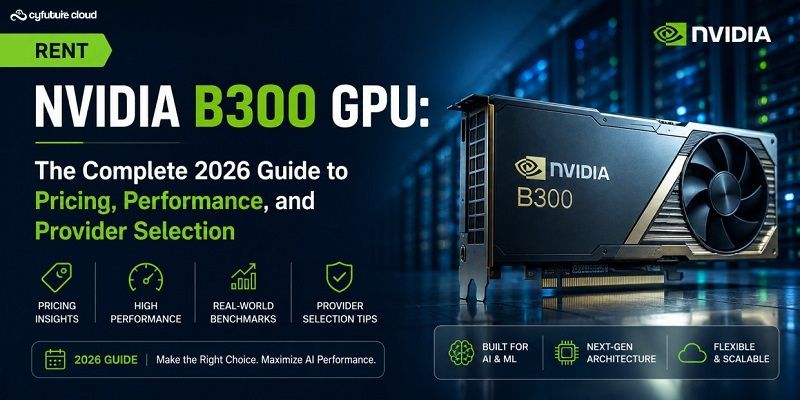
Businesses looking for advanced hardware can Rent NVIDIA B300 GPU resources to access Blackwell Ultra-based computing without making the same upfront investment required for hardware ownership.
GPU rental can offer:
- Lower initial capital expenditure
- Flexible deployment
- Access to newer GPU generations
- Faster infrastructure provisioning
- Easier capacity scaling
- Suitable resources for short- and long-term projects
However, businesses should evaluate pricing, GPU availability, networking, storage, technical support, and contract terms before selecting a provider.
Server Colocation for GPU Infrastructure
Another option is Server Colocation, where an organization owns or leases dedicated hardware and places it inside a professional data center.
Colocation can provide access to important infrastructure such as:
- Data center power
- Cooling
- Physical security
- Network connectivity
- Rack space
- Remote management
- Infrastructure monitoring
This model can be useful for organizations that want greater control over their servers while avoiding the complexity of operating their own data center.
For GPU servers, however, organizations should confirm that the facility can support high-density systems. Power availability, cooling capacity, rack dimensions, and network connectivity are particularly important.
GPU Infrastructure: Cloud vs. Dedicated vs. Colocation
Organizations generally have three major deployment approaches.
Cloud GPU Infrastructure
Cloud infrastructure provides flexible access to GPUs without requiring businesses to manage physical hardware. It works well for variable workloads and rapid experimentation.
Dedicated GPU Servers
Dedicated servers provide predictable access to GPU resources. They can be suitable for organizations running consistent workloads that require dedicated capacity.
Server Colocation
Colocation provides physical infrastructure while allowing businesses to retain more control over their hardware. It can be attractive for organizations with long-term infrastructure requirements.
The right option depends on workload requirements, budget, security needs, scalability, and operational preferences.
How to Choose the Right GPU Infrastructure
Before selecting a GPU infrastructure solution, organizations should evaluate several factors.
GPU memory: Large AI models may require GPUs with substantial memory capacity.
Compute performance: Consider the precision and processing requirements of the workload.
Networking: Multi-GPU workloads require high-speed communication between GPUs and servers.
Storage: Large datasets require fast and scalable storage.
Power and cooling: High-density GPU systems can have significant power and cooling requirements.
Scalability: Infrastructure should allow organizations to add computing resources as workloads grow.
Cost: Compare rental, cloud, dedicated server, and colocation costs based on actual usage.
Future of GPU Infrastructure
GPU infrastructure will continue to evolve alongside AI. Organizations are increasingly moving from experimental AI projects toward production-scale applications. As models become larger and inference workloads become more complex, infrastructure will need greater compute capacity, memory, networking bandwidth, and efficiency.
NVIDIA’s Blackwell Ultra platform demonstrates this direction. The GB300 NVL72, for example, combines 72 GPUs in a rack-scale architecture designed for demanding AI reasoning workloads.
At the same time, infrastructure providers are likely to offer more flexible GPU-as-a-service, dedicated GPU, and colocation options.
Conclusion
GPU infrastructure has become a critical component of modern AI and data science environments. It combines GPUs with high-performance servers, networking, storage, software, power, and cooling to support computationally intensive workloads.
Organizations can choose between cloud GPU services, dedicated servers, GPU rental, and Server Colocation depending on their requirements. For businesses that need advanced computing capacity without purchasing an entire infrastructure stack, options such as Rent NVIDIA B300 GPU can provide a flexible path to modern AI computing.
As AI adoption continues to grow, investing in scalable and well-designed GPU infrastructure can help organizations improve performance, accelerate development, and prepare their computing environment for increasingly demanding workloads.













Stay Ahead of the Curve.
Join the Cloud Movement, today!
Send this to a friend