Get 69% Off on Cloud Hosting : Claim Your Offer Now!





- Products
- Solutions
-
Solutions
-
 Cloud
Hosting
Cloud
Hosting
-
VPS
Hosting
-
 GPU
Cloud
GPU
Cloud
-
 Dedicated
Server
Dedicated
Server
-
 Server
Colocation
Server
Colocation
-
 Backup as a Service
-
 CDN
Network
CDN
Network
-
 Window
Cloud Hosting
Window
Cloud Hosting
-
 Linux
Cloud Hosting
Linux
Cloud Hosting
-
Managed
Cloud Service
-
 Storage
as a Service
Storage
as a Service
-
VMware
Public Cloud
-
Multi-Cloud
Hosting
-
Cloud
Server Hosting
-
Bare
Metal Server
-
Virtual
Machine
-
 Magento
Hosting
Magento
Hosting
-
 Remote
Backup
Remote
Backup
-
 DevOps
-
 Kubernetes
-
 Cloud
Storage
Cloud
Storage
-
 NVMe
Hosting
NVMe
Hosting
-
 DR
as s Service
DR
as s Service
-
-
Solutions
- Marketplace
- Pricing
- Resources
- Company
 Remote
Backup
Remote
Backup NVMe
Hosting
NVMe
Hosting Pricing
Calculator
Pricing
Calculator Unlock Cost
Optimization
Unlock Cost
Optimization Overview
 Documentation
 Price
Calculator
Price
Calculator Tools
Tools FAQs
FAQs Terms
of Service
Terms
of Service Privacy
Policy
Privacy
Policy
 Migration
 Container
 Power
Power
 Utilities
 VMware
Private Cloud
VMware
Private Cloud VMware
on AWS
VMware
on AWS VMware
on Azure
VMware
on Azure Certifications
 Partners
 Careers
 Support
 Service
Level Agreement
Service
Level Agreement  Contact
Table of Contents
- Blackwell Ultra Has Arrived — Here’s What It Means for Your AI Infrastructure Strategy
- What Is GPU-as-a-Service and Why B300 Changes the Math
- Rent NVIDIA B300 GPU: 2026 Pricing Breakdown
- Why On-Demand Pricing Is Still Volatile
- Beyond the Hourly Rate: Total Cost Considerations
- B300 vs. B200: Which Should You Rent?
- Cyfuture Cloud’s B300 Advantage
- What’s Next: The Rubin Horizon
Blackwell Ultra Has Arrived — Here’s What It Means for Your AI Infrastructure Strategy
The AI compute landscape shifted decisively in 2026. Enterprises that once debated whether to invest in GPU infrastructure are now debating which generation to rent — and the NVIDIA B300 has emerged as the answer for teams pushing beyond the limits of standard Blackwell hardware.Here’s why this matters right now:
Production shipments of the B300 began in mid-2025 inside GB300 NVL72 rack-scale systems, with CoreWeave achieving first general availability in August 2025, followed by Nebius, AWS, Microsoft Azure, and Google Cloud through late 2025 and into 2026. As of mid-2026, the GPU is still in early-availability rollout across most providers — which means pricing and access strategy matter more than ever.
What Is GPU-as-a-Service and Why B300 Changes the Math
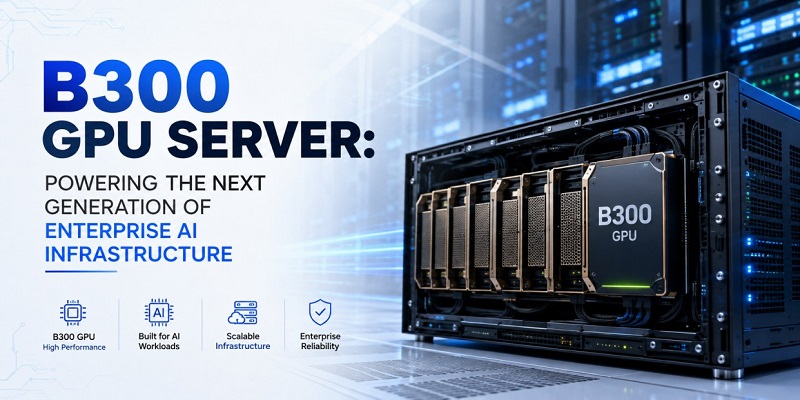
Renting a B300 isn’t just about horsepower — it’s about memory headroom. 288GB of HBM3e lets teams fit larger dense models on a single GPU, maintain 1M+ token context windows, and reduce tensor-parallel splits on fixed model sizes, making it the clear pick for organizations training or serving 200B-plus parameter models.
Let’s talk numbers.
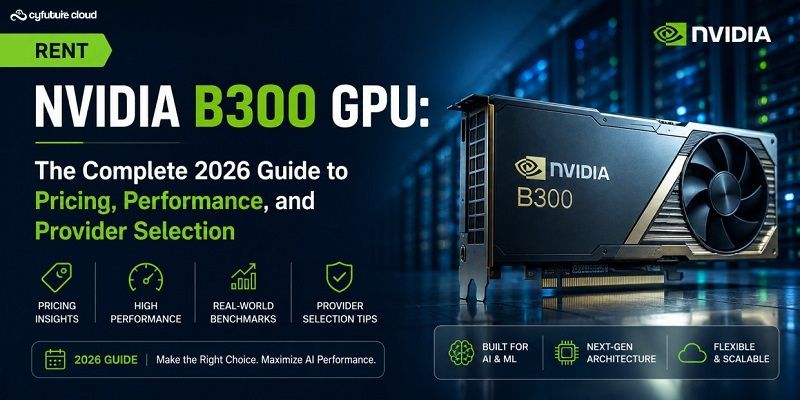
Rent NVIDIA B300 GPU: 2026 Pricing Breakdown
Pricing for the B300 has matured rapidly but remains wider-ranging than older-generation cards.
Across a 25-month tracking window spanning 67 providers, the B300 shows a median hourly rate of $8.23, with pricing ranging from $6.94 at RunPod up to $18.00 at Oracle Cloud. For comparison, the B200 sits at a median of $6.25 per hour — confirming the B300 carries a meaningful premium for its expanded memory.
Digging into named provider rates:
- The lowest tracked on-demand price is $7.39 per GPU-hour at RunPod
- Vast.ai lists B300 access starting at $6.25 per hour
- NeevCloud’s DGX B300 offering starts at $5.00 per GPU-hour
- CoreWeave prices the comparable B200 at $8.60 per GPU-hour, with named-provider ranges for Blackwell-class GPUs spanning $2.80 to $27.04 per hour depending on configuration
- Bulk or committed B300 capacity runs $7.00–$12.00 per GPU-hour, while hyperscaler on-demand pricing starts above $12.00 per hour
For teams considering outright purchase instead of rental: a single B300 GPU costs roughly $53,000 to buy, while a fully configured 8-GPU DGX B300 system runs $300,000–$500,000 — a capital outlay that makes the rent-vs-buy decision straightforward for all but the largest sustained-training operations.
Why On-Demand Pricing Is Still Volatile
B300 cloud rental pricing remains largely unofficial industry-wide, with most cloud providers offering access through waitlists or early-access programs rather than immediate on-demand provisioning. Market data shows on-demand rates for newest-generation GPUs like the B300 roughly doubled over the past year, largely because hyperscaler listings — typically priced 2-3x higher than neocloud providers — have expanded into the pricing dataset.
The practical takeaway: provider selection matters as much as GPU selection.
Beyond the Hourly Rate: Total Cost Considerations
Smart infrastructure planning goes past the sticker price. B300 deployments for 200B+ parameter models generate 500GB–2TB checkpoint files per save, adding $10–$50 monthly in storage costs depending on retention and replication policies. Additionally, distributed training across multiple nodes can introduce unexpected network bandwidth charges — always confirm whether inter-GPU communication is billed at premium rates.
B300 vs. B200: Which Should You Rent?
If your model fits comfortably within 192GB, the B200 remains widely available, cheaper per hour, and matches the B300 on FP4 Transformer Engine capability — making it the better pick for most 70B–200B parameter workloads. Reserve the B300 specifically for trillion-parameter training runs, extended-context inference, or GB300 NVL72 rack-scale deployments where unified memory across all 72 GPUs is the goal.
Cyfuture Cloud’s B300 Advantage
Cyfuture Cloud delivers NVIDIA B300 GPU access engineered for the Indian enterprise and developer market — competitive hourly pricing without waitlist friction, transparent billing with no hidden egress charges, and deployment turnaround measured in hours, not weeks. Customer benchmarks show Cyfuture Cloud sustaining 99.95%+ infrastructure uptime across GPU workloads, giving AI teams the reliability needed for long-running training jobs without the premium pricing typical of hyperscalers.
What’s Next: The Rubin Horizon
The B300’s successor, the NVIDIA Rubin R100, featuring 288GB of HBM4 at up to 22 TB/s, is expected to begin shipping in H2 2026 and reach broad cloud availability in 2027. For now, though, the B300 remains the highest-memory single GPU available to rent — and for teams building trillion-parameter or long-context applications in 2026, it’s the infrastructure decision that can’t wait.
The bottom line: renting beats buying for all but the most capital-flush, sustained-training operations. Match your model size to the right GPU tier, factor in storage and networking overhead, and choose a provider that combines competitive per-hour pricing with genuine availability — not a waitlist.












Stay Ahead of the Curve.
Join the Cloud Movement, today!
Send this to a friend