Get 69% Off on Cloud Hosting : Claim Your Offer Now!





- Products
- Solutions
-
Solutions
-
 Cloud
Hosting
Cloud
Hosting
-
VPS
Hosting
-
 GPU
Cloud
GPU
Cloud
-
 Dedicated
Server
Dedicated
Server
-
 Server
Colocation
Server
Colocation
-
 Backup as a Service
-
 CDN
Network
CDN
Network
-
 Window
Cloud Hosting
Window
Cloud Hosting
-
 Linux
Cloud Hosting
Linux
Cloud Hosting
-
Managed
Cloud Service
-
 Storage
as a Service
Storage
as a Service
-
VMware
Public Cloud
-
Multi-Cloud
Hosting
-
Cloud
Server Hosting
-
Bare
Metal Server
-
Virtual
Machine
-
 Magento
Hosting
Magento
Hosting
-
 Remote
Backup
Remote
Backup
-
 DevOps
-
 Kubernetes
-
 Cloud
Storage
Cloud
Storage
-
 NVMe
Hosting
NVMe
Hosting
-
 DR
as s Service
DR
as s Service
-
-
Solutions
- Marketplace
- Pricing
- Resources
- Company
 Remote
Backup
Remote
Backup NVMe
Hosting
NVMe
Hosting Pricing
Calculator
Pricing
Calculator Unlock Cost
Optimization
Unlock Cost
Optimization Overview
 Documentation
 Price
Calculator
Price
Calculator Tools
Tools FAQs
FAQs Terms
of Service
Terms
of Service Privacy
Policy
Privacy
Policy
 Migration
 Container
 Power
Power
 Utilities
 VMware
Private Cloud
VMware
Private Cloud VMware
on AWS
VMware
on AWS VMware
on Azure
VMware
on Azure Certifications
 Partners
 Careers
 Support
 Service
Level Agreement
Service
Level Agreement  Contact
Table of Contents
- Top 7 Benefits of Data Center Colocation
- 1. Significant Cost Reduction
- 2. Enterprise-Grade Reliability and Uptime
- 3. Superior Network Connectivity
- 4. Seamless Hybrid Cloud Integration
- 5. Enhanced Security and Compliance
- 6. Rapid Scalability for Growing Workloads
- 7. Improved IT Team Productivity
- Why Enterprises Choose Cyfuture Cloud for Colocation
- Conclusion
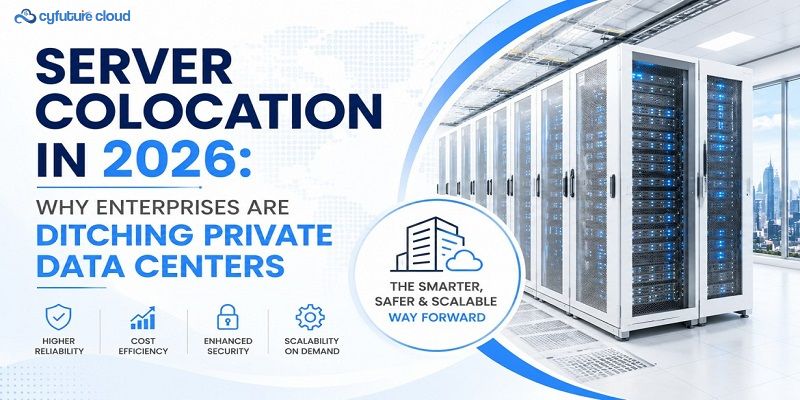
In 2026, enterprises are under enormous pressure to modernize IT environments while keeping costs, security, and scalability under control. And here’s the catch—traditional on-premises server rooms can no longer keep pace with AI workloads, hybrid cloud architectures, and high-density computing requirements.
That’s where data center colocation becomes a game changer.
Instead of investing millions into building private facilities, organizations are shifting toward colocation-powered Cloud Infrastructure strategies that combine operational control with cloud agility.
But why is this model gaining so much traction globally?
According to the Uptime Institute Global Data Center Survey 2025, more than 63% of enterprises now rely on third-party colocation providers for at least a portion of their mission-critical workloads. Meanwhile, Gartner predicts that by 2027, over 70% of enterprise AI workloads will operate in hybrid environments connected through colocation ecosystems.
And that’s not all…
Modern colocation facilities now offer AI-ready infrastructure, direct cloud connectivity, enterprise-grade redundancy, and sustainability-focused operations—making them a cornerstone of next-generation IT strategies.
For organizations seeking reliability, flexibility, and performance, providers like Cyfuture Cloud are helping businesses deploy scalable, secure, and future-ready infrastructure environments with high-performance connectivity and enterprise-grade support.
Why Data Center Colocation Matters in 2026
AI adoption, edge computing, cloud-native applications, and data sovereignty regulations are reshaping infrastructure priorities worldwide.
Building a private data center today requires:
- Massive CAPEX investment
- Specialized cooling systems
- Redundant power architecture
- Compliance certifications
- 24/7 monitoring teams
- Multi-carrier network ecosystems
For many enterprises, that simply isn’t practical anymore.
Here’s where colocation bridges the gap between on-premises control and cloud flexibility.
Let’s explore the top benefits.
Top 7 Benefits of Data Center Colocation
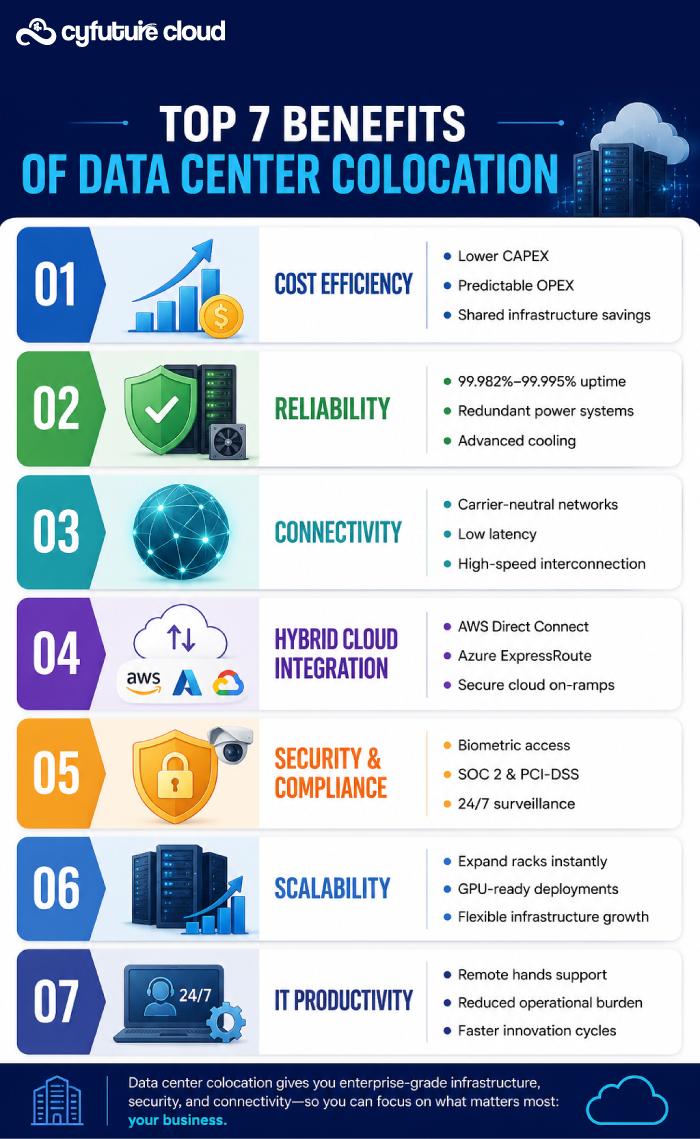
1. Significant Cost Reduction
Building a private facility is incredibly expensive.
According to Synergy Research Group, enterprise data center construction costs increased by over 18% globally between 2023 and 2025 due to rising energy and hardware demands.
Now compare that with colocation.
Instead of spending heavily on:
- Real estate
- Cooling infrastructure
- Backup generators
- Fire suppression
- Security systems
Businesses convert those costs into predictable operational expenditure (OPEX).
And there’s more…
Shared infrastructure models dramatically improve cost efficiency because tenants distribute operational overhead across the facility.
This is especially valuable for:
- AI startups
- SaaS companies
- BFSI organizations
- Enterprises running hybrid cloud environments
For organizations scaling GPU workloads or multi-cloud deployments, colocation minimizes infrastructure waste while maximizing ROI.
2. Enterprise-Grade Reliability and Uptime
Downtime is expensive.
According to the Uptime Institute, the average cost of a major data center outage now exceeds $100,000 per hour for enterprise organizations.
Modern colocation providers combat this with:
- N+1 or 2N power redundancy
- Advanced cooling systems
- UPS backups
- Diesel generators
- Real-time monitoring
- Automated failover systems
Tier III and Tier IV facilities can deliver uptime availability ranging from 99.982% to 99.995%.
That means your workloads remain operational even during:
- Utility failures
- Cooling disruptions
- Hardware incidents
- Network interruptions
For AI inference systems, financial platforms, healthcare applications, and e-commerce environments, this level of resilience is critical.
3. Superior Network Connectivity
Connectivity determines application performance.
Traditional server rooms often depend on a single ISP or limited networking options. Colocation facilities, however, are usually carrier-neutral environments.
That means businesses can access:
- Multiple telecom providers
- Low-latency routes
- Direct peering exchanges
- High-bandwidth interconnections
And here’s the important part…
Better connectivity directly improves:
- Application response times
- Video streaming performance
- AI inference latency
- Cross-region synchronization
- Customer experience
According to Cisco’s Global Networking Trends Report, low-latency infrastructure can improve enterprise application efficiency by up to 35%.
4. Seamless Hybrid Cloud Integration
Hybrid cloud is no longer optional—it’s the default architecture.
Modern enterprises increasingly combine:
- Private infrastructure
- Public cloud services
- Edge environments
- AI compute clusters
Colocation facilities simplify this integration through direct cloud on-ramps such as:
- AWS Direct Connect
- Microsoft Azure ExpressRoute
- Google Cloud Interconnect
These private connections provide:
- Faster throughput
- Lower latency
- Enhanced security
- Predictable network performance
This creates an optimized Cloud Infrastructure ecosystem where workloads move seamlessly between environments.
And that’s exactly what modern enterprises need in 2026.
5. Enhanced Security and Compliance
Cybersecurity threats are escalating rapidly.
IBM’s Cost of a Data Breach Report 2025 states that the average global data breach cost reached $4.88 million.
Colocation providers address this through multi-layered physical and operational security measures, including:
|
Security Layer |
Features |
|
Physical Security |
Biometric access, CCTV, mantraps |
|
Network Security |
DDoS protection, segmentation |
|
Environmental Security |
Fire suppression, leak detection |
|
Compliance |
SOC 2, PCI-DSS, HIPAA, ISO 27001 |
And here’s why this matters…
Achieving these compliance standards independently is both technically complex and financially demanding.
Colocation dramatically simplifies enterprise compliance readiness.
6. Rapid Scalability for Growing Workloads
Business requirements change constantly.
AI workloads surge unexpectedly. Storage needs expand rapidly. Customer traffic spikes overnight.
With colocation, scaling becomes much easier.
Organizations can quickly add:
- Additional racks
- Dedicated cages
- High-density GPU deployments
- Network bandwidth
- Storage clusters
Without:
- New construction
- Long procurement delays
- Facility redesign
For enterprises embracing AI, HPC, and cloud-native applications, scalability is now a competitive advantage—not just an IT requirement.
7. Improved IT Team Productivity
Managing facility operations drains valuable engineering time.
Internal IT teams often spend countless hours dealing with:
- Power maintenance
- Cooling issues
- Hardware monitoring
- Generator testing
- Physical security management
Colocation providers handle these operational complexities through 24/7 infrastructure management and remote hands support.
Result?
Your engineers can focus on:
- Application modernization
- AI development
- DevOps automation
- Security innovation
- Business growth initiatives
And honestly, that’s where enterprise value is truly created.
Why Enterprises Choose Cyfuture Cloud for Colocation
As businesses modernize infrastructure in 2026, choosing the right colocation partner becomes critical.
Cyfuture Cloud delivers enterprise-grade colocation solutions designed for modern hybrid and AI-driven environments.
Key strengths include:
- High-availability infrastructure
- Advanced cooling architecture
- Multi-layered security
- High-speed network connectivity
- Scalable hybrid cloud integration
- 24/7 technical support
With growing demand for AI-ready infrastructure and secure hybrid deployments, Cyfuture Cloud helps enterprises accelerate digital transformation while maintaining operational efficiency.
Conclusion
The future of enterprise IT is hybrid, scalable, and interconnected.
And data center colocation sits right at the center of that transformation.
From reducing infrastructure costs to enabling seamless cloud integration, colocation empowers organizations to modernize their Cloud Infrastructure without sacrificing performance, control, or security.
In 2026, enterprises are no longer asking whether colocation is necessary.
They’re asking how quickly they can implement it.



Stay Ahead of the Curve.
Join the Cloud Movement, today!
Send this to a friend