Get 69% Off on Cloud Hosting : Claim Your Offer Now!





- Products
- Solutions
-
Solutions
-
 Cloud
Hosting
Cloud
Hosting
-
VPS
Hosting
-
 GPU
Cloud
GPU
Cloud
-
 Dedicated
Server
Dedicated
Server
-
 Server
Colocation
Server
Colocation
-
 Backup as a Service
-
 CDN
Network
CDN
Network
-
 Window
Cloud Hosting
Window
Cloud Hosting
-
 Linux
Cloud Hosting
Linux
Cloud Hosting
-
Managed
Cloud Service
-
 Storage
as a Service
Storage
as a Service
-
VMware
Public Cloud
-
Multi-Cloud
Hosting
-
Cloud
Server Hosting
-
Bare
Metal Server
-
Virtual
Machine
-
 Magento
Hosting
Magento
Hosting
-
 Remote
Backup
Remote
Backup
-
 DevOps
-
 Kubernetes
-
 Cloud
Storage
Cloud
Storage
-
 NVMe
Hosting
NVMe
Hosting
-
 DR
as s Service
DR
as s Service
-
-
Solutions
- Marketplace
- Pricing
- Resources
- Company
 Remote
Backup
Remote
Backup NVMe
Hosting
NVMe
Hosting Pricing
Calculator
Pricing
Calculator Unlock Cost
Optimization
Unlock Cost
Optimization Overview
 Documentation
 Price
Calculator
Price
Calculator Tools
Tools FAQs
FAQs Terms
of Service
Terms
of Service Privacy
Policy
Privacy
Policy
 Migration
 Container
 Power
Power
 Utilities
 VMware
Private Cloud
VMware
Private Cloud VMware
on AWS
VMware
on AWS VMware
on Azure
VMware
on Azure Certifications
 Partners
 Careers
 Support
 Service
Level Agreement
Service
Level Agreement  Contact
Table of Contents
- The Heat Problem No One Is Ignoring Anymore
- Why Air Cooling Is Hitting a Wall
- The Three Core Liquid Cooling Technologies Powering AI Infrastructure
- Liquid Cooling vs. Air Cooling: A Head-to-Head Comparison
- The Water Paradox — And How Closed-Loop Systems Solve It
- The Business Case: What the Numbers Say
- India’s AI Data Center Moment — And Why Liquid Cooling Is the Differentiator
- Cyfuture Cloud: India’s Future-Ready AI Compute Partner
- What This Means for You: A Practical Decision Framework
The Heat Problem No One Is Ignoring Anymore
Here’s the thing most people don’t tell you about AI: it runs hot. Dangerously hot.
A single NVIDIA GB200 NVL72 rack — the kind powering cutting-edge LLM training today — consumes up to 120 kilowatts of power. That’s roughly equivalent to running 40 average Indian households simultaneously, in a box the size of a large wardrobe. Traditional air conditioning systems were never designed for this. Not even close.
In 2026, this is no longer a future problem. It’s happening on the floor of every serious AI data center right now.
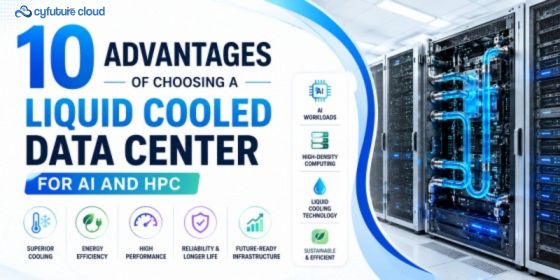
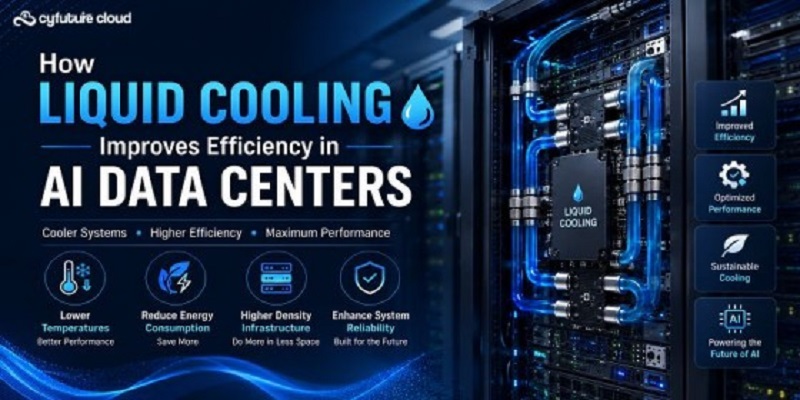
That’s why liquid cooled AI data centers have moved from being a niche engineering curiosity to an absolute operational necessity. And that’s exactly what this deep-dive is about.

Key Terms:
- PUE (Power Usage Effectiveness): Total facility power ÷ IT equipment power. The closer to 1.0, the more efficient.
- WUE (Water Usage Effectiveness): Water consumed ÷ IT energy used. A key sustainability metric.
- DTC (Direct-to-Chip): A closed-loop liquid cooling method where coolant flows directly over cold plates attached to processors.
- Immersion Cooling: Servers are fully submerged in non-conductive dielectric fluid.
- Thermal Throttling: When a processor automatically reduces its speed to prevent damage from overheating, causing direct performance loss.
Why Air Cooling Is Hitting a Wall
Let’s be blunt: air cooling is running out of road.
Data centers globally consume approximately 460 terawatt-hours of electricity annually, with cooling alone representing roughly 40% of total energy use in traditional facilities. Meanwhile, NVIDIA’s GPU roadmap shows processor power consumption doubling every two years — reaching 1,500 watts per chip by 2026.
The math doesn’t lie. You cannot cool a 100+ kW rack with air-conditioning.
What makes liquid so fundamentally superior? Water conducts heat approximately 25 times more efficiently than air. That single physical fact is why the entire industry is restructuring itself around liquid cooling technologies.
Goldman Sachs estimates that 76% of AI servers deployed by end of 2026 will be liquid-cooled — a seismic shift from just a few years ago, when liquid cooling was considered exotic. Regulators are catching up too: the EU Energy Efficiency Directive (EED) now mandates PUE and WUE reporting for all data centers, and Singapore allows new data center permits only with a PUE under 1.2.
The Three Core Liquid Cooling Technologies Powering AI Infrastructure
1. Direct-to-Chip (DTC) / Direct Liquid Cooling
Think of this as precision cooling surgery. Cold plates — flat metal blocks with internal microchannels — are mounted directly on CPUs, GPUs, and AI accelerators. A chilled liquid (typically water or a water-glycol mixture) is pumped through these plates in a closed loop, absorbing heat and carrying it to an external heat exchanger.
Why it matters: DTC systems can handle rack densities above 20 kW (ASHRAE’s 2026 Class H1 thermal guidelines now formally recommend DTC as the threshold crosses 20 kW per rack). AWS deployed a custom DTC solution achieving up to 46% reduction in mechanical energy consumption during peak cooling cycles.
2. Single-Phase Immersion Cooling
Here, entire servers are submerged in a tank filled with engineered, non-conductive dielectric fluid. The fluid absorbs heat on contact, rises to the surface as it warms, cools, and circulates back — a natural convection cycle.
Why it matters: Single-phase immersion cooling achieves PUE as low as 1.04–1.08, versus the industry average of 1.4–1.8 for air-cooled facilities. Compared to traditional air cooling, it can reduce electricity consumption by nearly 50% and support up to 99% less water consumption through closed-loop operation.
3. Two-Phase Immersion Cooling
More advanced still — the dielectric fluid actually changes state from liquid to vapor as it absorbs heat, then condenses back in a closed cycle. This phase-change mechanism extracts enormous amounts of heat with minimal fluid flow.
Why it matters: Two-phase systems can achieve PUE of 1.02–1.05, among the lowest in the industry, making them ideal for extreme-density AI accelerator deployments. The global immersion cooling market reached $4.87 billion in 2025 and is forecast to hit $11.10 billion by 2030 at a CAGR of 17.91%.
Liquid Cooling vs. Air Cooling: A Head-to-Head Comparison
Parameter
Air Cooling
Direct-to-Chip (DTC)
Immersion Cooling
Typical PUE
1.4 – 1.8
1.1 – 1.3
1.02 – 1.08
Max Rack Density Supported
~15–20 kW
30–80 kW
80–200+ kW
Energy Reduction vs. Air
Baseline
~30–46%
~40–50%
Water Consumption
High (evaporative)
Low (closed-loop)
Very Low (closed-loop)
Hardware Thermal Throttling Risk
High at AI densities
Low
Very Low
Capital Cost
Lower upfront
Medium
Higher upfront
Ideal Workload
Low-density, legacy
AI training & inference
Hyperscale AI / HPC
The Water Paradox — And How Closed-Loop Systems Solve It
Wait — isn’t liquid cooling going to drain water resources? It’s a fair question, and one that enterprise sustainability teams are rightly asking.
Here’s the nuance: not all liquid cooling is equal when it comes to water consumption.
Open-loop evaporative cooling (like old-school cooling towers) can indeed consume massive volumes of freshwater — a serious concern in water-stressed regions like parts of India and the U.S. Southwest.
But closed-loop DTC and immersion systems are fundamentally different. The same liquid recirculates continuously through sealed piping. There is no evaporation, no water loss. Closed-loop liquid cooling actually reduces direct water use by 70–90% compared to traditional evaporative methods. For facilities in India — where water stress is a real and growing concern — this distinction is critical.
Emerging on the horizon: microfluidic chip cooling, where microscopic liquid channels are etched directly inside silicon chips, extracting heat at the source with unprecedented precision. Intel and several fabless chip designers have active R&D programs here, and commercial deployments are anticipated within 2–3 years.
The Business Case: What the Numbers Say
Let’s get commercial for a moment. Because for tech leaders and enterprise decision-makers reading this, the ROI question is always on the table.
- Energy cost reduction: Advanced liquid cooling systems reduce energy use by over 30% compared to traditional thermal management — a direct OpEx reduction for data center operators.
- Regulatory compliance: The EU EED’s 2026 PUE/WUE reporting mandates and U.S. state-level quarterly disclosure laws (California AB 1577, Michigan SB 762, Iowa HF 2447) mean air-cooled infrastructure above 20 kW per rack is now a compliance liability, not just an efficiency gap.
- Compute performance: Liquid cooling eliminates thermal throttling, meaning AI training runs complete faster, time-to-revenue for AI services shortens, and GPU utilization improves — directly impacting the bottom line.
- Market growth: The global data center liquid cooling market grew from $4.18 billion in 2024 to $5.1 billion in 2025 at a CAGR of 21.9% — confirming this is not an emerging trend but an established infrastructure paradigm.
India’s AI Data Center Moment — And Why Liquid Cooling Is the Differentiator
India’s data center market is at an inflection point. Installed capacity is projected to grow from approximately 1.3 GW in early 2025 to over 4.5 GW by 2030. The Indian data center market — valued at around $4.5 billion in 2023 — is expected to surpass $8 billion by 2026.
The catalyst? AI. Generative AI workloads require rack densities of 30–40 kW and beyond, versus the traditional 8–10 kW racks most legacy Indian data centers were designed for. Without liquid cooling, these workloads are physically impossible to operate at scale.
This is exactly where Cyfuture Cloud’s 10MW Liquid-Cooled AI Data Center enters the picture.
Cyfuture Cloud: India’s Future-Ready AI Compute Partner
Cyfuture Cloud operates multiple Tier III, MeiTy-empaneled data centers across India, delivering enterprise-grade cloud infrastructure with a 100% uptime guarantee. As a MeiTy-empaneled cloud services provider, Cyfuture Cloud meets India’s most stringent government compliance standards — critical for enterprises, PSUs, and developers handling sensitive data within India’s borders.
The 10MW Liquid-Cooled AI Data Center is engineered from the ground up for high-density AI and GPU workloads. This isn’t retrofitted air-cooled infrastructure with liquid bolted on as an afterthought. It is a purpose-built facility designed to support next-generation AI compute — including Vera Rubin NVL72 Infrastructure , NVIDIA Blackwell-ready infrastructure, GPU colocation with liquid cooling, and direct-to-chip colocation capabilities that match the thermal profiles of today’s most demanding AI accelerators.
For enterprises building LLM training pipelines, developers running inference at scale, and tech leaders planning their AI infrastructure roadmap, this represents AI-ready colocation services with the reliability backbone India’s digital economy demands.
What This Means for You: A Practical Decision Framework
So where does this leave enterprise architects, developers, and CIOs evaluating their infrastructure stack in 2026?
If you are running AI training workloads:
You need DTC or immersion cooling. Air-cooled infrastructure will thermally throttle your GPUs, extend training runs, and inflate your compute costs. The performance penalty is real.If you are planning colocation for GPU clusters:
Ask your provider directly: what is your maximum rack density? What is your PUE? Do you support direct-to-chip colocation? A vendor unwilling to answer these questions concretely is not ready for AI workloads.If you are an enterprise evaluating TCO:
Factor in the regulatory trajectory. Liquid cooling is not just an efficiency choice in 2026 — it is a compliance preparation decision. Energy and water disclosure mandates are expanding globally and in India.







Stay Ahead of the Curve.
Join the Cloud Movement, today!
Send this to a friend