Get 69% Off on Cloud Hosting : Claim Your Offer Now!





- Products
- Solutions
-
Solutions
-
 Cloud
Hosting
Cloud
Hosting
-
VPS
Hosting
-
 GPU
Cloud
GPU
Cloud
-
 Dedicated
Server
Dedicated
Server
-
 Server
Colocation
Server
Colocation
-
 Backup as a Service
-
 CDN
Network
CDN
Network
-
 Window
Cloud Hosting
Window
Cloud Hosting
-
 Linux
Cloud Hosting
Linux
Cloud Hosting
-
Managed
Cloud Service
-
 Storage
as a Service
Storage
as a Service
-
VMware
Public Cloud
-
Multi-Cloud
Hosting
-
Cloud
Server Hosting
-
Bare
Metal Server
-
Virtual
Machine
-
 Magento
Hosting
Magento
Hosting
-
 Remote
Backup
Remote
Backup
-
 DevOps
-
 Kubernetes
-
 Cloud
Storage
Cloud
Storage
-
 NVMe
Hosting
NVMe
Hosting
-
 DR
as s Service
DR
as s Service
-
-
Solutions
- Marketplace
- Pricing
- Resources
- Company
 Remote
Backup
Remote
Backup NVMe
Hosting
NVMe
Hosting Pricing
Calculator
Pricing
Calculator Unlock Cost
Optimization
Unlock Cost
Optimization Overview
 Documentation
 Price
Calculator
Price
Calculator Tools
Tools FAQs
FAQs Terms
of Service
Terms
of Service Privacy
Policy
Privacy
Policy
 Migration
 Container
 Power
Power
 Utilities
 VMware
Private Cloud
VMware
Private Cloud VMware
on AWS
VMware
on AWS VMware
on Azure
VMware
on Azure Certifications
 Partners
 Careers
 Support
 Service
Level Agreement
Service
Level Agreement  Contact
Table of Contents
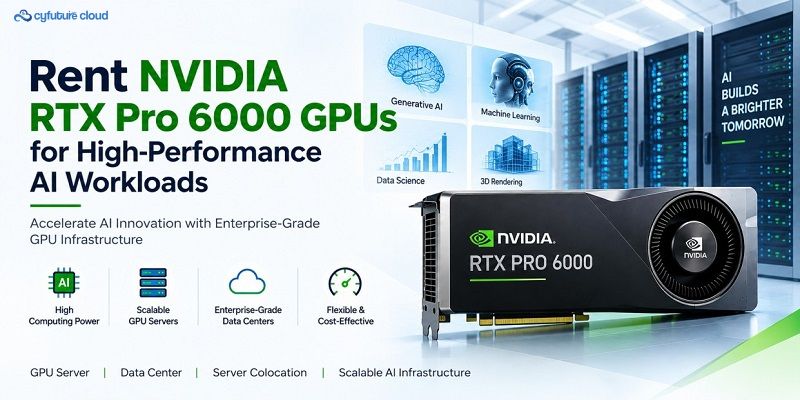
AI workloads are becoming more demanding as organizations work with larger models, complex datasets, and real-time applications. Renting NVIDIA RTX PRO 6000 GPUs provides businesses, developers, researchers, and enterprises with access to high-performance GPU computing without the large upfront cost of purchasing and maintaining hardware. Built on NVIDIA Blackwell architecture, the RTX PRO 6000 Server Edition includes 96 GB of GDDR7 memory and is designed for demanding AI and visual computing workloads.
The RTX PRO 6000 is designed for applications such as generative AI, AI inference, model development, scientific computing, 3D rendering, and data analytics. NVIDIA lists 24,064 CUDA cores, fifth-generation Tensor Cores, and up to 1 PFLOP of FP16/BF16 Tensor Core performance for the Server Edition. It also supports up to 600W configurable power consumption.
In this article, we will explore the benefits of renting NVIDIA RTX PRO 6000 GPUs, important GPU specifications, common AI workloads, and how GPU servers, Server Colocation, and a modern Data Center environment can support high-performance computing requirements.
What Are NVIDIA RTX PRO 6000 GPUs?
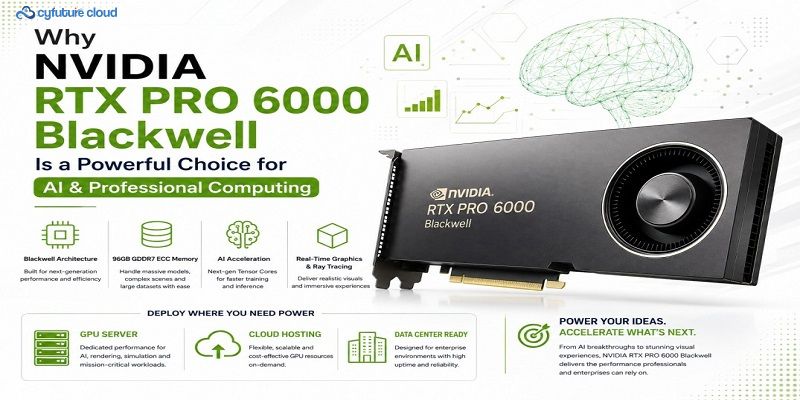
The NVIDIA RTX PRO 6000 Blackwell series is a professional GPU family designed for AI, graphics, simulation, and other compute-intensive applications. The Server Edition is specifically designed for multi-GPU server deployments and enterprise data center environments.
Its 96 GB GDDR7 memory helps users handle large AI models and complex datasets. Furthermore, ECC memory support improves data reliability for professional workloads.
Key specifications of the RTX PRO 6000 Blackwell Server Edition include:
- Architecture: NVIDIA Blackwell
- CUDA Cores: 24,064
- GPU Memory: 96 GB GDDR7 with ECC
- Memory Interface: 512-bit
- Memory Bandwidth: Up to 1,597 GB/s
- FP32 Performance: Up to 120 TFLOPS
- FP16/BF16 Tensor Performance: Up to 1 PFLOP
- RT Cores: 188 fourth-generation cores
- PCIe: PCIe Gen 5 x16
- Power: Up to 600W, configurable
These specifications make the GPU suitable for organizations that require substantial compute and memory capacity.
Why Rent NVIDIA RTX PRO 6000 GPUs?
Purchasing enterprise-grade GPUs can require significant capital investment. It also involves server infrastructure, power, cooling, networking, maintenance, and hardware management.
GPU rental offers a more flexible alternative. Businesses can provision the required computing resources for a specific project or workload. Therefore, teams can avoid committing their budget to hardware that may not be required continuously.
Lower Upfront Infrastructure Cost
With GPU rental, businesses pay for access instead of purchasing complete GPU infrastructure. This can make high-performance computing more accessible to startups, research teams, developers, and enterprises.
Flexible GPU Capacity
AI workloads can change quickly. For example, a company may need additional GPU capacity during model training but require fewer resources during development. Renting GPUs allows organizations to scale their infrastructure according to workload requirements.
Faster Deployment
A dedicated GPU server can take time to procure, install, configure, and test. A rental service can provide pre-configured infrastructure, allowing teams to start their workloads faster.
Access to Modern GPU Technology
GPU technology evolves rapidly. Renting can help businesses access newer hardware without repeatedly replacing their own infrastructure.
AI Workloads Supported by RTX PRO 6000
The RTX PRO 6000 Blackwell Server Edition is designed for a wide range of AI and enterprise workloads. NVIDIA highlights applications including generative AI, agentic AI, scientific computing, data analytics, rendering, and virtual workstations.
Generative AI and LLM Inference
Generative AI applications often require substantial GPU memory and compute performance. The 96 GB memory capacity of the RTX PRO 6000 can help developers work with larger models and demanding inference workloads.
It can also support AI assistants, content-generation systems, and other production AI applications.
AI Model Development and Fine-Tuning
Developers and data scientists can use GPU infrastructure for model training, experimentation, and fine-tuning. High GPU memory capacity can be particularly useful when datasets and model requirements become larger.
Computer Vision
Computer vision applications process images and video using neural networks. These workloads can benefit from GPU acceleration for model training, inference, image processing, and real-time analysis.
Scientific Computing
Research organizations often require accelerated computing for simulations, data analysis, and complex mathematical workloads. GPU-based infrastructure can reduce processing times compared with CPU-only environments.
3D Rendering and Visualization
The RTX PRO 6000 also combines AI capabilities with professional graphics features. Its fourth-generation RT Cores are designed to accelerate ray tracing and demanding visual workloads.
RTX PRO 6000 GPU Server for AI Computing
A GPU Server combines one or more GPUs with high-performance CPUs, memory, storage, networking, and supporting infrastructure. This configuration allows organizations to build an environment specifically optimized for accelerated workloads.
A suitable GPU server configuration can provide:
- Dedicated GPU resources
- High-speed NVMe storage
- High-capacity system RAM
- High-bandwidth networking
- Enterprise-grade security
- Remote management
- Scalable infrastructure
For multi-GPU applications, server architecture becomes especially important. NVIDIA also supports RTX PRO server configurations ranging from 2-GPU to 8-GPU systems through its certified ecosystem.
Role of Data Centers in GPU Hosting
A modern Data Center provides the infrastructure required to operate high-performance GPU servers reliably. GPUs generate substantial heat and consume significant power, so proper cooling, power distribution, networking, and physical security are essential.
Data centers can provide:
- Redundant power infrastructure
- Advanced cooling systems
- High-speed network connectivity
- Physical security
- Backup systems
- Monitoring and technical support
- Reliable server environments
For enterprises running AI workloads continuously, these infrastructure capabilities are important for maintaining performance and availability.
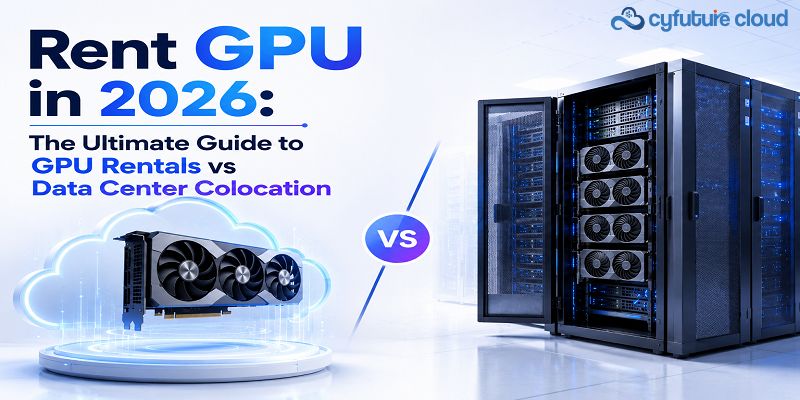
Server Colocation vs. GPU Rental
Server Colocation and GPU rental are two different infrastructure approaches.
With colocation, a business typically owns its server hardware and places it inside a professional data center. The provider supplies facilities such as power, cooling, connectivity, and physical security.
With GPU rental, the provider generally supplies the GPU server or GPU computing resources. This reduces the customer’s responsibility for hardware procurement and maintenance.
Therefore, businesses that already own specialized GPU hardware may prefer colocation. Meanwhile, organizations looking for flexible access to high-performance GPUs may find rental more convenient.
How to Choose an RTX PRO 6000 GPU Rental
Before renting an RTX PRO 6000, businesses should evaluate several infrastructure requirements.
1. GPU Memory
Check whether 96 GB of GPU memory is sufficient for the intended model, dataset, or application.
2. Number of GPUs
Determine whether the workload requires one GPU or a multi-GPU configuration. Distributed AI workloads may require several GPUs.
3. CPU and RAM
GPU performance can be affected by system configuration. Therefore, choose sufficient CPU cores and system memory for the workload.
4. Storage
AI datasets can become very large. High-speed NVMe storage can help reduce data-loading bottlenecks.
5. Network Connectivity
Distributed workloads and cloud-based applications require reliable, high-speed networking. This becomes even more important when multiple GPU servers communicate with each other.
6. Data Center Infrastructure
Evaluate power availability, cooling, network redundancy, security, and technical support before selecting a provider.
Conclusion
Renting NVIDIA RTX PRO 6000 GPUs provides businesses with flexible access to high-performance infrastructure for modern AI, data science, visualization, and computing workloads. With Blackwell architecture, 96 GB of GDDR7 memory, advanced Tensor Cores, and substantial compute capabilities, the RTX PRO 6000 Server Edition is designed for demanding enterprise applications.
A properly configured GPU Server, supported by reliable Data Center infrastructure, can provide the performance and scalability required for AI development and production workloads. Moreover, organizations can choose between GPU rental and Server Colocation based on their ownership, scalability, and infrastructure requirements.
As AI adoption continues to grow, flexible GPU infrastructure can help organizations access advanced computing resources while controlling deployment complexity and infrastructure costs.







Stay Ahead of the Curve.
Join the Cloud Movement, today!
Send this to a friend