Get 69% Off on Cloud Hosting : Claim Your Offer Now!





- Products
- Solutions
-
Solutions
-
 Cloud
Hosting
Cloud
Hosting
-
VPS
Hosting
-
 GPU
Cloud
GPU
Cloud
-
 Dedicated
Server
Dedicated
Server
-
 Server
Colocation
Server
Colocation
-
 Backup as a Service
-
 CDN
Network
CDN
Network
-
 Window
Cloud Hosting
Window
Cloud Hosting
-
 Linux
Cloud Hosting
Linux
Cloud Hosting
-
Managed
Cloud Service
-
 Storage
as a Service
Storage
as a Service
-
VMware
Public Cloud
-
Multi-Cloud
Hosting
-
Cloud
Server Hosting
-
Bare
Metal Server
-
Virtual
Machine
-
 Magento
Hosting
Magento
Hosting
-
 Remote
Backup
Remote
Backup
-
 DevOps
-
 Kubernetes
-
 Cloud
Storage
Cloud
Storage
-
 NVMe
Hosting
NVMe
Hosting
-
 DR
as s Service
DR
as s Service
-
-
Solutions
- Marketplace
- Pricing
- Resources
- Company
 Remote
Backup
Remote
Backup NVMe
Hosting
NVMe
Hosting Pricing
Calculator
Pricing
Calculator Unlock Cost
Optimization
Unlock Cost
Optimization Overview
 Documentation
 Price
Calculator
Price
Calculator Tools
Tools FAQs
FAQs Terms
of Service
Terms
of Service Privacy
Policy
Privacy
Policy
 Migration
 Container
 Power
Power
 Utilities
 VMware
Private Cloud
VMware
Private Cloud VMware
on AWS
VMware
on AWS VMware
on Azure
VMware
on Azure Certifications
 Partners
 Careers
 Support
 Service
Level Agreement
Service
Level Agreement  Contact
Table of Contents
- The Growing Importance of AI Data Center Protection
- Why Traditional Backup Methods Are Not Enough
- Role of Backup As a Service in AI Infrastructure
- Key Benefits of Backup As a Service for AI Data Centers
- Why Backup As a Service Is Critical for 2026
- How Cyfuture Cloud Supports AI Data Protection
- Future of AI Data Center Backup Infrastructure
- Conclusion
Artificial Intelligence is changing how businesses operate, innovate, and compete. From generative AI models to real-time analytics and autonomous systems, organizations are investing heavily in AI infrastructure. But here is the challenge: AI workloads are only as reliable as the infrastructure protecting them.
A modern AI Data Center handles massive volumes of training data, model checkpoints, user information, and operational workloads. A single failure, cyberattack, hardware issue, or data corruption event can disrupt critical AI operations and cause significant financial losses.
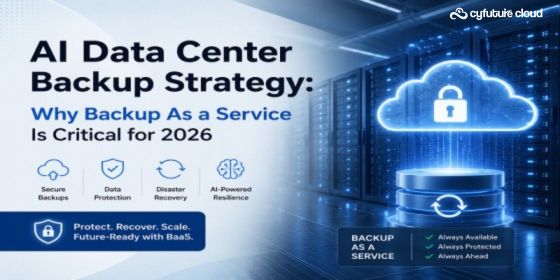
This is where Backup As a Service (BaaS) becomes a strategic requirement in 2026. Instead of treating backup as a secondary IT activity, enterprises are now adopting intelligent, automated, and scalable backup frameworks designed specifically for AI-driven environments.
According to the International Energy Agency (IEA), global data center electricity consumption is expected to reach around 945 TWh by 2030, more than double current levels, largely driven by AI adoption and accelerated computing workloads.
The bigger the AI infrastructure grows, the bigger the responsibility becomes.
The Growing Importance of AI Data Center Protection
AI environments are different from traditional IT environments.
A conventional application may depend on databases and servers. However, an AI workload depends on multiple interconnected components:
- Training datasets
- AI models
- GPU clusters
- Configuration files
- ML pipelines
- Deployment environments
- User-generated data
Losing any of these components can impact the entire AI lifecycle.
Think about this:
An AI model trained for months using millions of data points is not just a file. It is a valuable business asset.
Organizations using AI for healthcare analytics, financial forecasting, automation, cybersecurity, and customer intelligence cannot afford prolonged downtime.
The Uptime Institute 2025 outage analysis highlighted that while overall outage trends have improved, cyber incidents and external risks continue to create serious operational challenges for data center operators.
Why Traditional Backup Methods Are Not Enough
Legacy backup approaches often fail to meet AI infrastructure demands because AI workloads require:
|
Traditional Backup Challenge |
Impact on AI Workloads |
|
Manual backup processes |
Higher risk of human errors |
|
Limited scalability |
Cannot handle AI data growth |
|
Slow recovery |
Interrupts model training |
|
Local-only storage |
Vulnerable to disasters |
|
Poor automation |
Increases operational complexity |
AI environments require:
- Faster recovery time objectives (RTO)
- Lower recovery point objectives (RPO)
- Automated protection
- Multi-location redundancy
- Security-focused backup architecture
This is why enterprises are moving toward Backup As a Service.
Role of Backup As a Service in AI Infrastructure
Backup As a Service transforms backup from a manual operational task into an automated cloud-managed process.
A modern BaaS solution provides:
1. Automated AI Data Protection
AI systems continuously generate new datasets and model versions.
BaaS automatically schedules backups, reducing dependency on manual intervention.
2. Scalable Storage
AI workloads can grow from terabytes to petabytes.
Cloud-based backup infrastructure allows organizations to expand storage capacity without investing heavily in physical infrastructure.
3. Disaster Recovery Readiness
A strong AI Data Center backup strategy includes:
- Data replication
- Geographic redundancy
- Disaster recovery planning
- Rapid restoration
4. Security Against Cyber Threats
AI infrastructure is becoming a target for ransomware and cyberattacks.
BaaS solutions typically include:
- Encryption
- Access controls
- Backup isolation
- Monitoring
Key Benefits of Backup As a Service for AI Data Centers
1. Cost Optimization
Building an in-house backup environment requires:
- Storage hardware
- Maintenance
- Skilled teams
- Backup software
- Infrastructure upgrades
With BaaS, enterprises pay according to usage while avoiding large upfront investments.
2. Faster AI Recovery
AI projects often involve expensive GPU resources.
If training environments fail, recovery delays can waste:
- Compute hours
- Engineering resources
- Business opportunities
BaaS enables faster restoration of critical workloads.
3. Better Compliance
Industries such as:
- Banking
- Healthcare
- Government
- Research
need strong data protection practices.
A managed backup strategy helps organizations maintain governance and regulatory readiness.
Why Backup As a Service Is Critical for 2026
The AI ecosystem is becoming larger, faster, and more complex.
Future AI Data Centers will support:
- Large language models
- Autonomous applications
- Real-time AI decision systems
- Digital twins
- AI-powered automation
With this growth, data protection cannot remain an afterthought.
The question is no longer “Should we back up AI workloads?”
The question is:
“How quickly can we recover when AI infrastructure faces disruption?”
How Cyfuture Cloud Supports AI Data Protection
Cyfuture Cloud helps enterprises build secure and scalable cloud environments designed for modern workloads.
With enterprise-grade infrastructure, Cyfuture Cloud supports businesses with:
- Reliable cloud infrastructure
- Scalable storage solutions
- Secure data management
- High availability architecture
Cyfuture Cloud operates advanced data center facilities and provides cloud solutions designed for businesses requiring performance, security, and operational reliability.
For AI-driven organizations, combining AI-ready infrastructure with effective backup strategies helps create resilient digital operations.
Future of AI Data Center Backup Infrastructure
The next generation of backup solutions will become more intelligent.
Future trends include:
- AI-powered backup monitoring
- Predictive failure detection
- Automated recovery workflows
- Immutable backup storage
- Zero-trust security models
As AI adoption accelerates, backup infrastructure will become a core component of enterprise technology strategy.

Conclusion
An AI Data Center is the foundation of modern intelligent applications, but without a strong protection strategy, organizations remain vulnerable to downtime, data loss, and operational disruptions.
Backup As a Service provides the automation, scalability, and security required to protect AI workloads in 2026 and beyond.
For enterprises building AI-first environments, backup is not simply storage.
It is business continuity.





Stay Ahead of the Curve.
Join the Cloud Movement, today!
Send this to a friend