Get 69% Off on Cloud Hosting : Claim Your Offer Now!





- Products
- Solutions
-
Solutions
-
 Cloud
Hosting
Cloud
Hosting
-
VPS
Hosting
-
 GPU
Cloud
GPU
Cloud
-
 Dedicated
Server
Dedicated
Server
-
 Server
Colocation
Server
Colocation
-
 Backup as a Service
-
 CDN
Network
CDN
Network
-
 Window
Cloud Hosting
Window
Cloud Hosting
-
 Linux
Cloud Hosting
Linux
Cloud Hosting
-
Managed
Cloud Service
-
 Storage
as a Service
Storage
as a Service
-
VMware
Public Cloud
-
Multi-Cloud
Hosting
-
Cloud
Server Hosting
-
Bare
Metal Server
-
Virtual
Machine
-
 Magento
Hosting
Magento
Hosting
-
 Remote
Backup
Remote
Backup
-
 DevOps
-
 Kubernetes
-
 Cloud
Storage
Cloud
Storage
-
 NVMe
Hosting
NVMe
Hosting
-
 DR
as s Service
DR
as s Service
-
-
Solutions
- Marketplace
- Pricing
- Resources
- Company
 Remote
Backup
Remote
Backup NVMe
Hosting
NVMe
Hosting Pricing
Calculator
Pricing
Calculator Unlock Cost
Optimization
Unlock Cost
Optimization Overview
 Documentation
 Price
Calculator
Price
Calculator Tools
Tools FAQs
FAQs Terms
of Service
Terms
of Service Privacy
Policy
Privacy
Policy
 Migration
 Container
 Power
Power
 Utilities
 VMware
Private Cloud
VMware
Private Cloud VMware
on AWS
VMware
on AWS VMware
on Azure
VMware
on Azure Certifications
 Partners
 Careers
 Support
 Service
Level Agreement
Service
Level Agreement  Contact
Table of Contents
- Definition: Understanding Storage as a Service
- The AI Data Center Storage Challenge in 2026
- Key Drivers: Why Storage as a Service Dominates AI Infrastructure
- How Storage as a Service Optimizes the AI Data Center Stack
- Cyfuture Cloud: Powering AI Data Center Storage Excellence
- Sustainability: The Hidden STaaS Advantage
- The 2026 Reality: Storage-First AI Architecture
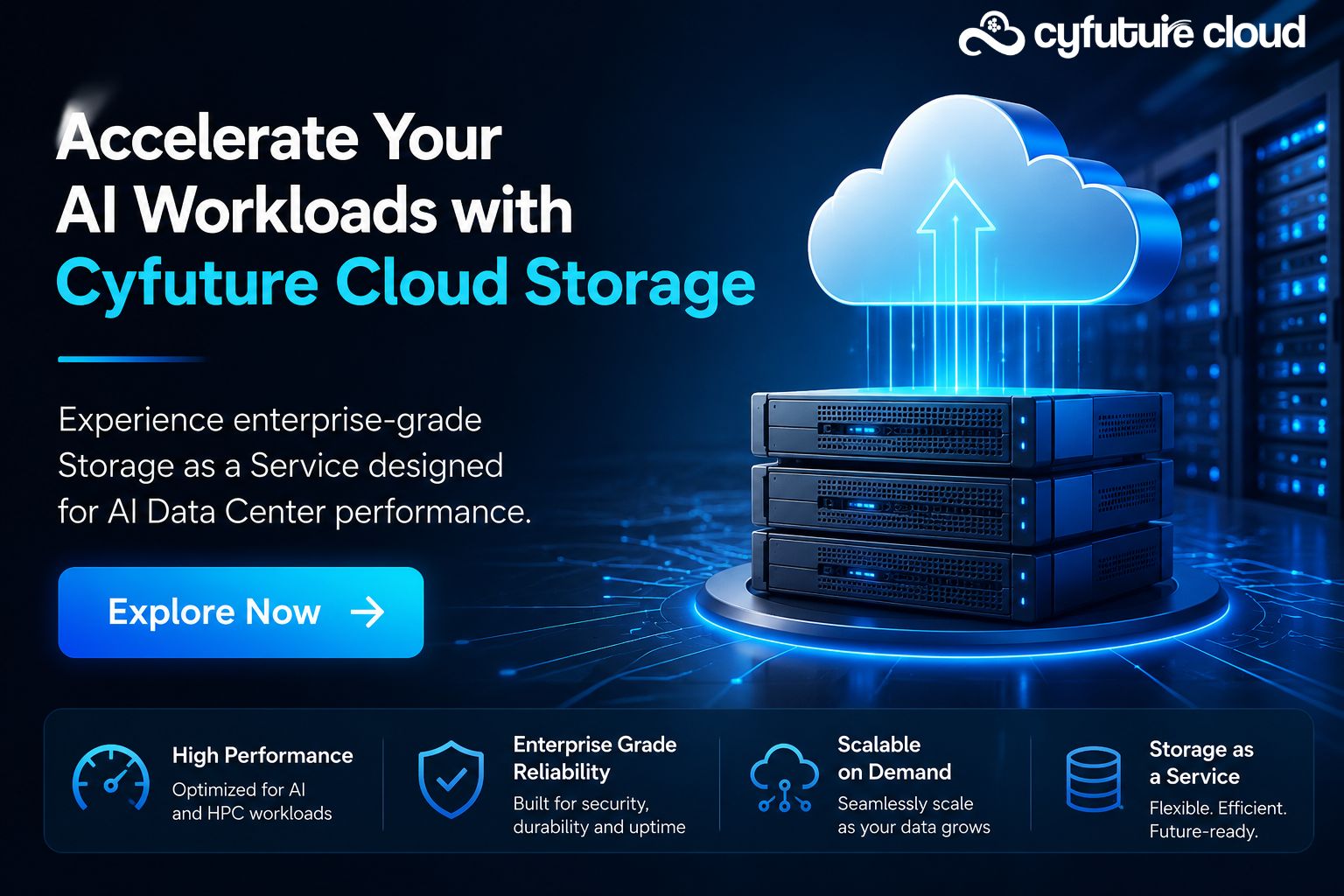
Storage as a Service (STaaS) has emerged as the critical infrastructure layer enabling AI Data Center operations at unprecedented scale. As organizations deploy larger language models, computer vision systems, and autonomous AI agents, the storage bottleneck has shifted from a backend concern to a front-line performance determinant.
Here’s the reality:
In 2026, the global AI infrastructure market reached USD 187 billion, with storage systems accounting for 28% of total spending—up from just 18% in 2023. This shift reflects a fundamental truth: AI models are only as fast as the data they can access.
Definition: Understanding Storage as a Service
Storage as a Service (STaaS) is a cloud-based infrastructure model where organizations consume storage resources on-demand without purchasing, deploying, or managing physical storage hardware. STaaS provides dynamically scalable capacity, automated data management, and consumption-based pricing optimized for high-throughput, low-latency AI workloads.
The AI Data Center Storage Challenge in 2026
Training GPT-4 class models requires accessing 45+ terabytes of training data with sustained read speeds exceeding 400 GB/s.
Here’s what that means:
Traditional storage architectures—even enterprise NAS and SAN systems—simply cannot deliver the I/O operations per second (IOPS) and throughput modern AI Data Center infrastructure demands.
The numbers tell the story:
According to IDC’s 2026 AI Infrastructure Report, AI training workloads generate storage I/O requirements 15-20x higher than traditional enterprise applications. A single NVIDIA H100 GPU cluster with 256 GPUs can saturate 1.2 petabytes of storage bandwidth during training operations.
And that’s just one cluster.
Hyperscale AI Data Center facilities now operate 50,000+ GPU configurations requiring coordinated storage systems capable of delivering 50+ petabytes/second aggregate throughput.
Key Drivers: Why Storage as a Service Dominates AI Infrastructure
1. Unprecedented Data Gravity
Global data creation reached 147 zettabytes in 2025, with unstructured data (images, video, text corpora) comprising 85% of AI training datasets.
The challenge?
AI models need rapid access to massive, diverse datasets without the operational overhead of managing petabyte-scale storage arrays.
Storage as a Service solves this through:
- Object storage tiers optimized for large file access patterns
- Automated data lifecycle management moving cold data to cost-optimized tiers
- Global replication ensuring training data availability across distributed AI Data Center locations
2. Breaking the “Memory Wall”
Modern AI accelerators (NVIDIA H100, AMD MI300X, Google TPU v5) process data at rates exceeding 3 terabytes/second per chip.
Here’s the problem:
Searched the web
Searched the web
If storage cannot keep pace, GPUs sit idle. When storage cannot saturate a Blackwell-class GPU cluster, the financial impact is immediate: approximately USD 30,000 per node in annual capital and power costs is wasted on idle cycles.
Storage as a Service addresses this through:
|
Technology |
Performance Impact |
|
NVMe-over-Fabrics (NVMe-oF) |
Sub-millisecond latency, direct GPU memory access |
|
RDMA Integration |
40-100 Gbps sustained throughput per storage node |
|
PCIe Gen5/Gen6 |
32-64 GB/s per SSD, eliminating I/O bottlenecks |
The global NVMe over Fiber Channel market is projected to grow at a compound annual growth rate of 14.8% through 2035, driven by AI workload demands.
3. CapEx to OpEx Transformation
Building enterprise-grade storage infrastructure for AI Data Center operations requires massive capital investment.
Here’s what that looks like:
A petabyte-scale all-flash array costs USD 8-15 million upfront, plus 18-25% annual maintenance. For organizations running experimental AI projects or variable workloads, this creates financial risk.
Storage as a Service converts this model to consumption-based pricing:
- Pay only for utilized capacity (typically USD 0.05-0.15 per GB/month)
- Dynamic performance scaling without hardware refresh cycles
- Predictable monthly costs aligned with business outcomes
AI data centers are expected to consume approximately 70% of high-end DRAM in 2026, creating supply constraints that make flexible STaaS models increasingly attractive.
How Storage as a Service Optimizes the AI Data Center Stack
Training & Pre-Processing Workloads
Modern LLM training requires loading 100+ billion tokens per training batch.
The challenge:
Data preprocessing pipelines must deliver sustained parallel read/write operations while GPUs process previous batches.
Storage as a Service enables this through:
- Parallel file systems distributing data across hundreds of storage nodes
- Automated prefetching anticipating GPU data requirements
- Burst IOPS capability handling irregular access patterns during multi-modal training
Enterprise SSD demand is expected to grow by 41% in 2026, underscoring the rapid acceleration in high-performance storage requirements.
Inference & Retrieval-Augmented Generation (RAG)
Real-time AI inference requires sub-10ms access to vector databases and knowledge bases.
Why this matters:
A chatbot serving 10,000 concurrent users must retrieve contextual embeddings from multi-terabyte vector stores in microseconds.
Storage as a Service provides:
- Low-latency object storage optimized for small-object retrieval
- Caching tiers keeping hot data in high-speed memory
- Geo-distributed replication reducing latency for global user bases
Backup & Data Protection
AI training datasets represent massive investments—often millions of dollars in data licensing and curation.
Here’s the risk:
Hardware failures during training runs can corrupt checkpoints, forcing teams to restart multi-week training cycles.
Storage as a Service mitigates this through:
- Continuous snapshotting without performance degradation
- Tiered backup strategies moving older checkpoints to cost-optimized storage
- Point-in-time recovery enabling rollback to any training state
Cyfuture Cloud: Powering AI Data Center Storage Excellence
Cyfuture Cloud has strategically positioned its Storage as a Service offerings to address AI Data Center requirements.
Performance benchmarks:
- 99.995% uptime SLA across all storage tiers
- Sub-2ms average latency for NVMe-backed storage
- Linear scalability from terabytes to exabytes without architecture redesign
Customer deployments demonstrate real-world impact:
A leading computer vision startup reduced their training infrastructure costs by 42% by migrating from on-premises storage arrays to Cyfuture Cloud’s STaaS platform, while simultaneously improving dataset load times by 3.7x.
Key differentiators:
✓ GPU-optimized storage paths eliminating unnecessary protocol overhead
✓ Integrated data lifecycle management automatically tiering cold training data
✓ Consumption-based pricing with no minimum commitments
✓ API-first architecture enabling programmatic storage provisioning
Sustainability: The Hidden STaaS Advantage
AI Data Center energy consumption reached 4.5% of global electricity demand in 2025.
Storage contributes significantly:
Traditional disk-based arrays consume 5-8 watts per terabyte, while all-flash architectures can shrink rack count and power draw up to 90% for equivalent capacity and throughput.
Storage as a Service accelerates sustainability through:
- Multi-tenant efficiency amortizing infrastructure across multiple customers
- Automated power management spinning down unused resources
- Higher density storage media reducing physical footprint
Navigating the 2026 Storage Landscape
The AI Data Center storage market has consolidated around several key technologies:
Performance Tier (Training/Inference):
- NVMe SSDs with PCIe Gen5/Gen6 interfaces
- Storage class memory (SCM) for ultra-low latency
- GPU-direct storage eliminating CPU bottlenecks
Capacity Tier (Datasets/Archives):
- High-density QLC SSDs replacing spinning disks
- Object storage with intelligent tiering
- Cloud-native file systems optimized for AI workflows
Leading hard-drive manufacturers are reporting that their production capacity for 2026 is already sold out, with prices rising rapidly, making STaaS’s dynamic provisioning increasingly valuable. IT Pro
The 2026 Reality: Storage-First AI Architecture
The paradigm has shifted.
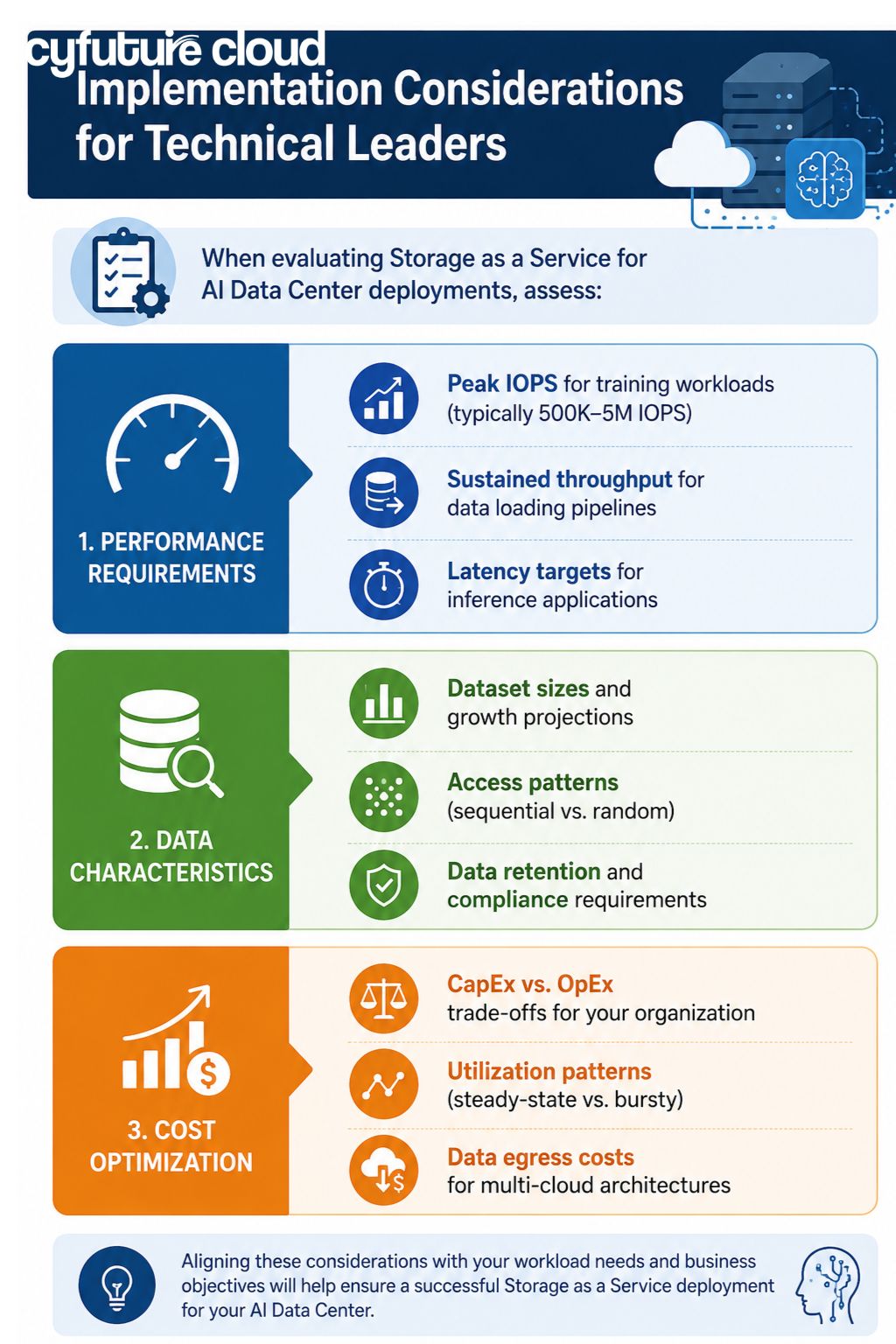
AI Data Center design now begins with storage, not compute. Organizations that understand this architectural principle achieve 30-50% better GPU utilization and correspondingly improved project ROI.
Storage as a Service has emerged as the enabling technology layer, providing:
✓ Dynamic scalability matching AI workload variability
✓ Performance levels previously requiring multi-million dollar capital investments
✓ Operational simplicity allowing teams to focus on model development, not infrastructure management
Cyfuture Cloud’s STaaS platform delivers all these capabilities with enterprise-grade reliability, transparent pricing, and seamless integration with leading AI frameworks and tools.
The competitive advantage in AI increasingly belongs to organizations that can iterate faster—and storage performance directly determines iteration velocity.





Stay Ahead of the Curve.
Join the Cloud Movement, today!
Send this to a friend