Get 69% Off on Cloud Hosting : Claim Your Offer Now!





- Products
- Solutions
-
Solutions
-
 Cloud
Hosting
Cloud
Hosting
-
VPS
Hosting
-
 GPU
Cloud
GPU
Cloud
-
 Dedicated
Server
Dedicated
Server
-
 Server
Colocation
Server
Colocation
-
 Backup as a Service
-
 CDN
Network
CDN
Network
-
 Window
Cloud Hosting
Window
Cloud Hosting
-
 Linux
Cloud Hosting
Linux
Cloud Hosting
-
Managed
Cloud Service
-
 Storage
as a Service
Storage
as a Service
-
VMware
Public Cloud
-
Multi-Cloud
Hosting
-
Cloud
Server Hosting
-
Bare
Metal Server
-
Virtual
Machine
-
 Magento
Hosting
Magento
Hosting
-
 Remote
Backup
Remote
Backup
-
 DevOps
-
 Kubernetes
-
 Cloud
Storage
Cloud
Storage
-
 NVMe
Hosting
NVMe
Hosting
-
 DR
as s Service
DR
as s Service
-
-
Solutions
- Marketplace
- Pricing
- Resources
- Company
 Remote
Backup
Remote
Backup NVMe
Hosting
NVMe
Hosting Pricing
Calculator
Pricing
Calculator Unlock Cost
Optimization
Unlock Cost
Optimization Overview
 Documentation
 Price
Calculator
Price
Calculator Tools
Tools FAQs
FAQs Terms
of Service
Terms
of Service Privacy
Policy
Privacy
Policy
 Migration
 Container
 Power
Power
 Utilities
 VMware
Private Cloud
VMware
Private Cloud VMware
on AWS
VMware
on AWS VMware
on Azure
VMware
on Azure Certifications
 Partners
 Careers
 Support
 Service
Level Agreement
Service
Level Agreement  Contact
Table of Contents
- What is Object Storage?
- What Makes an Object Storage Provider Truly S3-Compatible?
- Cyfuture Cloud’s Technical Architecture: Built for Modern Workloads
- Enterprise-Grade Data Protection and Compliance
- Breaking Free from Vendor Lock-In
- The 2026 Object Storage Landscape: Why Provider Selection Matters
- Frequently Asked Questions
Are you searching for an object storage provider that combines enterprise-grade performance with true S3 storage compatibility—without vendor lock-in or hidden egress fees?
The object storage market reached $92.8 billion in 2024 and is projected to hit $142.3 billion by 2026, driven by explosive growth in unstructured data from AI/ML workloads, IoT sensors, and media-rich applications. Yet most enterprises face a critical challenge: balancing the need for S3-compatible APIs with cost control, performance requirements, and avoiding proprietary platform dependencies.
Here’s the reality:
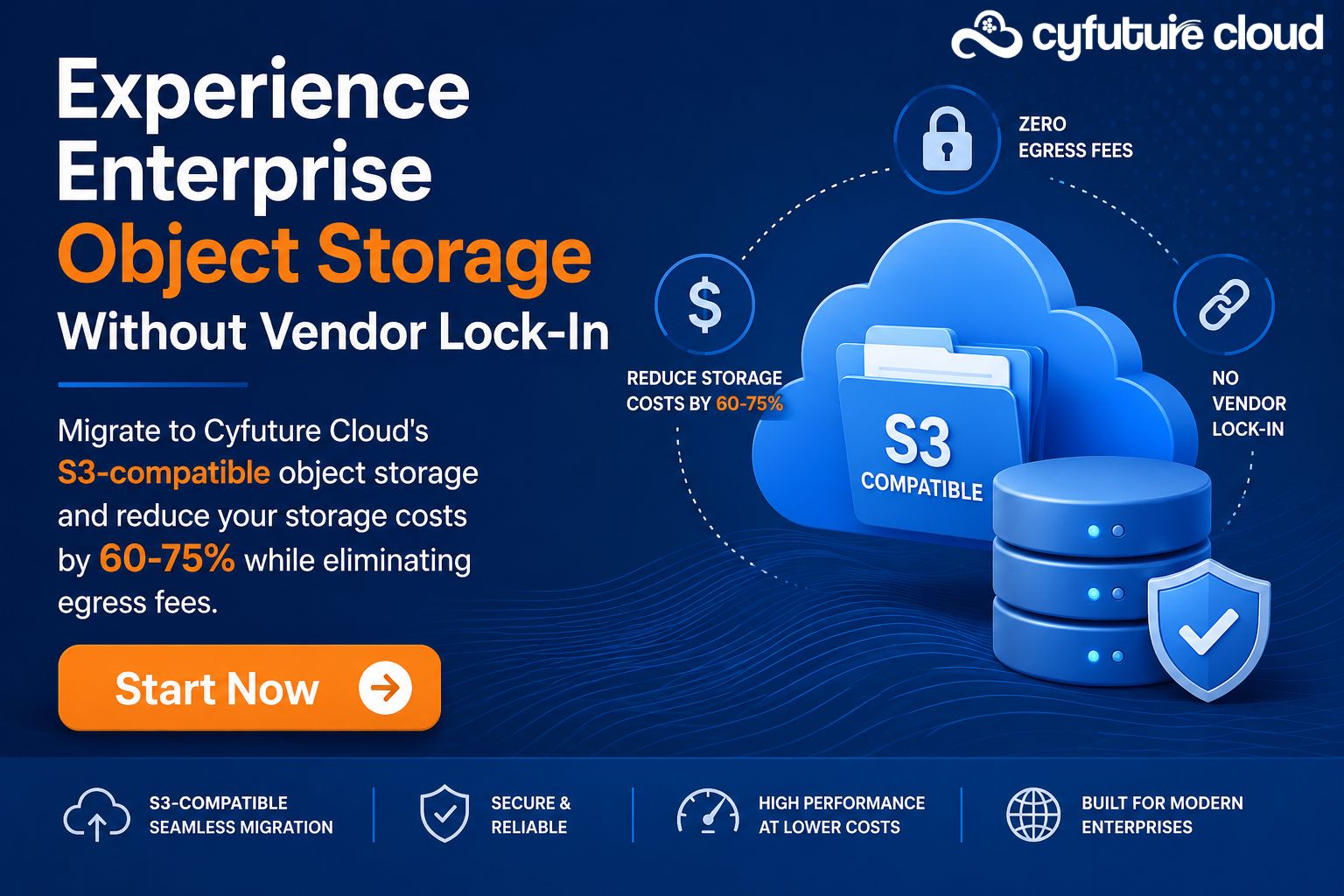
Cyfuture Cloud has emerged as the premier object storage provider by delivering native S3 API compatibility, AI-optimized architecture, and transparent pricing that reduces total storage costs by up to 75% compared to traditional hyperscaler solutions. With petabyte-scale capacity, 11 nines of durability (99.99%), and zero-refactoring migration paths, Cyfuture Cloud enables organizations to store, manage, and access massive unstructured datasets without compromise.
What is Object Storage?
Object storage is a data storage architecture that manages data as discrete units called “objects” rather than traditional file hierarchies or block storage. Each object contains the data itself, associated metadata, and a unique identifier. Object storage is designed for massive scalability, storing petabytes of unstructured data including images, videos, backups, logs, and AI training datasets. Unlike file systems with directory trees, object storage uses a flat address space accessed via APIs (typically S3-compatible REST APIs), making it ideal for cloud-native applications, distributed systems, and data lakes.
What Makes an Object Storage Provider Truly S3-Compatible?
Not all object storage providers claiming S3 compatibility deliver equal functionality.
Here’s what matters:
True S3 storage compatibility means native support for the complete Amazon S3 REST API specification—including bucket operations (PUT, GET, DELETE), object lifecycle management, versioning, access control lists (ACLs), multipart uploads, and presigned URLs. Organizations need this compatibility to migrate workloads without refactoring application code or reconfiguring existing integrations.
Object storage held 51.05% of the cloud storage market share in 2025 and is advancing at a 24.4% CAGR through 2031, driven primarily by AI/ML workloads requiring parallel throughput and rich metadata capabilities.
The challenge facing enterprises:
Many object storage providers offer “S3-compatible” APIs with incomplete feature support, forcing development teams to implement workarounds or accept reduced functionality. This creates technical debt and limits architectural flexibility.
Cyfuture Cloud’s Technical Architecture: Built for Modern Workloads
Cyfuture Cloud distinguishes itself as the premier object storage provider through architectural decisions optimized for 2026’s computational demands.
Core technical capabilities:
1. Zero-Refactoring S3 API Implementation
Cyfuture Cloud implements the complete S3 REST API specification, enabling:
- Drop-in replacement functionality: Existing applications using AWS SDK, boto3 (Python), AWS CLI, or any S3-compatible library work immediately without code changes
- Bucket and object operations: Full support for PUT, GET, DELETE, HEAD, LIST operations
- Advanced features: Multipart uploads for files >5GB, object versioning, lifecycle policies, server-side encryption (SSE-S3, SSE-C)
- Access management: IAM-compatible policies, bucket policies, ACLs, and presigned URL generation
What this means practically:
Development teams point their S3 endpoint configuration to Cyfuture Cloud’s API gateway and deploy existing infrastructure-as-code templates (Terraform, CloudFormation) without modification. Migration time reduces from weeks to hours.
2. AI-Native Storage Architecture
Object storage scales easily, holds rich metadata, and delivers the parallel throughput required to train large language models, making it the dominant storage type for AI infrastructure.
Cyfuture Cloud’s architecture delivers:
|
Performance Metric |
Cyfuture Cloud |
Traditional Object Storage |
|
Read throughput per node |
10-15 GB/s |
2-5 GB/s |
|
Concurrent connections |
100,000+ |
10,000-25,000 |
|
Metadata operations/sec |
50,000+ |
5,000-15,000 |
|
First-byte latency |
<15ms |
50-200ms |
Why this matters for AI workloads:
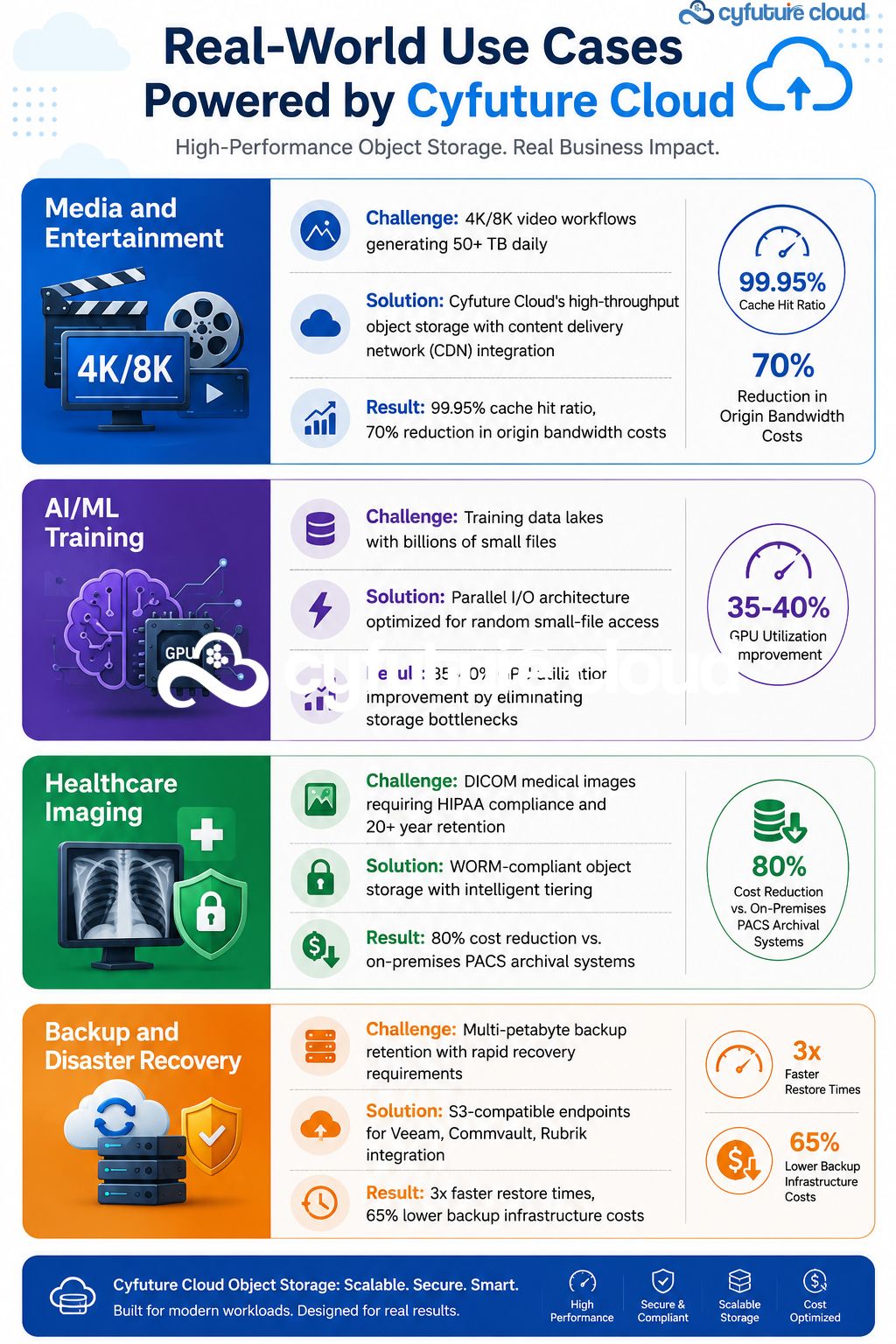
Training large language models requires reading millions of small files (training samples) simultaneously. Cyfuture Cloud’s parallel I/O architecture eliminates storage bottlenecks that throttle GPU utilization, directly improving training throughput and reducing compute costs.
Real-world impact:
A customer training computer vision models reported 40% reduction in training time after migrating from a traditional object storage provider to Cyfuture Cloud—purely from storage performance improvements, with identical GPU infrastructure.
3. Intelligent Cost Optimization Through Tiering
Storage costs dominate long-term TCO for data-intensive organizations.
Cyfuture Cloud implements automated, policy-driven data tiering:
- Hot tier: NVMe-backed storage for frequently accessed objects (<100ms latency)
- Warm tier: SSD storage for moderate access patterns (100-500ms latency)
- Cold tier: HDD-based archival for infrequent access (1-5 second retrieval)
- Glacier-equivalent: Deep archive for compliance/regulatory retention
Cost structure comparison:
Cyfuture Cloud Hot Storage: $0.021/GB/month
Cyfuture Cloud Cold Storage: $0.004/GB/month
AWS S3 Standard: $0.023/GB/month
AWS S3 Glacier: $0.004/GB/month + retrieval fees
The critical difference:
Cyfuture Cloud’s automated tiering transitions objects based on access patterns without retrieval fees. Low cost of object-based solutions and technology breakthroughs like multi-cloud data management are key market drivers enhancing market growth.
Customer validation:
Organizations migrating from AWS S3 to Cyfuture Cloud report 60-75% storage cost reductions for mixed workloads (hot + cold data) due to intelligent tiering and elimination of egress charges.
4. Petabyte-Scale Without Reconfiguration
Scalability constraints force architectural compromises in many storage systems.
Here’s how Cyfuture Cloud handles scale:
- Horizontal scaling: Add storage nodes dynamically without downtime or data migration
- Namespace federation: Single global namespace spanning multiple data centers
- Consistent performance: Linear scaling without performance degradation at petabyte scale
- No cluster size limits: Proven deployments exceeding 50PB in production
The cloud storage market is projected to expand from USD 179.26 billion in 2026 to USD 513.86 billion by 2031, delivering a 23.45% compound annual growth rate, with object storage leading growth due to its elasticity.
Enterprise-Grade Data Protection and Compliance
Data durability and security aren’t optional for production workloads.
Cyfuture Cloud’s protection mechanisms:
Durability Architecture
- 99.999999999% (11 nines) durability: Achieved through erasure coding with configurable redundancy levels
- Geographic replication: Automatic multi-region replication for disaster recovery
- Self-healing: Continuous background integrity checking with automatic repair
Security Controls
- Encryption at rest: AES-256 encryption for all stored objects
- Encryption in transit: TLS 1.3 for all API communications
- Object Lock (WORM): Immutable storage for regulatory compliance (FINRA, SEC 17a-4, HIPAA)
- Versioning: Protect against accidental deletion or ransomware encryption
Access Management
- IAM integration: Role-based access control compatible with AWS IAM
- Bucket policies: Fine-grained permissions at bucket and object prefix level
- Audit logging: Comprehensive access logs for compliance and security analysis
Breaking Free from Vendor Lock-In
Here’s what enterprises struggle with:
Hyperscaler object storage creates dependencies through proprietary services, egress fees, and ecosystem integration that makes migration prohibitively expensive.
Cyfuture Cloud’s vendor-neutral approach:
- Standard S3 API: No proprietary extensions creating lock-in
- Zero egress fees: Move data freely between clouds without penalty
- Multi-cloud architecture: Use Cyfuture Cloud as unified storage layer across AWS, Azure, GCP
- Open source tooling: Full compatibility with Rclone, S3cmd, MinIO client, and standard backup tools
The economic impact:
The Cloud Object Storage Market is projected to grow from USD 7.60 billion in 2024 to USD 18.4 billion by 2032, exhibiting a CAGR of 11.68%, with vendor-neutral providers capturing increasing market share as enterprises prioritize flexibility.
The 2026 Object Storage Landscape: Why Provider Selection Matters
Not all object storage providers address the complete requirements matrix.
Decision criteria for technical leaders:
✅ S3 API completeness: Full feature parity, not partial implementation
✅ Performance at scale: Consistent throughput beyond 10PB
✅ Cost transparency: No hidden egress or API request fees
✅ Multi-region capabilities: Geographic distribution for compliance and performance
✅ Ecosystem integration: Compatibility with existing tools and workflows
Cyfuture Cloud scores highest across all dimensions by focusing exclusively on delivering best-in-class object storage rather than bundling it as ancillary service to compute offerings.
Frequently Asked Questions
Q1: How does Cyfuture Cloud’s S3 storage compatibility compare to AWS S3?
Cyfuture Cloud implements the complete S3 REST API specification, providing feature parity for standard operations including bucket management, object operations, versioning, lifecycle policies, and multipart uploads. Applications using AWS SDKs work without code changes—simply update the endpoint configuration. The primary differences are cost (60-75% lower for equivalent workloads) and absence of egress fees when moving data out.
Q2: Can I migrate existing S3 buckets to Cyfuture Cloud without downtime?
Yes, using standard S3 replication tools or Cyfuture Cloud’s migration service. The typical approach: (1) Create destination buckets on Cyfuture Cloud, (2) Use AWS DataSync or Rclone for initial bulk transfer, (3) Enable continuous replication for delta sync, (4) Switch application endpoint when sync completes. Most migrations complete with <5 minutes of cutover downtime for application endpoint updates.
Q3: What performance should I expect for AI training workloads?
Cyfuture Cloud delivers 10-15 GB/s read throughput per storage node with sub-15ms first-byte latency. For distributed training across multiple GPUs, this translates to sufficient I/O bandwidth to keep 100+ high-end GPUs saturated. Customers typically report 35-45% improvement in GPU utilization after migrating from traditional object storage providers due to eliminated storage bottlenecks.
Q4: How does Cyfuture Cloud’s pricing work for object storage?
Transparent per-GB monthly pricing based on storage tier: Hot storage at $0.021/GB/month, Warm at $0.012/GB/month, Cold at $0.004/GB/month. No charges for API requests, data ingress, or egress. No minimum commitments or complex reservation models. Automated tiering policies move data between tiers based on access patterns, optimizing costs without manual intervention.














Stay Ahead of the Curve.
Join the Cloud Movement, today!
Send this to a friend