Get 69% Off on Cloud Hosting : Claim Your Offer Now!





- Products
- Solutions
-
Solutions
-
 Cloud
Hosting
Cloud
Hosting
-
VPS
Hosting
-
 GPU
Cloud
GPU
Cloud
-
 Dedicated
Server
Dedicated
Server
-
 Server
Colocation
Server
Colocation
-
 Backup as a Service
-
 CDN
Network
CDN
Network
-
 Window
Cloud Hosting
Window
Cloud Hosting
-
 Linux
Cloud Hosting
Linux
Cloud Hosting
-
Managed
Cloud Service
-
 Storage
as a Service
Storage
as a Service
-
VMware
Public Cloud
-
Multi-Cloud
Hosting
-
Cloud
Server Hosting
-
Bare
Metal Server
-
Virtual
Machine
-
 Magento
Hosting
Magento
Hosting
-
 Remote
Backup
Remote
Backup
-
 DevOps
-
 Kubernetes
-
 Cloud
Storage
Cloud
Storage
-
 NVMe
Hosting
NVMe
Hosting
-
 DR
as s Service
DR
as s Service
-
-
Solutions
- Marketplace
- Pricing
- Resources
- Company
 Remote
Backup
Remote
Backup NVMe
Hosting
NVMe
Hosting Pricing
Calculator
Pricing
Calculator Unlock Cost
Optimization
Unlock Cost
Optimization Overview
 Documentation
 Price
Calculator
Price
Calculator Tools
Tools FAQs
FAQs Terms
of Service
Terms
of Service Privacy
Policy
Privacy
Policy
 Migration
 Container
 Power
Power
 Utilities
 VMware
Private Cloud
VMware
Private Cloud VMware
on AWS
VMware
on AWS VMware
on Azure
VMware
on Azure Certifications
 Partners
 Careers
 Support
 Service
Level Agreement
Service
Level Agreement  Contact
Table of Contents
- 1. Superior Cooling Efficiency
- 3. Lower Energy Consumption
- 4. Improved Hardware Performance
- 5. Increased Equipment Lifespan
- 6. Better Sustainability
- 7. Reduced Operational Costs
- 8. Higher Reliability and Uptime
- 9. Optimized Space Utilization
- 10. Future-Ready AI Data Center Infrastructure
- Liquid Cooling Technologies Used in AI Data Centers
- Industries Benefiting from Liquid Cooled Data Centers
- Conclusion
Artificial Intelligence (AI) and High-Performance Computing (HPC) are transforming industries such as healthcare, finance, manufacturing, scientific research, and autonomous technologies. However, these advanced workloads generate enormous heat due to the growing demand for powerful GPUs and high-density servers. Traditional air cooling systems often struggle to maintain optimal temperatures under such conditions. As a result, businesses are increasingly adopting a Liquid Cooled Data Center to improve efficiency, reliability, and performance.
According to the International Energy Agency (IEA), data centers account for nearly 1–1.5% of global electricity consumption, and cooling represents a significant portion of that energy usage. Meanwhile, AI workloads continue to grow rapidly, pushing data centers to support rack densities exceeding 50–100 kW. Liquid cooling can remove heat more efficiently than conventional air cooling, making it an ideal solution for modern computing environments.
Why AI and HPC Need Advanced Cooling Solutions
AI model training, machine learning, deep learning, and HPC simulations require powerful GPUs and CPUs that consume significant energy. Consequently, these systems generate substantial heat that traditional cooling methods cannot always handle efficiently.
A Liquid Cooled Data Center transfers heat directly from critical components using liquid coolant instead of relying solely on airflow. Therefore, it delivers better thermal management while reducing energy consumption and operational costs.
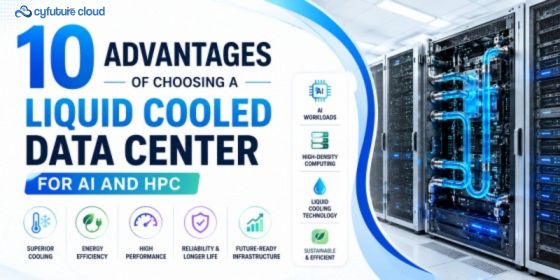
10 Advantages of Liquid Cooled Data Centers
1. Superior Cooling Efficiency
The biggest advantage of a Liquid Cooled Data Center is its exceptional cooling capability. Liquids absorb and transfer heat much faster than air.
As a result, servers remain within safe operating temperatures even during intensive AI training and HPC workloads. Moreover, stable temperatures reduce the risk of hardware failures and unexpected downtime.
- Supports High-Density AI Infrastructure
Modern AI applications require powerful GPU clusters with extremely high rack densities. Traditional cooling systems often struggle to cool racks exceeding 30–40 kW.
However, a Liquid Cooled Data Center easily supports rack densities of 100 kW or more. Therefore, organizations can deploy advanced AI hardware without worrying about overheating.
3. Lower Energy Consumption
Cooling consumes a significant share of data center energy. Air conditioning systems require large amounts of electricity to maintain optimal temperatures.
Liquid cooling removes heat more efficiently, which reduces dependence on mechanical cooling equipment. Consequently, organizations experience lower power consumption and improved Power Usage Effectiveness (PUE).
Additionally, reduced energy usage contributes to long-term operational savings.
4. Improved Hardware Performance
High temperatures can reduce processor performance due to thermal throttling. This affects AI training speed and HPC simulations.
A Liquid Cooled Data Center maintains consistent temperatures across servers. As a result, CPUs and GPUs operate at peak performance for extended periods.
Moreover, organizations achieve faster AI model training and better computational efficiency.
5. Increased Equipment Lifespan
Excessive heat accelerates hardware wear and reduces component life.
Liquid cooling minimizes thermal stress on servers, storage devices, and networking equipment. Therefore, organizations experience fewer hardware failures and longer equipment lifespan.
In addition, reduced maintenance requirements help lower infrastructure management costs.
6. Better Sustainability
Sustainability has become a major priority for businesses worldwide.
A Liquid Cooled Data Center significantly reduces electricity consumption and cooling-related carbon emissions. Some advanced systems also recycle waste heat for other applications.
Consequently, organizations can meet environmental goals while improving operational efficiency.
Furthermore, energy-efficient cooling supports corporate ESG initiatives.
7. Reduced Operational Costs
Although liquid cooling may require a higher initial investment, it delivers substantial long-term savings.
Lower electricity bills, reduced cooling infrastructure, fewer hardware replacements, and decreased maintenance expenses contribute to lower total operating costs.
Therefore, many enterprises view liquid cooling as a strategic long-term investment rather than a short-term expense.
8. Higher Reliability and Uptime
Downtime can disrupt business operations and lead to financial losses.
A Liquid Cooled Data Center provides stable thermal conditions that reduce overheating risks. Consequently, critical AI applications remain available even during demanding workloads.
Moreover, improved hardware reliability minimizes service interruptions and enhances business continuity.
9. Optimized Space Utilization
Traditional air-cooled facilities require wider aisles, raised floors, and additional cooling infrastructure.
Liquid cooling supports higher server densities within the same physical footprint. As a result, organizations maximize available data center space while accommodating future growth.
Additionally, efficient space utilization reduces the need for expensive facility expansions.
10. Future-Ready AI Data Center Infrastructure
AI technologies continue to evolve rapidly. New GPUs and processors consume even more power than previous generations.
A Liquid Cooled Data Center is designed to support next-generation AI computing platforms. Therefore, organizations can scale infrastructure without major cooling limitations.
Moreover, future-ready cooling ensures businesses remain competitive as AI workloads become increasingly complex.
Liquid Cooling Technologies Used in AI Data Centers
Different liquid cooling technologies are available depending on workload requirements.
Direct-to-Chip Cooling
This method circulates coolant through cold plates attached directly to CPUs and GPUs. It efficiently removes heat from high-performance processors.
Immersion Cooling
Servers are immersed in a special dielectric liquid that absorbs heat directly from all components. This approach offers exceptional cooling efficiency for ultra-high-density environments.
Rear Door Heat Exchangers
These systems remove heat from server exhaust before it enters the data center environment. Consequently, they improve overall cooling performance while supporting existing infrastructure.
Industries Benefiting from Liquid Cooled Data Centers
Many industries rely on AI and HPC workloads that demand advanced cooling solutions.
Some key sectors include:
- Artificial Intelligence and Machine Learning
- Scientific Research
- Financial Services
- Healthcare and Genomics
- Automotive Engineering
- Oil and Gas Exploration
- Media Rendering
- Government Research
- Manufacturing
- Cloud Computing Providers
These industries require high computing performance, reliability, and energy efficiency, making liquid cooling an ideal choice.
Conclusion
As AI and HPC workloads continue to expand, traditional cooling methods are becoming less effective. A Liquid Cooled Data Center offers a practical solution by delivering superior cooling efficiency, lower energy consumption, improved hardware performance, and greater infrastructure reliability.
Additionally, organizations benefit from reduced operational costs, better sustainability, and support for future high-density computing environments. Whether you are deploying GPU clusters, training large AI models, or running complex scientific simulations, investing in a modern AI Data Center with liquid cooling provides long-term value.
Choosing the right cooling technology today prepares your infrastructure for tomorrow’s computing challenges while ensuring optimal performance, scalability, and business continuity.









Stay Ahead of the Curve.
Join the Cloud Movement, today!
Send this to a friend