Get 69% Off on Cloud Hosting : Claim Your Offer Now!





- Products
- Solutions
-
Solutions
-
 Cloud
Hosting
Cloud
Hosting
-
VPS
Hosting
-
 GPU
Cloud
GPU
Cloud
-
 Dedicated
Server
Dedicated
Server
-
 Server
Colocation
Server
Colocation
-
 Backup as a Service
-
 CDN
Network
CDN
Network
-
 Window
Cloud Hosting
Window
Cloud Hosting
-
 Linux
Cloud Hosting
Linux
Cloud Hosting
-
Managed
Cloud Service
-
 Storage
as a Service
Storage
as a Service
-
VMware
Public Cloud
-
Multi-Cloud
Hosting
-
Cloud
Server Hosting
-
Bare
Metal Server
-
Virtual
Machine
-
 Magento
Hosting
Magento
Hosting
-
 Remote
Backup
Remote
Backup
-
 DevOps
-
 Kubernetes
-
 Cloud
Storage
Cloud
Storage
-
 NVMe
Hosting
NVMe
Hosting
-
 DR
as s Service
DR
as s Service
-
-
Solutions
- Marketplace
- Pricing
- Resources
- Company
 Remote
Backup
Remote
Backup NVMe
Hosting
NVMe
Hosting Pricing
Calculator
Pricing
Calculator Unlock Cost
Optimization
Unlock Cost
Optimization Overview
 Documentation
 Price
Calculator
Price
Calculator Tools
Tools FAQs
FAQs Terms
of Service
Terms
of Service Privacy
Policy
Privacy
Policy
 Migration
 Container
 Power
Power
 Utilities
 VMware
Private Cloud
VMware
Private Cloud VMware
on AWS
VMware
on AWS VMware
on Azure
VMware
on Azure Certifications
 Partners
 Careers
 Support
 Service
Level Agreement
Service
Level Agreement  Contact
Table of Contents
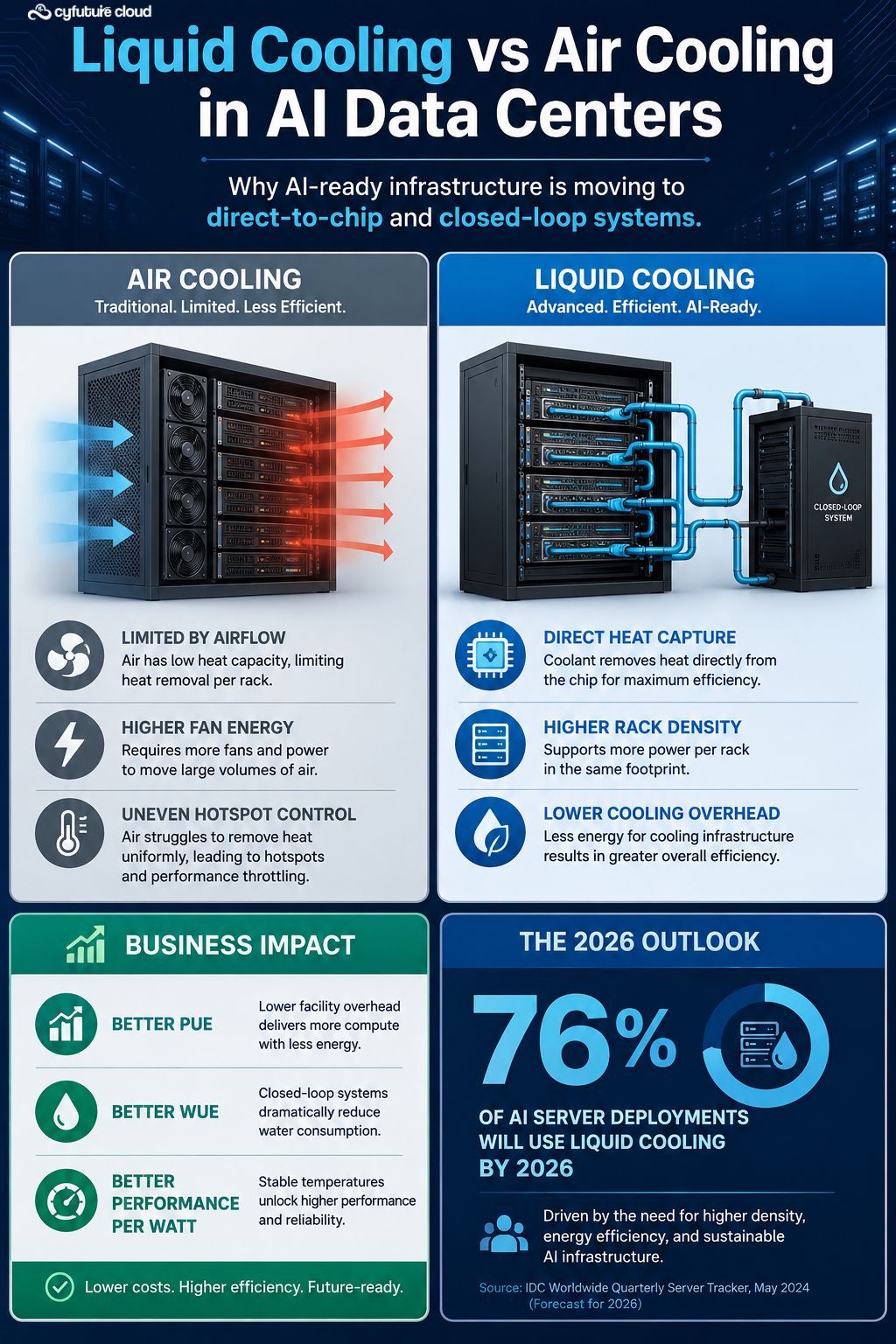
AI data centers are entering a new design era. Traditional air cooling is struggling to keep up with rising GPU density, higher power draw, and the constant need for better energy efficiency. Liquid cooling is becoming the practical answer because it moves heat more directly, uses less energy for thermal management, and supports the kind of dense AI workloads that modern training and inference require.

Why Air Cooling Is Hitting Limits
Here’s the reality: AI servers are no longer gentle on infrastructure. Dense racks, advanced accelerators, and nonstop training jobs create concentrated heat that makes air-based cooling expensive and less effective at scale. Schneider Electric’s 2026 data center coverage notes that liquid cooling is now being positioned as the default for AI infrastructure, with the industry moving beyond PUE alone and toward metrics like PCE and WUE.
And that shift matters. In 2026, Goldman Sachs estimates that 76% of AI servers deployed by the end of the year will be liquid-cooled, while liquid cooling can support rack densities above 100 kW and reach PUE levels around 1.05 to 1.15.
How It Improves Efficiency
So, what actually changes when liquid cooling is introduced?
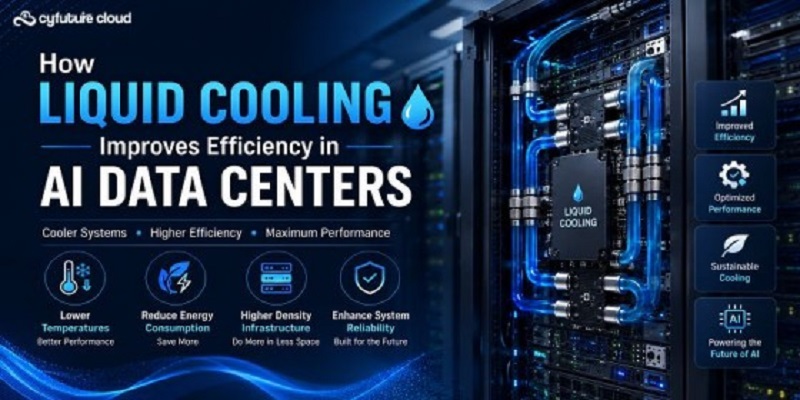
Liquid cooling improves efficiency in three big ways. First, it removes heat closer to the source, which reduces wasted energy from moving large volumes of air through the facility. Second, it enables higher compute density per rack, which means more AI work can run in less space. Third, it reduces dependency on mechanical cooling systems, which lowers energy consumption and operational strain.
Bucket brigade: That sounds technical, but the outcome is simple. More GPU power, less thermal waste, and better economics for AI infrastructure. NVIDIA’s June 2026 reporting around Rubin AI servers highlights a fan-free, closed-loop 100% liquid-cooled design that can run coolant at 45 degrees Celsius, helping reduce both power and water use at hyperscale.
The Numbers That Matter
The strongest case for liquid cooling is in the numbers.
|
Metric |
What 2026 sources indicate |
|
Liquid cooling adoption |
76% of AI servers expected to be liquid-cooled by end of 2026. se+1 |
|
Efficiency levels |
PUE around 1.05 to 1.15 is achievable in liquid-cooled environments. |
|
Rack density |
Liquid cooling supports racks above 100 kW. |
|
Water reduction |
NVIDIA says its 45°C liquid-cooled Rubin system can drive water use near zero in favorable climates. |
|
Cost impact |
A 50 MW hyperscale site could save more than $4 million a year in cooling-related energy and water costs. |
These figures show why liquid cooling is not just a thermal upgrade. It is becoming a financial and operational strategy for AI operators that need to optimize both performance and sustainability.
Why It Matters for AI Workloads
AI workloads are different from standard enterprise computing. Training large models and running inference at scale create sustained heat, not just occasional spikes. That means cooling must be efficient for long periods, not merely reactive. Liquid cooling helps keep temperatures more stable, which supports consistent GPU performance and reduces the risk of thermal throttling.
For tech leaders, this matters because infrastructure efficiency is now tied directly to AI throughput. For developers and students, it explains why next-generation AI stacks are being designed around liquid-cooled racks, closed-loop systems, and higher thermal headroom rather than legacy air-only systems.
Operational Benefits
Beyond raw cooling, liquid systems bring broader infrastructure gains.
- Higher compute density in the same physical footprint.
- Lower cooling energy consumption compared with air-heavy designs.
- Reduced water use in advanced closed-loop systems.
- Better support for next-generation GPUs and AI accelerators.
- Improved sustainability reporting through WUE and other outcome-based metrics.
Bucket brigade: And that is where the business case gets stronger. When a cooling architecture improves both efficiency and scalability, it stops being a facility decision and becomes a competitive advantage.
Cyfuture Cloud Advantage
Cyfuture Cloud is positioning itself for this shift with India’s premier 10MW direct-to-chip liquid-cooled AI data center, purpose-built for large-scale AI workloads. The facility is designed for high-density GPU deployments and supports next-generation platforms such as NVIDIA Vera Rubin and AMD CDNA 5-class workloads, which makes it relevant for enterprise AI and HPC demand in India.
Cyfuture Cloud also offers enterprise-grade GPU cloud and HPC services, including flexible high-performance computing infrastructure and data-center GPU access for AI, ML, and HPC workloads. For Indian buyers, that combination of local infrastructure, scalable provisioning, and AI-oriented design can mean lower latency, easier deployment, and better alignment with domestic compliance and procurement needs.
What Enterprises Should Do Now
The next step is not to wait for a perfect cooling model. It is to evaluate whether your current AI infrastructure can support rising rack densities, growing power demand, and sustainability targets over the next 12 to 24 months. If your roadmap includes LLM training, multi-GPU inference, or HPC-style compute, liquid cooling should already be part of capacity planning.
A practical migration path includes:
- Assessing current rack heat loads and future GPU density.
- Tracking PUE plus WUE, not PUE alone.
- Planning for direct-to-chip or other liquid-cooled architectures.
- Aligning facility design with AI workload growth.
- Choosing infrastructure partners that already support liquid-cooled AI deployments.

Closing Thought
Liquid cooling is no longer a niche option for specialty HPC systems. In 2026, it is becoming a mainstream enabler of AI efficiency, sustainability, and scale. For organizations building serious AI capability, the cooling layer is now part of the compute strategy itself.












Stay Ahead of the Curve.
Join the Cloud Movement, today!
Send this to a friend