
 Cloud
Hosting
VPS
Hosting
Cloud
Hosting
VPS
Hosting
 GPU
Cloud
GPU
Cloud
 Dedicated
Server
Dedicated
Server
 Server
Colocation
Server
Colocation
 Backup as a Service
 CDN
Network
CDN
Network
 Window
Cloud Hosting
Window
Cloud Hosting
 Linux Cloud
Hosting
Managed
Cloud Service
Linux Cloud
Hosting
Managed
Cloud Service
 Storage
as a Service
VMware Public
Cloud
Multi-Cloud
Hosting
Cloud
Server Hosting
Bare
Metal Server
Virtual
Machine
Storage
as a Service
VMware Public
Cloud
Multi-Cloud
Hosting
Cloud
Server Hosting
Bare
Metal Server
Virtual
Machine
 Magento
Hosting
Magento
Hosting
 Remote
Backup
Remote
Backup
 DevOps
 Kubernetes
 Cloud
Storage
Cloud
Storage
 NVMe
Hosting
NVMe
Hosting
 DR
as s Service
DR
as s Service
 API Gateway
Renting an NVIDIA B300 GPU server gives businesses access to Blackwell Ultra-powered infrastructure without the high upfront cost of purchasing, installing, and maintaining on-premises hardware. NVIDIA B300 systems are designed for demanding workloads such as large language model training, AI inference, fine-tuning, synthetic data generation, scientific computing, and enterprise-grade generative AI.
The NVIDIA DGX B300 platform includes eight Blackwell Ultra GPUs, with up to 2.3 TB of combined GPU memory, 14.4 TB/s aggregate NVLink bandwidth, and high-speed networking of up to 800 Gb/s. NVIDIA lists the DGX B300 system’s maximum power consumption at approximately 14.5 kW, making high-density power delivery, thermal management, and low-latency networking essential considerations when renting this infrastructure.
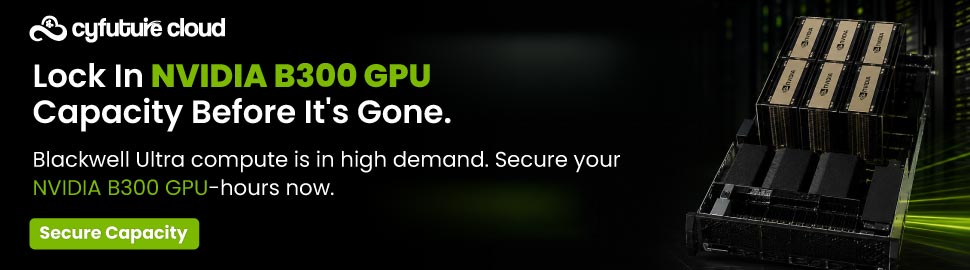
The NVIDIA B300 is part of the Blackwell Ultra generation of data center accelerators. It is built for AI factories that need high memory capacity, fast GPU-to-GPU communication, and optimized performance for modern precision formats such as FP4 and FP8.
A B300 server may be offered as a dedicated GPU node, an eight-GPU DGX system, an HGX-based server, or as part of a larger managed cluster. Depending on the provider, customers may choose between bare-metal access, virtualized GPU instances, Kubernetes clusters, Slurm-based environments, or managed AI platforms.
NVIDIA’s CUDA documentation identifies B300 as a compute capability 10.3 data-center GPU. NVIDIA also notes that Blackwell applications should be tested for compatibility, especially when applications contain only precompiled GPU binaries and do not include suitable PTX code.developer.
Renting B300 infrastructure can be more practical than purchasing hardware when workloads fluctuate or when an organization needs immediate access to advanced accelerators.
Key benefits include:
Lower capital expenditure: Avoid the cost of buying GPUs, servers, networking equipment, cooling systems, and data center space.
Faster deployment: Start AI projects without waiting for procurement, installation, and infrastructure commissioning.
Flexible scaling: Add or release GPU capacity as training, inference, or research requirements change.
Access to modern architecture: Use Blackwell Ultra capabilities without committing to a long hardware refresh cycle.
Managed operations: Select services may include monitoring, technical support, operating system management, security controls, and cluster administration.
Predictable infrastructure: Pay-per-use, monthly, reserved-capacity, or dedicated-server models can align infrastructure costs with business needs.
Cyfuture’s planned AI data center infrastructure is designed for high-density GPU deployments, with liquid-cooling readiness, rack densities of up to 150 kW after validation, 400G/800G networking options, and support for managed GPU cloud, dedicated clusters, inference, RAG, and MLOps workloads. These specifications are indicative and subject to final engineering validation.
Before selecting a provider, evaluate the complete infrastructure stack rather than comparing GPU-hour pricing alone.
Confirm whether the offer includes one B300 GPU, a multi-GPU server, or an eight-GPU platform. Large model training often benefits from high-bandwidth interconnects, while inference workloads may require fewer GPUs but stronger availability and networking guarantees.
Ask for details about GPU memory, NVLink, NVSwitch, PCIe connectivity, and the networking fabric. NVIDIA DGX B300 systems provide 14.4 TB/s of aggregate NVLink bandwidth and support high-speed InfiniBand or Ethernet connectivity.
B300 systems require carefully designed power and thermal infrastructure. Confirm rack power availability, redundant feeds, cooling architecture, temperature limits, and whether the provider supports direct-to-chip liquid cooling or another approved design.
Check support for the required NVIDIA drivers, CUDA Toolkit, cuDNN, TensorRT-LLM, PyTorch, JAX, vLLM, Kubernetes, and container registries. Your provider should also help validate Blackwell compatibility for existing workloads.
AI training requires fast access to datasets and checkpoints. Look for local NVMe storage, parallel file systems, object storage, high-throughput private networking, RDMA, and low-latency connectivity between GPU nodes.
Compare on-demand, reserved, monthly, and dedicated-server pricing. Review GPU availability, uptime commitments, support response times, data transfer charges, cancellation terms, maintenance windows, and minimum rental periods.
NVIDIA B300 rental is suitable for:
Large language model pre-training and fine-tuning.
Generative AI inference and model serving.
Retrieval-augmented generation and vector search.
Multimodal AI involving text, image, audio, and video.
Synthetic data generation and reinforcement learning.
Scientific research, drug discovery, and engineering simulation.
AI development environments, notebooks, and MLOps pipelines.
High-performance computing and enterprise analytics.
For sensitive workloads, consider India-hosted infrastructure, private networking, encryption, tenant isolation, audit logging, and compliance support. Cyfuture Cloud can position B300 capacity alongside dedicated clusters, managed Kubernetes, GPU-as-a-Service, storage, and sovereign AI deployment options.
Pricing depends on the GPU count, server configuration, rental duration, storage, networking, support level, and whether the capacity is on-demand or reserved. Request a customized quote instead of relying only on hourly pricing.
Yes. Its large memory capacity, high-bandwidth interconnect, and support for modern low-precision formats make it suitable for demanding inference and model-serving workloads. Actual performance depends on model architecture, batch size, quantization, framework optimization, and networking.
A single GPU may be sufficient for experimentation, smaller fine-tuning jobs, or inference. Distributed training and large models generally benefit from multi-GPU servers with NVLink, NVSwitch, and RDMA-enabled networking.
Prepare your container images, datasets, model checkpoints, dependency versions, security requirements, expected GPU utilization, storage needs, and network topology. Also confirm that your application supports the Blackwell architecture and required CUDA version.
Renting an NVIDIA B300 GPU server enables organizations to access next-generation AI compute without building a complete data center environment. The right solution should combine B300 hardware with reliable power, advanced cooling, high-speed networking, optimized software, secure storage, and a flexible commercial model.

Let’s talk about the future, and make it happen!






 Pricing
Calculator
Pricing
Calculator Unlock
Cost Optimization
Unlock
Cost Optimization Overview
 Documentation
 Price
Calculator
Price
Calculator Tools
Tools FAQs
FAQs Terms of
Service
Terms of
Service Privacy
Policy
Privacy
Policy
 Migration
 Container
 Power
Power
 Utilities
 VMware
Private Cloud
VMware
Private Cloud VMware on
AWS
VMware on
AWS VMware on
Azure
VMware on
Azure Certifications
 Customers
 Partners
 Careers
 Support
 Service
Level Agreement
Service
Level Agreement  Contact
