
 Cloud
Hosting
VPS
Hosting
Cloud
Hosting
VPS
Hosting
 GPU
Cloud
GPU
Cloud
 Dedicated
Server
Dedicated
Server
 Server
Colocation
Server
Colocation
 Backup as a Service
 CDN
Network
CDN
Network
 Window
Cloud Hosting
Window
Cloud Hosting
 Linux Cloud
Hosting
Managed
Cloud Service
Linux Cloud
Hosting
Managed
Cloud Service
 Storage
as a Service
VMware Public
Cloud
Multi-Cloud
Hosting
Cloud
Server Hosting
Bare
Metal Server
Virtual
Machine
Storage
as a Service
VMware Public
Cloud
Multi-Cloud
Hosting
Cloud
Server Hosting
Bare
Metal Server
Virtual
Machine
 Magento
Hosting
Magento
Hosting
 Remote
Backup
Remote
Backup
 DevOps
 Kubernetes
 Cloud
Storage
Cloud
Storage
 NVMe
Hosting
NVMe
Hosting
 DR
as s Service
DR
as s Service
 API Gateway
Hybrid cloud colocation combines the scalability of public cloud with the security and control of private colocation facilities.
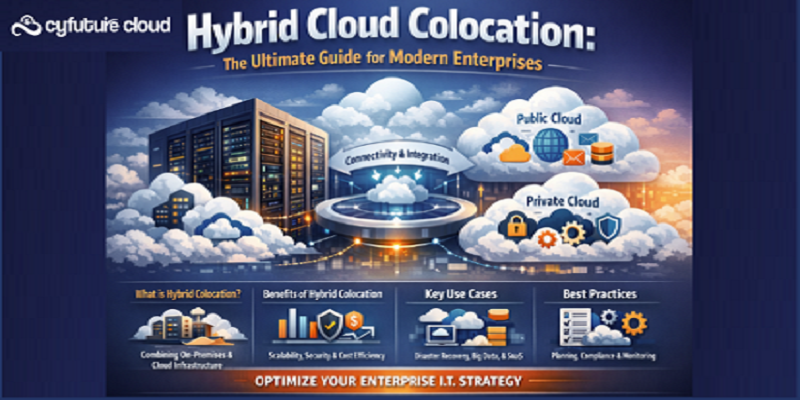
Key benefits for enterprises include:
Cost Efficiency: Pay only for what you use while avoiding massive upfront infrastructure investments.
Scalability and Flexibility: Seamlessly burst to public cloud during peak demands.
Enhanced Security and Compliance: Keep sensitive data on-premises or in secure colo while leveraging cloud for less critical workloads.
Performance Optimization: Low-latency access via dedicated colocation with high-speed cloud interconnects.
Disaster Recovery and Reliability: Robust redundancy across hybrid environments.
Future-Proof Innovation: Integrate AI, edge computing, and multi-cloud strategies effortlessly.
Cyfuture Cloud's hybrid colocation services deliver these advantages with Tier-III data centers in India, 99.99% uptime, and seamless AWS/Azure integrations.
Hybrid cloud colocation represents a strategic fusion of public cloud services (like AWS, Azure, or Google Cloud) with private colocation facilities. In this model, enterprises house their own servers or use dedicated racks in a colocation data center while connecting them to public cloud resources via high-speed, private links. This hybrid approach addresses the limitations of pure public or private cloud, offering enterprises a best-of-both-worlds solution.
For modern businesses, especially in India's booming digital economy, hybrid cloud colocation is transformative. Cyfuture Cloud, with its state-of-the-art facilities in Noida and Mumbai, exemplifies this by providing secure colocation spaces integrated with major hyperscalers. Let's dive into the key benefits.
.png)
One of the standout advantages is dramatic cost savings. Traditional on-premises data centers demand huge capital expenditures (CapEx) for hardware, cooling, power, and maintenance. Public cloud, while scalable, can lead to unpredictable operational expenses (OpEx) from over-provisioning.
Hybrid colocation flips this script. Enterprises colocate critical workloads in Cyfuture Cloud's facilities, paying predictable fees for space, power, and cooling—often 30-50% less than building your own. For variable demands, you burst to public cloud, paying only for actual usage. A retail giant, for instance, might run core inventory systems in colo for steady-state loads and scale e-commerce traffic to AWS during festive seasons like Diwali, slashing costs by up to 40%.
Cyfuture Cloud enhances this with energy-efficient designs and transparent billing, ensuring ROI within months.
Enterprises face fluctuating workloads—think sudden spikes from marketing campaigns or seasonal e-commerce surges. Pure public cloud scales easily but risks vendor lock-in; pure private setups lack elasticity.
Hybrid colocation bridges this gap. Colocated servers handle baseline operations reliably, while direct, low-latency connections (like Cyfuture's 100Gbps+ fiber links to cloud providers) enable instant scaling. This "pay-as-you-grow" model supports DevOps agility, containerization with Kubernetes, and microservices architectures.
For Indian enterprises expanding globally, Cyfuture Cloud's global peering ensures seamless hybrid orchestration, reducing time-to-market for new apps by weeks.
Data breaches cost enterprises an average of $4.45 million globally (IBM 2023). Public clouds offer strong security, but enterprises often need granular control for sensitive data under regulations like India's DPDP Act 2023 or GDPR.
Colocation provides physical and logical isolation: your hardware in a secure vault-like facility with 24/7 surveillance, biometric access, and compliance certifications (ISO 27001, PCI-DSS). Cyfuture Cloud's facilities feature advanced firewalls, DDoS mitigation, and encrypted interconnects.
Hybrid setups let you store regulated data (e.g., financial records) in colo while processing analytics in the cloud. Encryption-at-rest and zero-trust models ensure compliance without sacrificing performance.
Latency kills user experience. Server Colocation positions servers near internet exchanges and cloud on-ramps, delivering sub-millisecond response times. Cyfuture Cloud's carrier-neutral facilities in key metros connect to 200+ ISPs and direct cloud gateways.
Enterprises in BFSI or gaming benefit immensely—real-time trading or multiplayer sessions demand this edge. Hybrid colocation also supports edge computing, pushing workloads closer to users for 5G/IoT applications.
Downtime costs $9,000 per minute (Ponemon Institute). Hybrid colocation builds resilience: replicate data across colo sites and cloud regions. Cyfuture Cloud offers geo-redundant facilities with automated failover, achieving RTO/RPO under 15 minutes.
During events like Cyclone Amphan (2020), hybrid users maintained operations by shifting loads effortlessly.
Hybrid colocation unlocks AI/ML, big data, and multi-cloud strategies. Train models on colo GPUs for data sovereignty, then infer in the cloud. Cyfuture Cloud's NVIDIA partnerships and API gateways make this plug-and-play.
As enterprises adopt sovereign clouds post-DPDP, this model ensures agility without rework.
Hybrid cloud colocation empowers enterprises with cost savings, scalability, security, performance, reliability, and innovation—tailored for India's data-sovereign future. Cyfuture Cloud leads with affordable, compliant solutions that minimize risks and maximize value. Partnering with us means hybrid excellence without complexity. Contact Cyfuture Cloud today to architect your hybrid journey.
Q1: How does Cyfuture Cloud ensure seamless integration between colocation and public clouds?
A: Through private interconnects like AWS Direct Connect or Azure ExpressRoute, offering dedicated bandwidth up to 100Gbps with SLAs for <1ms latency.
Q2: What industries benefit most from hybrid cloud colocation?
A: BFSI for compliance, e-commerce for scalability, healthcare for data security, and gaming/media for low-latency performance.
Q3: Is hybrid colocation suitable for SMEs?
A: Absolutely—start with a single rack at Cyfuture Cloud for as low as ₹50,000/month, scaling as needed without CapEx.

Let’s talk about the future, and make it happen!






 Pricing
Calculator
Pricing
Calculator Unlock
Cost Optimization
Unlock
Cost Optimization Overview
 Documentation
 Price
Calculator
Price
Calculator Tools
Tools FAQs
FAQs Terms of
Service
Terms of
Service Privacy
Policy
Privacy
Policy
 Migration
 Container
 Power
Power
 Utilities
 VMware
Private Cloud
VMware
Private Cloud VMware on
AWS
VMware on
AWS VMware on
Azure
VMware on
Azure Certifications
 Customers
 Partners
 Careers
 Support
 Service
Level Agreement
Service
Level Agreement  Contact
