
 Cloud
Hosting
VPS
Hosting
Cloud
Hosting
VPS
Hosting
 GPU
Cloud
GPU
Cloud
 Dedicated
Server
Dedicated
Server
 Server
Colocation
Server
Colocation
 Backup as a Service
 CDN
Network
CDN
Network
 Window
Cloud Hosting
Window
Cloud Hosting
 Linux Cloud
Hosting
Managed
Cloud Service
Linux Cloud
Hosting
Managed
Cloud Service
 Storage
as a Service
VMware Public
Cloud
Multi-Cloud
Hosting
Cloud
Server Hosting
Bare
Metal Server
Virtual
Machine
Storage
as a Service
VMware Public
Cloud
Multi-Cloud
Hosting
Cloud
Server Hosting
Bare
Metal Server
Virtual
Machine
 Magento
Hosting
Magento
Hosting
 Remote
Backup
Remote
Backup
 DevOps
 Kubernetes
 Cloud
Storage
Cloud
Storage
 NVMe
Hosting
NVMe
Hosting
 DR
as s Service
DR
as s Service
 API Gateway
Hybrid cloud colocation improves business continuity by combining the scalability and flexibility of public cloud services with the security, control, and low-latency performance of dedicated colocation facilities. This setup ensures minimal downtime during outages, disasters, or high-demand periods through redundancy, rapid failover, data sovereignty compliance, and cost-efficient resource bursting—empowering businesses to maintain operations 24/7 with Cyfuture Cloud's integrated Hybrid cloud colocation infrastructure.
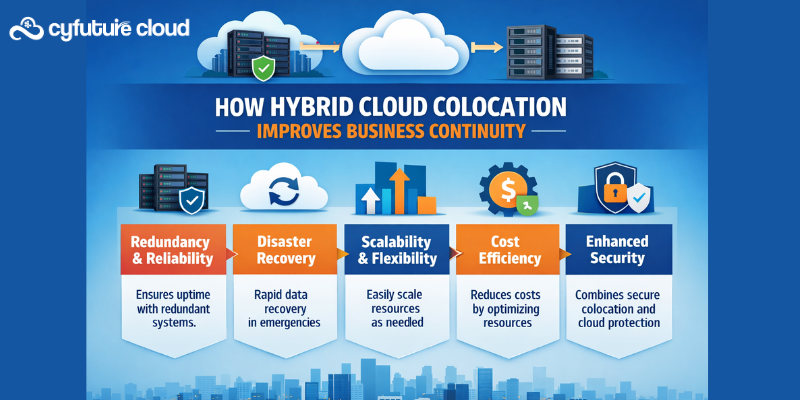
Hybrid cloud colocation merges server colocation services—where you house your servers in a provider's secure data center in India - with hybrid cloud architecture. In this model, your on-premises or colocated hardware connects seamlessly to public cloud platforms like AWS, Azure, or Cyfuture Cloud's own public cloud offerings.
Cyfuture Cloud excels here, providing Tier-III+ data centers in Noida and Mumbai with direct peering to major clouds. This isn't just storage; it's a strategic bridge. Businesses keep sensitive workloads in controlled colocation racks for compliance (e.g., RBI guidelines in India), while bursting non-critical tasks to the cloud for elasticity.
The result? A resilient ecosystem where colocation acts as the stable core, and cloud hosting provides overflow capacity. During disruptions like power failures or cyberattacks, traffic shifts automatically, slashing recovery time objectives (RTO) from hours to minutes.
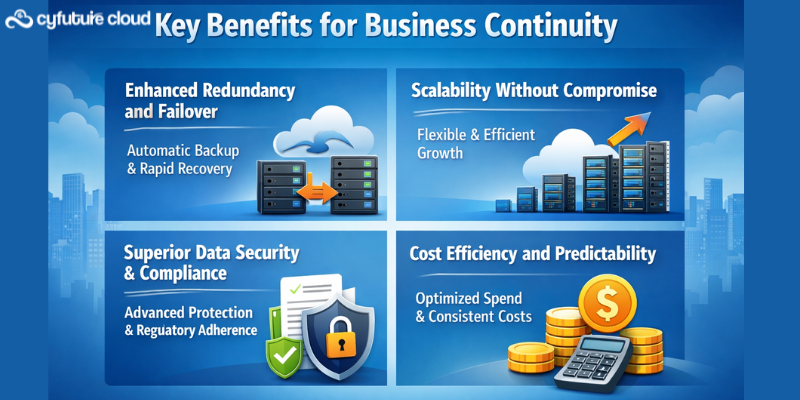
Business continuity planning (BCP) demands uptime, data protection, and quick recovery. Hybrid cloud colocation delivers on all fronts.
Traditional setups fail at single points of failure. Hybrid colocation distributes risk: colocated servers handle primary loads with built-in redundancies like dual power feeds and N+1 cooling at Cyfuture Cloud facilities. If issues arise, workloads failover to the public cloud via low-latency connections (under 1ms in India).
For instance, a Delhi-based fintech firm using Cyfuture Cloud colocates core transaction servers while mirroring data to AWS. A 2024 regional outage? Failover in 30 seconds, zero data loss—achieving recovery point objectives (RPO) near zero.
Pure cloud scales infinitely but risks vendor lock-in and latency for latency-sensitive apps like VoIP or real-time analytics. Pure colocation limits bursts. Hybrid fixes this: scale colocated resources on-demand by integrating with Cyfuture Cloud's burstable instances.
During peak events—like e-commerce Black Friday sales—non-essential VMs migrate to the cloud, freeing colocation space. Post-peak, they return, optimizing costs by 40-60% per industry benchmarks from Gartner.
Colocation offers physical security (biometric access, 24/7 surveillance) that public clouds can't match for air-gapped sensitive data. Cyfuture Cloud's ISO 27001-certified centers ensure data sovereignty under India's DPDP Act.
Hybrid setups encrypt data in transit via dedicated fiber links, with geo-redundant backups across zones. Ransomware hits the cloud? Restore from isolated colocation snapshots. This layered defense boosts continuity far beyond single-cloud reliance.
Full cloud migration spikes bills during spikes; on-premises demands CapEx. Hybrid colocation balances OpEx models: pay for colocation racks (predictable) plus cloud usage (variable). Cyfuture Cloud's pay-as-you-grow model cuts TCO by 30%, per IDC reports, funding advanced BCP tools like automated orchestration.
Cyfuture Cloud stands out with India-centric infrastructure: 100+ MW capacity, 99.999% uptime SLA, and hybrid management via a single pane—CloudPanel. Integrate with AWS Outposts or Azure Stack in-colo for true hybrid.
Real-world win: A Mumbai manufacturer faced Typhoon Tauktae floods in 2021. Cyfuture's hybrid setup shifted production monitoring to cloud in minutes, avoiding $500K losses. Tools like VMware on Cyfuture racks enable live migration, proving hybrid's continuity muscle.
Start with assessment: Map critical apps to colocation (high-security) vs. cloud (scalable). Cyfuture's architects design low-latency MPLS networks.
Deploy automation: Use Ansible or Terraform for failover scripts. Test quarterly with Cyfuture's DRaaS simulations.
Monitor holistically: Cyfuture's AI-driven observability predicts failures, auto-scaling resources.
Hybrid cloud colocation transforms business continuity from reactive to proactive, blending colocation's rock-solid reliability with cloud's agility. For Indian enterprises, Cyfuture Cloud delivers this via compliant, high-performance data centers—ensuring operations thrive amid disruptions. Partner with Cyfuture to build unbreakable resilience.
Q1: How much does hybrid cloud colocation cost with Cyfuture Cloud?
A: Starts at ₹50,000/month for a quarter rack with 1Gbps cloud connectivity, plus cloud usage. Custom quotes factor power, bandwidth, and DR features—contact sales for a TCO calculator.
Q2: Is it suitable for SMEs?
A: Absolutely. SMEs get enterprise-grade continuity without full CapEx. Cyfuture offers starter bundles with 10U colocation + 100TB cloud storage for ₹20,000/month.
Q3: How do I migrate to Cyfuture's hybrid setup?
A: Free assessment, lift-and-shift in 48 hours, zero-downtime cutover. Our team handles cabling, peering, and testing.

Let’s talk about the future, and make it happen!






 Pricing
Calculator
Pricing
Calculator Unlock
Cost Optimization
Unlock
Cost Optimization Overview
 Documentation
 Price
Calculator
Price
Calculator Tools
Tools FAQs
FAQs Terms of
Service
Terms of
Service Privacy
Policy
Privacy
Policy
 Migration
 Container
 Power
Power
 Utilities
 VMware
Private Cloud
VMware
Private Cloud VMware on
AWS
VMware on
AWS VMware on
Azure
VMware on
Azure Certifications
 Customers
 Partners
 Careers
 Support
 Service
Level Agreement
Service
Level Agreement  Contact
