
 Cloud
Hosting
VPS
Hosting
Cloud
Hosting
VPS
Hosting
 GPU
Cloud
GPU
Cloud
 Dedicated
Server
Dedicated
Server
 Server
Colocation
Server
Colocation
 Backup as a Service
 CDN
Network
CDN
Network
 Window
Cloud Hosting
Window
Cloud Hosting
 Linux Cloud
Hosting
Managed
Cloud Service
Linux Cloud
Hosting
Managed
Cloud Service
 Storage
as a Service
VMware Public
Cloud
Multi-Cloud
Hosting
Cloud
Server Hosting
Bare
Metal Server
Virtual
Machine
Storage
as a Service
VMware Public
Cloud
Multi-Cloud
Hosting
Cloud
Server Hosting
Bare
Metal Server
Virtual
Machine
 Magento
Hosting
Magento
Hosting
 Remote
Backup
Remote
Backup
 DevOps
 Kubernetes
 Cloud
Storage
Cloud
Storage
 NVMe
Hosting
NVMe
Hosting
 DR
as s Service
DR
as s Service
 API Gateway
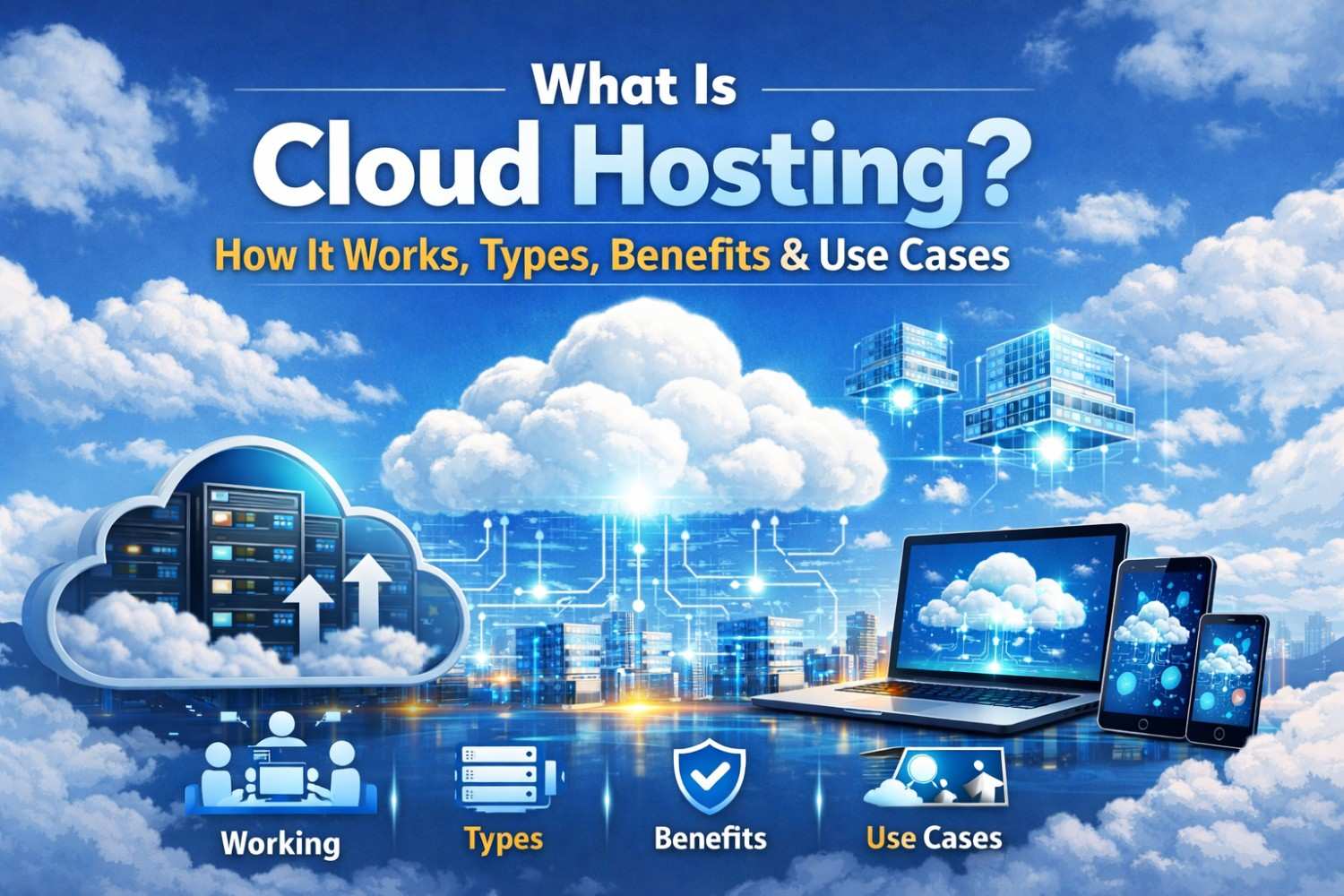
Cloud hosting is a web hosting model that uses a network of interconnected virtual and physical cloud servers to store, manage, and deliver websites and applications over the internet.
Unlike traditional hosting, which relies on a single physical server, cloud hosting distributes workloads across multiple servers. This ensures high availability, scalability, redundancy, and performance.
In simple terms:
Cloud hosting allows your website or application to run on multiple servers instead of one - eliminating single points of failure.
Cloud hosting works by using virtualization technology to divide physical servers into multiple virtual machines (VMs). These VMs are connected across a distributed infrastructure, often spanning multiple data centers.
Here’s how the architecture functions:
A hypervisor (such as VMware, KVM, or Hyper-V) abstracts hardware resources like CPU, RAM, and storage.
Computing resources are pooled together across multiple servers.
Traffic is distributed automatically to prevent overload on any single node.
If one server fails, another immediately takes over — minimizing downtime.
Resources scale automatically based on traffic demand.
This distributed infrastructure is what makes cloud hosting highly resilient compared to traditional hosting.
Cloud hosting can be categorized based on deployment model and service model.
Infrastructure shared across multiple tenants.
Examples: AWS, Microsoft Azure, Google Cloud.
Best for:
Dedicated cloud environment for a single organization.
Best for:
Combination of public and private cloud infrastructure.
Best for:
Provides virtual machines, storage, and networking.
Offers a development environment for building applications.
Delivers applications over the internet (e.g., CRM tools).
Cloud hosting eliminates the single-server dependency seen in traditional hosting models.
Multiple servers ensure minimal downtime.
Scale resources instantly during traffic spikes.
Pay only for resources consumed (in most cloud environments).
Low latency through distributed infrastructure.
Built-in redundancy across geographic locations.
Includes:
Data encryption
DDoS protection
Firewall isolation
Role-based access control
Cloud hosting supports a wide range of business scenarios:
Organizations that require 99.9%+ uptime often rely on cloud-based architectures.
Cloud hosting can be highly secure when implemented correctly.
Security depends on:
Most enterprise cloud environments follow shared responsibility models where the provider secures infrastructure, and customers secure applications and data.
A typical cloud hosting architecture includes:
This layered model ensures operational efficiency and resilience.
Cloud hosting is ideal if:
It may not be necessary for:
Some of the leading global cloud hosting providers include:
Businesses should evaluate providers based on:
Cloud hosting represents a shift from hardware-dependent hosting to distributed, virtualized infrastructure.
It provides scalability, resilience, and operational flexibility that traditional hosting models cannot match.
For businesses prioritizing performance, uptime, and growth readiness, cloud hosting has become the modern standard infrastructure model.
Cloud hosting uses multiple servers to host websites and applications instead of relying on a single server.
VPS runs on one physical server divided into virtual partitions. Cloud hosting runs across multiple interconnected servers.
Costs vary. Many providers offer pay-as-you-go pricing, making it cost-efficient for scalable workloads.
E-commerce, fintech, healthcare, SaaS, and enterprise IT environments benefit significantly.

Let’s talk about the future, and make it happen!






 Pricing
Calculator
Pricing
Calculator Unlock
Cost Optimization
Unlock
Cost Optimization Overview
 Documentation
 Price
Calculator
Price
Calculator Tools
Tools FAQs
FAQs Terms of
Service
Terms of
Service Privacy
Policy
Privacy
Policy
 Migration
 Container
 Power
Power
 Utilities
 VMware
Private Cloud
VMware
Private Cloud VMware on
AWS
VMware on
AWS VMware on
Azure
VMware on
Azure Certifications
 Customers
 Partners
 Careers
 Support
 Service
Level Agreement
Service
Level Agreement  Contact
