Get 69% Off on Cloud Hosting : Claim Your Offer Now!





- Products
- Solutions
-
Solutions
-
 Cloud
Hosting
Cloud
Hosting
-
VPS
Hosting
-
 GPU
Cloud
GPU
Cloud
-
 Dedicated
Server
Dedicated
Server
-
 Server
Colocation
Server
Colocation
-
 Backup as a Service
-
 CDN
Network
CDN
Network
-
 Window
Cloud Hosting
Window
Cloud Hosting
-
 Linux
Cloud Hosting
Linux
Cloud Hosting
-
Managed
Cloud Service
-
 Storage
as a Service
Storage
as a Service
-
VMware
Public Cloud
-
Multi-Cloud
Hosting
-
Cloud
Server Hosting
-
Bare
Metal Server
-
Virtual
Machine
-
 Magento
Hosting
Magento
Hosting
-
 Remote
Backup
Remote
Backup
-
 DevOps
-
 Kubernetes
-
 Cloud
Storage
Cloud
Storage
-
 NVMe
Hosting
NVMe
Hosting
-
 DR
as s Service
DR
as s Service
-
-
Solutions
- Marketplace
- Pricing
- Resources
- Company
 Remote
Backup
Remote
Backup NVMe
Hosting
NVMe
Hosting Pricing
Calculator
Pricing
Calculator Unlock Cost
Optimization
Unlock Cost
Optimization Overview
 Documentation
 Price
Calculator
Price
Calculator Tools
Tools FAQs
FAQs Terms
of Service
Terms
of Service Privacy
Policy
Privacy
Policy
 Migration
 Container
 Power
Power
 Utilities
 VMware
Private Cloud
VMware
Private Cloud VMware
on AWS
VMware
on AWS VMware
on Azure
VMware
on Azure Certifications
 Partners
 Careers
 Support
 Service
Level Agreement
Service
Level Agreement  Contact
Table of Contents
- Why%20AI%20Teams%20Are%20Moving%20GPU%20Cloud%20Servers%20Into%20Private%20Colocation%20Cages<%2Fstrong>%20https%3A%2F%2Fcyfuture.cloud%2Fblog%2Fwhy-ai-teams-are-moving-gpu-cloud-servers-into-private-colocation-cages%2F" title="" onclick="essb.tracking_only('', 'whatsapp', '1681510601', true);" target="_self" rel="nofollow" >WhatsApp
A 2024 MLOps Community survey revealed that 68% of AI teams running production workloads on cloud GPU instances experienced cost overruns exceeding 200% of initial budgets. The culprit? The intersection of insatiable GPU demand for training large language models (LLMs), computer vision systems, and generative AI applications with public cloud pricing models that weren’t designed for sustained, high-utilization compute workloads.
Here’s what’s happening:
Leading AI organizations—from autonomous vehicle startups to healthcare AI labs—are executing a strategic infrastructure shift. They’re purchasing NVIDIA H100, A100, and L40S GPU cloud servers and deploying them in private colocation cages rather than renting them hourly from hyperscalers.
The result? 60-75% cost reductions over 36 months while gaining performance control that public cloud simply cannot deliver.
What Is a Colocation Cage and Why Does It Matter for GPU Infrastructure?
A colocation cage is a physically secured, private enclosure within a data center facility where organizations deploy their own hardware infrastructure. Unlike shared rack space, cages offer:
- Exclusive floor space: Typically 100-2,000 square feet for dense server deployments
- Dedicated power circuits: 50-500 kW with customizable redundancy (N+1 or 2N configurations)
- Physical isolation: Chain-link or metal panel barriers with individual access control
- Custom cooling: Ability to implement rear-door heat exchangers or liquid cooling for GPU densities
For AI workloads, this architecture solves a critical problem:
GPU cloud servers generate extreme heat density—an 8-GPU NVIDIA H100 server consumes 10.2 kW and produces 34,800 BTU/hour. Standard data center racks designed for 5-8 kW can’t accommodate modern AI infrastructure without specialized cooling, which colocation cages provide through customized environmental controls.
Technical Advantages: Performance Control Public Cloud Cannot Match
1. Network Topology Optimization
GPU cloud servers in a private colocation cage enable custom InfiniBand or RoCE (RDMA over Converged Ethernet) fabrics. This matters critically for distributed training:
- Cloud inter-instance bandwidth: 100-400 Gbps with variable latency (5-50 microseconds)
- Private InfiniBAN fabric: 400-800 Gbps with deterministic sub-2 microsecond latency
Training a GPT-3 scale model (175B parameters) across 1,024 GPUs:
- Cloud configuration: 28-35 days training time
- Optimized colocation: 18-22 days training time
Time savings translate directly to competitive advantage in AI research and product development.
2. Storage Performance and Data Gravity
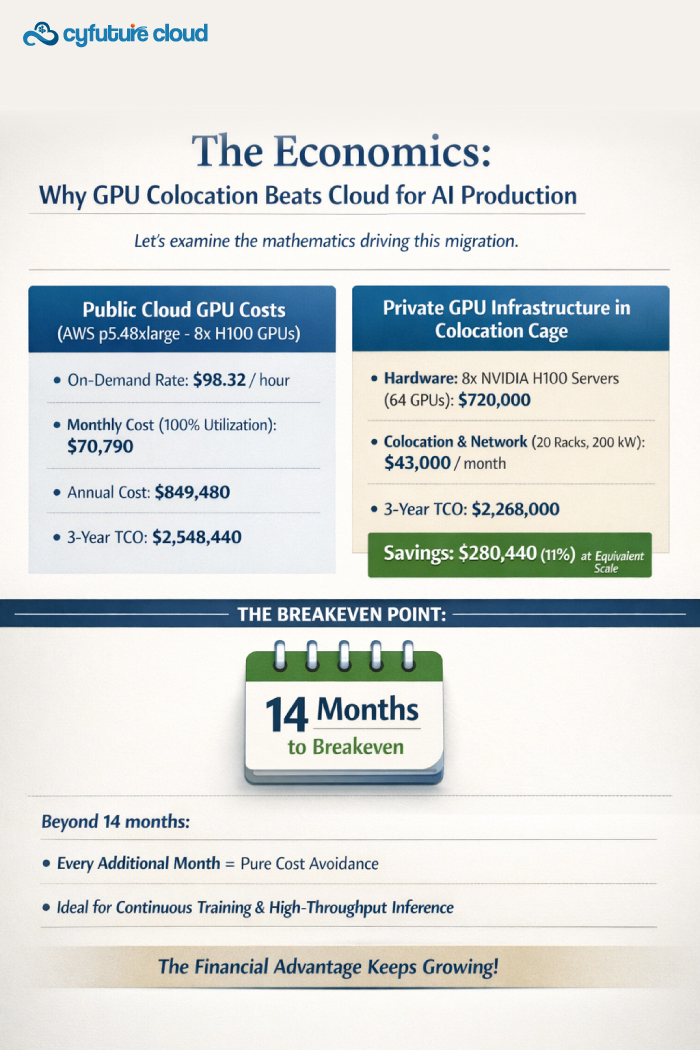
AI training datasets increasingly exceed 100TB. Cloud storage costs become prohibitive:
- AWS S3 storage: $0.023/GB/month = $23,000/month for 100TB
- Data egress: $0.09/GB = $9,000 per full dataset transfer
A colocation cage enables:
- Direct-attached NVMe storage arrays delivering 20-40 GB/s read throughput
- Zero egress fees for data movement between storage and compute
- Persistent fast storage (no cold start penalties)
3. GPU Utilization Optimization
Public cloud GPU instances bill hourly regardless of utilization. If your training job uses 60% average GPU utilization due to data loading bottlenecks, you’re paying for 40% idle capacity.
In a private colocation cage with owned GPU cloud servers:
- Optimize workload scheduling across your entire GPU fleet
- Run lower-priority inference workloads on temporarily idle training GPUs
- Achieve 85-95% sustained utilization through multi-tenancy
Real-World Success: AI Infrastructure Migration Case Study
Computer Vision Startup – Autonomous Driving
Challenge: Training perception models on 500TB video dataset with 12-hour iteration cycles costing $180,000/month on AWS p4d instances.
Solution: Deployed 48 NVIDIA A100 GPU cloud servers in Cyfuture Cloud colocation cage (Sydney facility).
Results after 18 months:
- Cost reduction: 68% ($115,000 monthly savings)
- Training acceleration: 40% faster due to optimized storage architecture
- Iteration velocity: Daily model updates vs. 3x weekly previously
- ROI: 11-month payback period
Future-Proofing: The AI Infrastructure Roadmap
The trajectory is clear:
NVIDIA’s 2024-2026 GPU roadmap (H200, B100, X100 architectures) continues increasing compute density and power requirements. By 2026, flagship AI accelerators will consume 1,000-1,500W per GPU (up from 700W for H100).
Colocation cages provide the infrastructure flexibility to evolve:
- Upgrade cooling systems as power density increases
- Swap GPU generations without changing facility contracts
- Scale storage and network independently from compute
- Adapt to emerging technologies (optical interconnects, quantum accelerators)
Public cloud GPU pricing historically remains static or increases as new generations launch—owning infrastructure in colocation cages protects against vendor pricing changes.
Architect Your Competitive AI Infrastructure Advantage
The economics and technical benefits are undeniable:
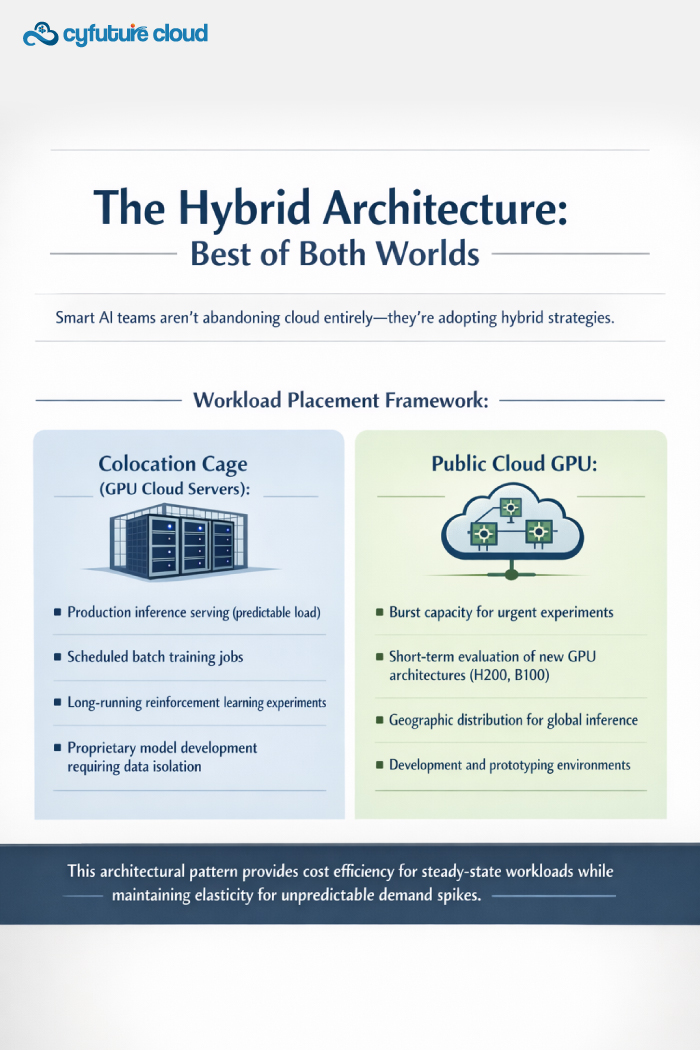
For AI teams with sustained GPU requirements, colocation cages housing privately-owned GPU cloud servers deliver superior cost efficiency, performance control, and strategic flexibility compared to renting cloud GPUs indefinitely.
Your decision framework:
If your AI workloads require GPUs for 12+ months at 50%+ average utilization, the financial case for colocation cages becomes compelling. If you need specialized network topologies, data sovereignty, or maximum performance for competitive advantage, the technical case is equally strong.
Start by calculating your current cloud GPU spend and utilization patterns. Model the capital expenditure for equivalent owned infrastructure in a colocation cage. Factor in your team’s operational capabilities—managing physical infrastructure requires skills distinct from cloud operations.
Cyfuture Cloud eliminates the operational complexity through managed colocation cage services that deliver the economics and performance of private GPU infrastructure without requiring you to become a data center expert.
Transform your AI infrastructure from a mounting cost center into a strategic competitive advantage—architect for performance, optimize for economics, and scale without compromise in purpose-built colocation cages designed specifically for the extreme demands of modern GPU workloads.




Stay Ahead of the Curve.
Join the Cloud Movement, today!
Send this to a friend