Get 69% Off on Cloud Hosting : Claim Your Offer Now!





- Products
- Solutions
-
Solutions
-
 Cloud
Hosting
Cloud
Hosting
-
VPS
Hosting
-
 GPU
Cloud
GPU
Cloud
-
 Dedicated
Server
Dedicated
Server
-
 Server
Colocation
Server
Colocation
-
 Backup as a Service
-
 CDN
Network
CDN
Network
-
 Window
Cloud Hosting
Window
Cloud Hosting
-
 Linux
Cloud Hosting
Linux
Cloud Hosting
-
Managed
Cloud Service
-
 Storage
as a Service
Storage
as a Service
-
VMware
Public Cloud
-
Multi-Cloud
Hosting
-
Cloud
Server Hosting
-
Bare
Metal Server
-
Virtual
Machine
-
 Magento
Hosting
Magento
Hosting
-
 Remote
Backup
Remote
Backup
-
 DevOps
-
 Kubernetes
-
 Cloud
Storage
Cloud
Storage
-
 NVMe
Hosting
NVMe
Hosting
-
 DR
as s Service
DR
as s Service
-
-
Solutions
- Marketplace
- Pricing
- Resources
- Company
 Remote
Backup
Remote
Backup NVMe
Hosting
NVMe
Hosting Pricing
Calculator
Pricing
Calculator Unlock Cost
Optimization
Unlock Cost
Optimization Overview
 Documentation
 Price
Calculator
Price
Calculator Tools
Tools FAQs
FAQs Terms
of Service
Terms
of Service Privacy
Policy
Privacy
Policy
 Migration
 Container
 Power
Power
 Utilities
 VMware
Private Cloud
VMware
Private Cloud VMware
on AWS
VMware
on AWS VMware
on Azure
VMware
on Azure Certifications
 Partners
 Careers
 Support
 Service
Level Agreement
Service
Level Agreement  Contact
Table of Contents
- What is Cloud Colocation?
- The 10 Technical Benefits Transforming Indian Enterprises
- 1. Data Sovereignty and Regulatory Compliance
- 2. Hybrid and Multi-Cloud Architecture Enablement
- 3. Superior Network Performance and Connectivity
- 4. Predictable and Optimized Cost Structure
- 5. Enhanced Security and Physical Protection
- 6. Scalability Without Disruption
- 7. High Availability and Disaster Recovery
- 8. Reduced Latency for End-User Performance
- 9. Environmental Sustainability and Green Infrastructure
- 10. Expert Support and Managed Services
- Strategic Implementation Considerations
- Transform Your Infrastructure with Strategic Cloud Colocation
Cloud colocation represents the convergence of traditional colocation services with cloud-native capabilities, enabling enterprises to deploy physical infrastructure within carrier-neutral data centers while maintaining seamless connectivity to public cloud platforms. For Indian enterprises, this hybrid approach has become increasingly critical, with the market reaching USD 1.9 billion in 2024 and projected to grow at 15.8% CAGR through 2026, driven by data localization mandates, digital India initiatives, and explosive growth in digital services.
The strategic question isn’t whether to adopt cloud colocation—it’s how to leverage it optimally.
Here’s why this matters now more than ever: Indian organizations face unique challenges including data sovereignty requirements, latency-sensitive applications serving diverse geographies, and the need to balance capital efficiency with infrastructure control.

What is Cloud Colocation?
Cloud colocation combines the physical infrastructure control of traditional colocation with the agility and connectivity of cloud computing. Organizations deploy their servers, storage, and networking equipment within third-party data center facilities—ranging from single rack units to dedicated colocation cages—while accessing carrier-neutral networks, redundant power, enterprise-grade security, and direct cloud on-ramps.
Think of it this way:
You own and manage your hardware (just like on-premises), but leverage world-class facilities, connectivity, and services (just like cloud) without the capital expenditure of building your own data center.
According to a 2024 NASSCOM report, 68% of Indian enterprises now utilize some form of cloud colocation as part of their hybrid infrastructure strategy, up from 41% in 2022.
The 10 Technical Benefits Transforming Indian Enterprises
1. Data Sovereignty and Regulatory Compliance
India’s evolving data protection landscape—including the Digital Personal Data Protection Act 2023 and RBI’s data localization norms—mandates local storage of critical data categories.
Cloud colocation facilities in Mumbai, Bangalore, Chennai, and Delhi NCR ensure compliance while maintaining:
- Full data residency within Indian borders
- Audit trails for regulatory reporting
- Sector-specific certifications (ISO 27001, PCI-DSS, HIPAA equivalents)
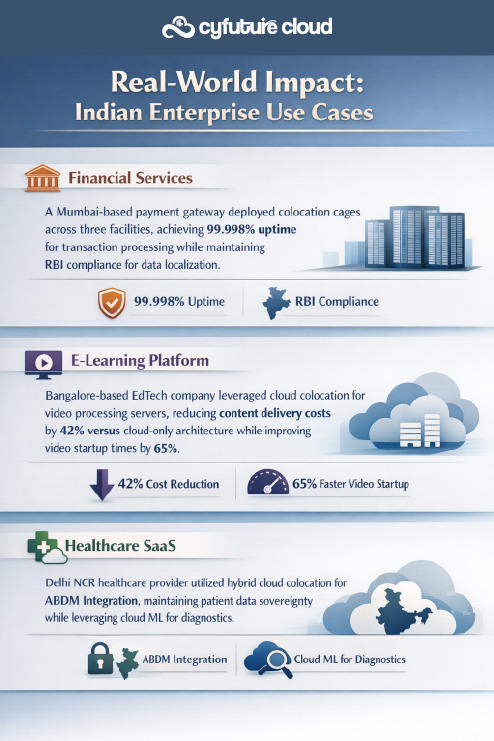
Cyfuture Cloud’s Indian facilities maintain comprehensive compliance frameworks, enabling financial services, healthcare, and government clients to meet stringent regulatory requirements without infrastructure compromises.
2. Hybrid and Multi-Cloud Architecture Enablement
Modern enterprises rarely operate in single-cloud environments. Cloud colocation serves as the ideal integration point:
- Direct cloud connectivity: Private connections to AWS (Direct Connect), Azure (ExpressRoute), Google Cloud (Dedicated Interconnect)
- Latency optimization: Sub-5ms connectivity to cloud regions versus 15-40ms over public internet
- Cost efficiency: Avoid egress charges by processing data in colocation cages before cloud transfer
A 2024 Gartner study found that enterprises using colocation for hybrid architectures reduce cloud costs by 30-35% compared to cloud-only deployments.
3. Superior Network Performance and Connectivity
Indian cloud colocation facilities offer carrier-neutral ecosystems with:
- Multiple tier-1 ISPs: Bharti Airtel, Tata Communications, Reliance Jio, BSNL
- International connectivity: Direct submarine cable access (SEA-ME-WE, Bay of Bengal Gateway)
- Internet Exchange Points: NIXI peering for domestic traffic optimization
- BGP routing control: Multi-homing with autonomous system numbers (ASN)
This diversity eliminates single points of failure and enables intelligent traffic routing based on cost, latency, and performance metrics.
4. Predictable and Optimized Cost Structure
Infrastructure economics favor cloud colocation for stable, predictable workloads:
Traditional Data Center vs. Cloud Colocation (36-month TCO):
- CapEx avoidance: USD 2-5 million for small enterprise facility
- Power costs: Fixed pricing versus variable utility rates
- Staffing: Eliminate 24/7 facility management teams (8-12 FTEs)
- Maintenance: Shared infrastructure costs across tenants
For compute-intensive or steady-state workloads, colocation cage deployments deliver 40-50% cost savings versus equivalent public cloud capacity over three-year periods.
5. Enhanced Security and Physical Protection
Enterprise cloud colocation facilities implement multi-layered security:
Physical Controls:
- Biometric access with multi-factor authentication
- 24/7 security personnel and CCTV surveillance
- Individual colocation cage access restrictions
- Mantrap entries and visitor escort protocols
Digital Protections:
- DDoS mitigation at network edge (up to 2 Tbps capacity)
- Intrusion detection/prevention systems (IDS/IPS)
- Security Operations Center (SOC) monitoring
- Compliance certifications (ISO 27001, SOC 2 Type II)
Cyfuture Cloud’s facilities maintain bank-grade security protocols with zero security breaches across operational history.
6. Scalability Without Disruption
Growth trajectories vary, but infrastructure must accommodate expansion:
Cloud colocation enables granular scaling:
- Start with quarter-rack (10U) for testing
- Expand to full racks (42U) as workloads grow
- Deploy dedicated colocation cages for 10+ rack requirements
- Add power incrementally (from 5A to 32A+ per rack)
This flexibility eliminates the binary choice between over-provisioning (wasted capital) and under-provisioning (constraining growth). Organizations scale precisely with demand.
7. High Availability and Disaster Recovery
Uptime isn’t negotiable for mission-critical applications.
Premium cloud colocation providers deliver:
- 99.995% uptime SLAs (26 minutes maximum downtime annually)
- N+1 or 2N power redundancy: Parallel UPS and generator systems
- Cooling redundancy: Multiple CRAC units with failover
- Geographic diversity: Multi-city deployments for DR (Mumbai-Bangalore corridors offer sub-15ms latency)
Indian enterprises leveraging colocation cage deployments across multiple availability zones achieve recovery time objectives (RTO) under 60 minutes and recovery point objectives (RPO) under 5 minutes.
8. Reduced Latency for End-User Performance
Application performance correlates directly with user satisfaction and revenue.
Cloud colocation in India’s tier-1 cities provides:
- Metro connectivity: Sub-2ms latency to 70%+ of Indian internet users
- Regional optimization: Strategic facility placement in Mumbai (West), Bangalore (South), Delhi NCR (North), Chennai (Southeast)
- Content delivery integration: Direct CDN peering and caching
For latency-sensitive applications—gaming, fintech transactions, video streaming, IoT—these milliseconds translate to competitive advantage. A 100ms latency reduction can improve conversion rates by 7-12% for e-commerce platforms.
9. Environmental Sustainability and Green Infrastructure
Corporate sustainability commitments increasingly influence infrastructure decisions.
Modern cloud colocation facilities feature:
- Renewable energy: 50-100% solar/wind power sourcing
- Power Usage Effectiveness (PUE): 1.25-1.4 (versus 1.8-2.0 for legacy facilities)
- Advanced cooling: Free cooling, evaporative systems, hot/cold aisle containment
- E-waste management: Certified disposal and recycling programs
Cyfuture Cloud’s commitment to carbon neutrality by 2026 aligns with enterprise ESG goals without compromising performance.
10. Expert Support and Managed Services
Technical expertise often constrains infrastructure initiatives.
Cloud colocation providers offer:
- 24/7/365 NOC support: Network monitoring and incident response
- Remote hands services: Hardware installation, cable management, equipment reboots
- Proactive monitoring: Environmental sensors, power consumption tracking
- Technical escalation: Access to infrastructure engineers for complex issues
This augments internal teams without requiring specialized facility management expertise. Organizations focus on application development while providers handle infrastructure operations.
Strategic Implementation Considerations
When deploying cloud colocation, evaluate:
- Location strategy: Proximity to users, cloud regions, and network hubs
- Power requirements: Current draw and future expansion needs (8-20kW per rack typical)
- Connectivity architecture: Cross-connect requirements, bandwidth commitments
- Cage vs. rack decision: Dedicated colocation cages for 10+ racks provide isolation and security
- Contract flexibility: Terms enabling scaling and technology refresh cycles

Transform Your Infrastructure with Strategic Cloud Colocation
The benefits of cloud colocation extend far beyond simple cost reduction—they represent a fundamental infrastructure evolution enabling agility, compliance, performance, and scale simultaneously.
For Indian enterprises navigating digital transformation, regulatory compliance, and competitive pressure, cloud colocation delivers the optimal balance between control and efficiency.
Your strategic advantage:
Deploy mission-critical workloads in secure colocation cages while maintaining seamless cloud integration, comprehensive compliance, and predictable economics.
Cyfuture Cloud’s Indian facilities combine carrier-neutral connectivity, enterprise-grade security, sustainability leadership, and technical expertise—empowering your infrastructure to scale precisely with business demands.
The question isn’t whether cloud colocation fits your strategy—it’s how quickly you can leverage these ten compelling benefits to accelerate your digital objectives.
Start your cloud colocation journey today with India’s most trusted infrastructure partner.










Stay Ahead of the Curve.
Join the Cloud Movement, today!
Send this to a friend