Get 69% Off on Cloud Hosting : Claim Your Offer Now!





- Products
- Solutions
-
Solutions
-
 Cloud
Hosting
Cloud
Hosting
-
VPS
Hosting
-
 GPU
Cloud
GPU
Cloud
-
 Dedicated
Server
Dedicated
Server
-
 Server
Colocation
Server
Colocation
-
 Backup as a Service
-
 CDN
Network
CDN
Network
-
 Window
Cloud Hosting
Window
Cloud Hosting
-
 Linux
Cloud Hosting
Linux
Cloud Hosting
-
Managed
Cloud Service
-
 Storage
as a Service
Storage
as a Service
-
VMware
Public Cloud
-
Multi-Cloud
Hosting
-
Cloud
Server Hosting
-
Bare
Metal Server
-
Virtual
Machine
-
 Magento
Hosting
Magento
Hosting
-
 Remote
Backup
Remote
Backup
-
 DevOps
-
 Kubernetes
-
 Cloud
Storage
Cloud
Storage
-
 NVMe
Hosting
NVMe
Hosting
-
 DR
as s Service
DR
as s Service
-
-
Solutions
- Marketplace
- Pricing
- Resources
- Company
 Remote
Backup
Remote
Backup NVMe
Hosting
NVMe
Hosting Pricing
Calculator
Pricing
Calculator Unlock Cost
Optimization
Unlock Cost
Optimization Overview
 Documentation
 Price
Calculator
Price
Calculator Tools
Tools FAQs
FAQs Terms
of Service
Terms
of Service Privacy
Policy
Privacy
Policy
 Migration
 Container
 Power
Power
 Utilities
 VMware
Private Cloud
VMware
Private Cloud VMware
on AWS
VMware
on AWS VMware
on Azure
VMware
on Azure Certifications
 Partners
 Careers
 Support
 Service
Level Agreement
Service
Level Agreement  Contact
Table of Contents
- What Is GPU as a Service (GPUaaS)?
- Why GPUs Are Critical for Modern Workloads
- Key Benefits of GPU as a Service
- Common Use Cases of GPUaaS
- How GPU as a Service Works
- GPUaaS Providers and Market Landscape
- Security, Compliance, and Reliability
- GPUaaS Market Trends and Future Outlook
- Frequently Asked Questions (FAQs)
- Final Thoughts
The rapid growth of artificial intelligence, machine learning, and data-driven applications has fundamentally changed how organizations consume computing power. Traditional CPU-based infrastructure is no longer sufficient for modern workloads such as deep learning, large language models, scientific simulations, and advanced rendering. This is where GPU as a Service (GPUaaS) has emerged as a transformative solution.
GPUaaS provides on-demand, cloud-based access to powerful Graphics Processing Units, allowing businesses to rent GPU resources instead of investing in expensive on-premise hardware. By shifting capital expenditure (CapEx) to operational expenditure (OpEx), GPUaaS enables scalability, flexibility, and cost efficiency—making high-performance computing accessible to startups, enterprises, and research institutions alike.
What Is GPU as a Service (GPUaaS)?
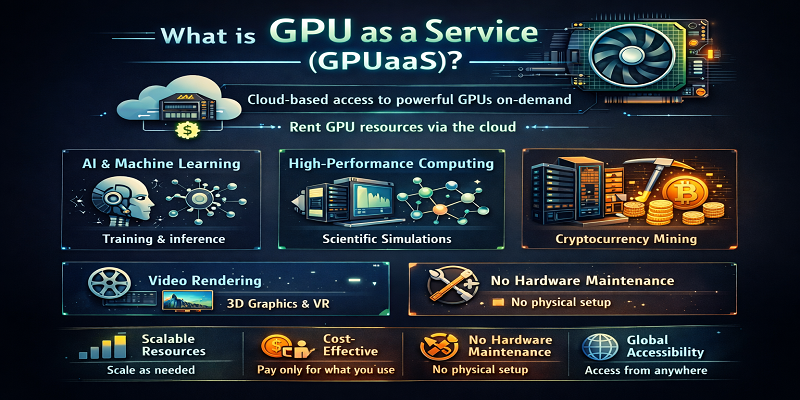
GPU as a Service is a cloud computing model that provides on-demand access to Graphics Processing Units through virtualized environments. Users can deploy GPU-powered workloads without owning or maintaining physical hardware. The cloud provider manages everything—from infrastructure and networking to maintenance, upgrades, and security.
GPUaaS typically offers access to high-end accelerators such as NVIDIA H100 GPU, A100 GPU, and equivalent GPUs from AMD. These GPUs are delivered through virtual machines, containers, or bare-metal GPU instances depending on performance and isolation requirements.
By converting capital expenditure (CapEx) into operational expenditure (OpEx), GPUaaS makes advanced computing financially viable and operationally efficient.
Why GPUs Are Critical for Modern Workloads
Unlike CPUs, which are optimized for sequential processing, GPUs excel at parallel processing. This makes them ideal for workloads that require massive mathematical computations across large datasets.
GPUs are essential for:
-
Training and running AI and ML models
-
Deep learning and neural networks
-
Scientific simulations and research
-
Big data analytics
-
Video rendering and visual effects
As AI models grow larger and more complex, GPU demand continues to rise—making GPUaaS a necessity rather than an option.
Key Benefits of GPU as a Service
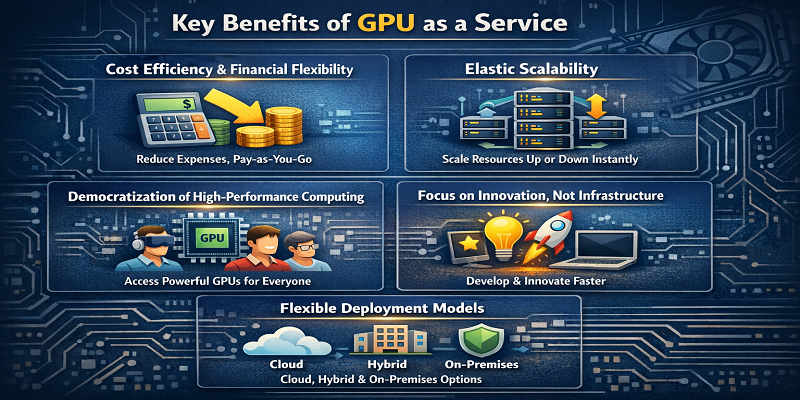
Cost Efficiency and Financial Flexibility
Purchasing GPUs requires significant upfront investment, along with ongoing costs for power, cooling, and maintenance. GPUaaS removes these barriers by offering pay-as-you-go pricing, allowing organizations to pay only for the resources they actually use.
This OpEx model improves cash flow, especially for startups and research teams with fluctuating compute needs.
Elastic Scalability
One of the biggest advantages of GPUaaS is scalability. Users can instantly scale GPU resources up or down based on workload demand. This elasticity is crucial for AI training, where workloads can spike dramatically during experimentation or model retraining.
Democratization of High-Performance Computing
GPUaaS levels the playing field. Startups, academic institutions, and mid-sized enterprises can access the same high-end GPUs used by large corporations, enabling innovation regardless of organizational size.
Focus on Innovation, Not Infrastructure
Cloud providers handle hardware procurement, setup, updates, and monitoring. Development and research teams can focus entirely on building models, running simulations, and delivering results.
Flexible Deployment Models
GPUaaS supports on-demand, reserved, and dedicated GPU options. It also integrates seamlessly with hybrid and multi-cloud environments, allowing businesses to modernize infrastructure at their own pace.
Common Use Cases of GPUaaS
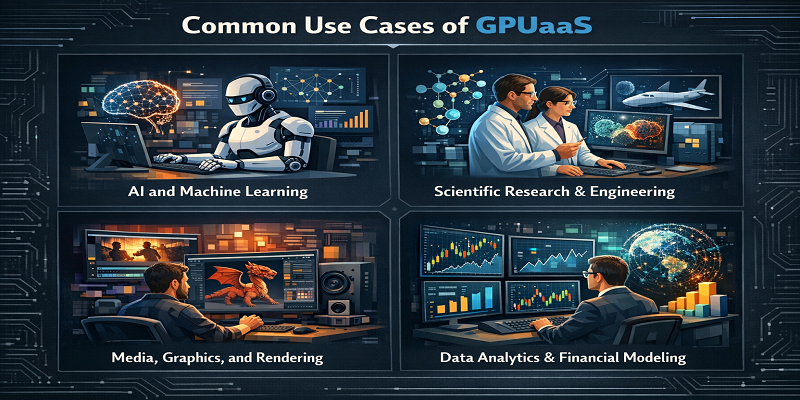
AI and Machine Learning
GPUaaS is the backbone of AI development. It accelerates training for deep learning models, supports real-time inference, and enables experimentation with large language models and generative AI.
Scientific Research and Engineering
Researchers rely on GPUaaS for simulations in physics, chemistry, genomics, climate modeling, and aerospace engineering. GPUs drastically reduce computation time for complex models.
Media, Graphics, and Rendering
High-resolution rendering, animation, gaming, and video processing require GPU acceleration. GPUaaS allows creative teams to render faster without investing in local GPU farms.
Data Analytics and Financial Modeling
GPU-accelerated analytics enables faster insights, especially in industries such as finance, healthcare, and eCommerce, where real-time data processing is critical.
How GPU as a Service Works
-
Users select GPU-enabled instances through a cloud provider
-
Virtualized GPUs (such as NVIDIA H100 GPU or A100) are provisioned
-
The provider manages infrastructure, security, and maintenance
-
Users deploy workloads via VMs, containers, or Kubernetes
-
GPUaaS integrates with existing systems using hybrid or multi-cloud models
This architecture ensures high availability, performance consistency, and operational simplicity.
GPUaaS Providers and Market Landscape
The GPUaaS market includes global hyperscalers, niche GPU cloud server providers, and regional cloud infrastructure companies. These providers offer access to advanced GPUs, high-speed networking, and optimized storage.
Alongside global providers, Cyfuture Cloud plays a key role by delivering scalable and secure GPU as a Service tailored for AI, ML, and enterprise workloads. With strong data center infrastructure and flexible deployment options, Cyfuture Cloud supports businesses seeking reliable GPU performance without infrastructure complexity.
Security, Compliance, and Reliability
Security is a top concern for GPUaaS users. Modern platforms implement:
-
Data encryption at rest and in transit
-
Network isolation and access controls
-
Compliance with ISO, SOC, and enterprise security standards
-
High availability through redundancy and failover mechanisms
These features make GPUaaS suitable for regulated industries and mission-critical workloads.
GPUaaS Market Trends and Future Outlook
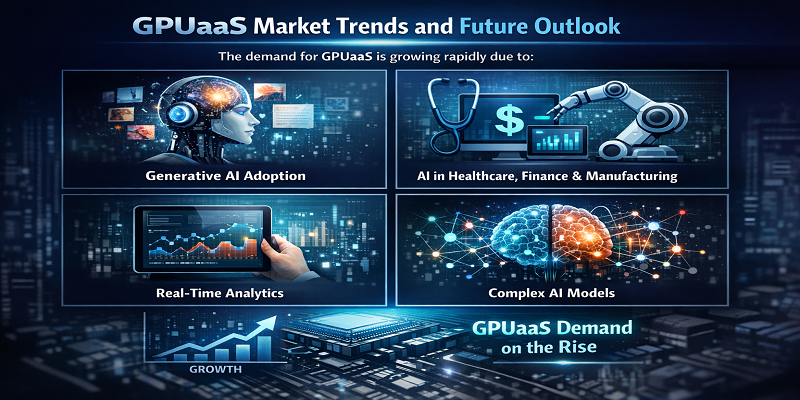
The demand for GPUaaS is growing rapidly due to:
-
Generative AI adoption
-
Expansion of AI in healthcare, finance, and manufacturing
-
Increased use of real-time analytics
-
Rising complexity of AI models
Rather than replacing cloud computing, AI is accelerating its evolution. GPUaaS is becoming a core pillar of modern cloud strategies.
Frequently Asked Questions (FAQs)
What is GPU as a service?
GPUaaS provides on-demand GPU computing through the cloud without owning hardware.
What are the benefits of GPU as a service?
Cost savings, scalability, accessibility, and faster innovation.
What is the demand for GPU as a service?
Demand is rapidly increasing due to AI, ML, and data-intensive workloads.
What companies offer GPUaaS?
Major cloud hosting providers, specialized GPU cloud platforms, and providers like Cyfuture Cloud.
What is GPU PaaS?
GPU Platform as a Service integrates GPU acceleration into application development platforms.
What are the disadvantages of GPUs?
High cost and power usage when deployed on-premise.
Who is NVIDIA’s biggest competitor?
AMD is NVIDIA’s primary competitor.
What is the market forecast for GPUaaS?
The GPUaaS market is expected to grow significantly over the next decade.
Will AI replace cloud computing?
No. AI depends on cloud computing, especially GPU-accelerated infrastructure.
Is there any Indian GPU company?
India has emerging GPU infrastructure and cloud providers, including Cyfuture Cloud.
What is the difference between GPUaaS and AIaaS?
GPUaaS provides compute infrastructure, while AIaaS provides ready-made AI tools.
Who is the king of cloud computing?
Global hyperscalers dominate, but regional providers play a crucial role.
Final Thoughts
GPU as a Service has fundamentally reshaped access to high-performance computing. By removing financial and operational barriers, GPUaaS enables organizations to innovate faster, scale smarter, and compete in an AI-driven world.
As AI adoption continues to accelerate, GPUaaS will remain a critical enabler of digital transformation. When combined with a reliable GPU Cloud Server, businesses gain the performance, flexibility, and resilience required to support next-generation AI, analytics, and high-performance workloads with confidence.













Stay Ahead of the Curve.
Join the Cloud Movement, today!
Send this to a friend