Get 69% Off on Cloud Hosting : Claim Your Offer Now!





- Products
- Solutions
-
Solutions
-
 Cloud
Hosting
Cloud
Hosting
-
VPS
Hosting
-
 GPU
Cloud
GPU
Cloud
-
 Dedicated
Server
Dedicated
Server
-
 Server
Colocation
Server
Colocation
-
 Backup as a Service
-
 CDN
Network
CDN
Network
-
 Window
Cloud Hosting
Window
Cloud Hosting
-
 Linux
Cloud Hosting
Linux
Cloud Hosting
-
Managed
Cloud Service
-
 Storage
as a Service
Storage
as a Service
-
VMware
Public Cloud
-
Multi-Cloud
Hosting
-
Cloud
Server Hosting
-
Bare
Metal Server
-
Virtual
Machine
-
 Magento
Hosting
Magento
Hosting
-
 Remote
Backup
Remote
Backup
-
 DevOps
-
 Kubernetes
-
 Cloud
Storage
Cloud
Storage
-
 NVMe
Hosting
NVMe
Hosting
-
 DR
as s Service
DR
as s Service
-
-
Solutions
- Marketplace
- Pricing
- Resources
- Company
 Remote
Backup
Remote
Backup NVMe
Hosting
NVMe
Hosting Pricing
Calculator
Pricing
Calculator Unlock Cost
Optimization
Unlock Cost
Optimization Overview
 Documentation
 Price
Calculator
Price
Calculator Tools
Tools FAQs
FAQs Terms
of Service
Terms
of Service Privacy
Policy
Privacy
Policy
 Migration
 Container
 Power
Power
 Utilities
 VMware
Private Cloud
VMware
Private Cloud VMware
on AWS
VMware
on AWS VMware
on Azure
VMware
on Azure Certifications
 Partners
 Careers
 Support
 Service
Level Agreement
Service
Level Agreement  Contact
Table of Contents
- Struggling with Skyrocketing Data Center Operational Costs?
- What is a Virtual Data Center?
- The Staggering Cost of Traditional Infrastructure
- 10 Proven Ways Virtual Data Centers Slash Operational Costs
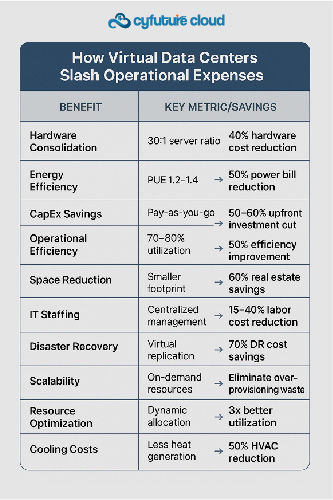
- 1. Hardware Consolidation: The 10:1 Efficiency Multiplier
- 2. Energy Efficiency: Cutting Power Bills by 50%+
- 3. Reduced Capital Expenditure: Save 50-60% on Hardware Investments
- 4. Operational Efficiency Through Automation
- 5. Reduced Physical Space Requirements
- 6. Minimized IT Staffing and Management Costs
- 7. Enhanced Disaster Recovery Without Breaking the Bank
- 8. Scalability Without Capital Investment
- 9. Improved Resource Utilization Rates
- 10. Reduced Cooling and HVAC Costs
- Cyfuture Cloud: India’s Virtual Data Center Leader
- The Real-World ROI: Case Studies That Matter
- Calculating Your Virtual Data Center Savings
- Critical Implementation Considerations
- Common Misconceptions Debunked
- Transform Your Infrastructure Economics with Virtual Data Centers
- FAQs: Virtual Data Center Cost Optimization
- How quickly can we realize cost savings from Virtual Data Center migration?
- What’s the difference between Virtual Data Centers and traditional cloud computing?
- Can we maintain the same performance levels with fewer physical resources?
- What about data security and compliance in Virtual Data Centers?
- How does Virtual Data Center pricing work compared to maintaining physical infrastructure?
- What happens to our existing hardware investments during migration?
- How do Virtual Data Centers handle disaster recovery and business continuity?
- What’s the environmental impact of Virtual Data Center adoption?
- How do we handle legacy applications that may not virtualize well?
Struggling with Skyrocketing Data Center Operational Costs?
Virtual Data Center technology represents a transformative shift in IT infrastructure management, utilizing virtualization to abstract physical hardware components into cloud-based resources. This approach enables organizations to consolidate multiple workloads onto fewer physical servers, dramatically reducing hardware requirements, energy consumption, and operational expenses while maintaining—or even improving—performance and scalability.
Here’s the reality:
Traditional physical data centers are bleeding budgets dry. With average costs to support 1 watt of IT capacity ranging from $9 to $10.50 in North America, and operational expenses consuming up to 70% of IT budgets, enterprises are searching for viable alternatives.
Enter the Virtual Data Center.
What is a Virtual Data Center?
A Virtual Data Center (VDC) represents a modern approach to IT infrastructure where traditional on-premises data center components are abstracted into a cloud-based environment. Instead of maintaining rows of physical servers, storage arrays, and networking equipment, organizations leverage virtualization technology to create software-defined cloud infrastructure that delivers the same capabilities with unprecedented flexibility and efficiency.
The Virtual Data Center market is experiencing explosive growth. The global market for Data Center Virtualization was estimated at US$7.3 Billion in 2023 and is projected to reach US$21.1 Billion by 2030, growing at a CAGR of 16.3%. This isn’t just hype—it’s a fundamental transformation of how modern enterprises manage their IT infrastructure.
The Staggering Cost of Traditional Infrastructure
Before we dive into cost reduction strategies, let’s understand the problem:
Energy Consumption Crisis: Data centers accounted for around 1-1.3% of global energy demand in 2022, with annual global data center energy consumption rising between 20-40% for some years.
Infrastructure Inefficiency: Traditional data centers typically operate at only 20-30% server utilization, meaning massive resources sit idle while companies continue paying for power, cooling, and maintenance.
Rising Operational Burden: Companies invest 65 to 70 percent of IT budgets on maintenance and support, leaving just 30 to 35 percent for new investments.
As one Reddit user aptly stated: “We were literally paying to cool empty server racks. The waste was astronomical until we virtualized.”
10 Proven Ways Virtual Data Centers Slash Operational Costs
1. Hardware Consolidation: The 10:1 Efficiency Multiplier
The most immediate cost benefit comes from server consolidation.
IT companies observed a 40% reduction in hardware and maintenance costs after virtualizing. But the numbers get even better.
Virtualization helps companies save costs, reducing expenses by up to 31% simply by consolidating multi server workloads onto fewer hosts.
Real-World Impact:
- A company reduced the number of servers from 200 to 50, achieved a 60% reduction in energy consumption and reduced maintenance costs by 40%
- VMware virtualization can consolidate servers by ratios up to 30:1
What This Means: Instead of maintaining 30 physical servers, you run the same workloads on a single virtualized host. That’s 29 fewer boxes to purchase, power, cool, and maintain.
2. Energy Efficiency: Cutting Power Bills by 50%+
Virtual Data Centers fundamentally transform energy economics.
Liquid cooling systems can reduce energy consumption by up to 30% compared to air cooling, and virtualization compounds these savings further.
Power Usage Effectiveness (PUE) Improvements:
- Data center owners and operators reported an average annual power usage effectiveness (PUE) ratio of 1.56 in 2024
- Power usage effectiveness (PUE) can decrease from 2.0-3.0 for conventional data centers to 1.2-1.4 in VDCs
- Leading providers like Google achieved an average annual power usage effectiveness of 1.09 for their global fleet of data centers in 2024
Translation: For every dollar you spend on cloud computing, you’re spending only 9-40 cents on overhead (cooling, power distribution, lighting) instead of $1.00-$2.00 in traditional setups.
3. Reduced Capital Expenditure: Save 50-60% on Hardware Investments
VMware business infrastructure virtualization solutions reduce capital expenses (CapEx) by up to 60 percent.
Capital purchases of new server hardware can be reduced by as much as 50 percent through virtualization.
Pay-As-You-Go Model: Virtual data centers operate on a pay-as-you-go model, allowing organizations to rent virtual infrastructure from cloud service providers, avoiding the expense of purchasing physical hardware.
Instead of massive upfront capital investments in hardware that depreciates rapidly, Virtual Data Centers shift to operational expenditure models where you pay only for resources consumed.
4. Operational Efficiency Through Automation
Here’s where Virtual Data Centers truly shine:
Companies observe a 50% improvement in operational efficiency after adopting virtualization.
Resource utilization increases from 20-30% in traditional setups to about 70-80% in a VDC.
Automation Benefits:
- Automated provisioning reduces deployment time from weeks to minutes
- Self-healing infrastructure minimizes downtime
- Policy-based resource allocation optimizes utilization
- Automated backup and disaster recovery
Provisioning time in a VDC takes minutes as opposed to weeks in traditional centers.
5. Reduced Physical Space Requirements
When you consolidate 30 servers into one, you don’t just save on hardware—you reclaim valuable real estate.
Space Savings Cascade:
- Smaller data center footprint
- Reduced cooling infrastructure
- Less racking and power distribution
- Lower facility rental costs
Sizing the data center design correctly can save nearly 60% in total cost.
For enterprises in expensive metropolitan areas, reclaiming thousands of square feet of data center space translates to substantial cost savings or revenue-generating opportunities.
6. Minimized IT Staffing and Management Costs
VMware virtualization and management solutions significantly reduce ongoing operational costs, providing organizations with additional time and fiscal resources through deferred hiring and managing more IT infrastructure with the same staff.
Staffing Impact:
- Customers using Microsoft system management products to manage their hosts had 15.6% lower annual IT labor costs ($9,486) per virtual machine than customers using VMware vCenter ($11,238)
- Centralized management reduces complexity
- Fewer physical systems to maintain
- Automated routine tasks free staff for strategic projects
As a Quora contributor noted: “Virtualization didn’t just cut our hardware costs—it gave our team back 40% of their time for innovation instead of maintenance.”
7. Enhanced Disaster Recovery Without Breaking the Bank
Traditional disaster recovery solutions require duplicating entire infrastructures across multiple sites—an expensive proposition.
Virtual Data Centers revolutionize DR:
- Rapid Recovery: Virtual machines can be replicated and restored in minutes
- Lower Costs: No need to maintain duplicate physical infrastructure
- Geographic Flexibility: Store replicas anywhere without physical limitations
- Testing Without Disruption: Test DR plans without impacting production
An average of 15 percent of hardware and software assets would not survive a physical move unscathed, requiring time troubleshooting problems. Virtualization eliminates this risk entirely.
8. Scalability Without Capital Investment
Traditional scaling means:
- Purchasing new hardware (weeks of lead time)
- Physical installation (days of work)
- Configuration and testing (more days)
- Paying for capacity before you need it
Virtual Data Center scaling means:
- Provision new resources in minutes
- Scale up or down based on actual demand
- Pay only for what you use
- No physical constraints
66% of companies have reported increased agility due to virtualization adoption.
9. Improved Resource Utilization Rates
Companies use only 25% of the available processing power of virtualized servers—but that’s still dramatically better than traditional environments where utilization often drops below 15%.
Dynamic Resource Allocation:
- CPU, memory, and cloud storage allocated on-demand
- Workloads automatically balanced across infrastructure
- Peak capacity shared across multiple applications
- No stranded capacity from over-provisioning
Virtualization can increase utilization to 70 to 80 percent compared to traditional 10-20% utilization rates.
10. Reduced Cooling and HVAC Costs
Fewer physical servers = less heat generation = lower cooling requirements.
Operational expenses are lowered by up to 50% by cutting down on hardware requirements and energy consumption.
Cooling Cost Breakdown:
- Traditional air cooling systems may struggle with high heat loads, leading to increased energy consumption and higher costs
- Virtual Data Centers reduce the number of heat-generating devices
- Modern facilities use advanced cooling technologies
- Lower ambient temperature requirements
- Reduced HVAC maintenance
Cyfuture Cloud: India’s Virtual Data Center Leader
Cyfuture Cloud exemplifies how Virtual Data Center technology delivers tangible business value. With four Tier III, MeiTY-empaneled data centers strategically located across India in Noida, Jaipur, Raipur, and Bengaluru, Cyfuture Cloud provides enterprise-grade infrastructure with guaranteed uptime exceeding 99.9%.
Cyfuture’s Competitive Advantages:
- Multi-Cloud Platform: Seamless integration with AWS, Google Cloud, Microsoft Azure, and Alibaba Cloud
- 200+ Certified Architects: Deep expertise across multiple cloud platforms
- VMware Cloud Verified: Enhanced performance, reliability, and industry-recognized assurance
- Pay-Per-Use Model: Eliminate waste by paying only for resources consumed
- 24/7 Support: Round-the-clock technical assistance
As India’s data center market surges toward USD 8 billion by 2026 with a 20% CAGR, Cyfuture Cloud stands at the forefront, supporting Digital India initiatives and enabling businesses to achieve operational cost reductions of up to 40% while maintaining world-class security and compliance standards.
The Real-World ROI: Case Studies That Matter
Financial Services Transformation
J.P. Morgan plans to transition nearly all of its applications from legacy systems to virtual data centers by the end of 2024, streamlining operations and reducing their hardware footprint significantly.
Manufacturing Efficiency
Carrier Global aimed to migrate 4,000 workloads to virtual data centers during its transition, successfully decommissioning numerous traditional servers and reducing operational costs.
Enterprise Savings
A company saved more than $20 million in hardware and the associated costs (power, cooling, insurance and personnel) to operate a new data center by leveraging virtualization.
Calculating Your Virtual Data Center Savings
Let’s break down the math for a mid-sized enterprise:
Traditional Infrastructure (200 Physical Servers):
- Hardware costs: $2,000,000 (initial) + $400,000/year (refresh cycle)
- Power consumption: $500,000/year
- Cooling: $300,000/year
- Space rental: $200,000/year
- IT staff (5 FTE): $500,000/year
- Maintenance: $150,000/year
- Total Annual Cost: $2,050,000
Virtual Data Center (20 Physical Hosts + Cloud):
- Infrastructure costs: $400,000 (initial) + $80,000/year
- Power consumption: $200,000/year (60% reduction)
- Cooling: $120,000/year (60% reduction)
- Space rental: $80,000/year (60% reduction)
- IT staff (3 FTE): $300,000/year (40% reduction)
- Cloud services: $300,000/year
- Total Annual Cost: $1,080,000
Annual Savings: $970,000 (47% reduction)
Critical Implementation Considerations
While Virtual Data Centers offer compelling cost benefits, successful implementation requires:
1. Workload Assessment
Not all applications virtualize equally. Legacy systems, high-performance computing, and certain specialized workloads may require hybrid approaches.
2. Security Architecture
Virtual environments can introduce new vulnerabilities, particularly if they are not properly isolated from one another. Implementing robust security measures and compliance frameworks is essential.
3. Performance Management
While virtualization can significantly increase efficiency, it can also lead to resource contention among VMs if not properly managed.
4. Skills and Training
The complexity of virtual environments can require significant expertise and sophisticated management tools.
Common Misconceptions Debunked
“Virtualization is Only for Large Enterprises”
Reality: Small and medium-sized enterprises with fewer than 100 computers are following up quickly with virtualization adoption.
“Cloud Means Loss of Control”
Reality: Modern Virtual Data Center solutions offer granular control, comprehensive monitoring, and configurable security policies that often exceed what’s possible with traditional infrastructure.
“Migration is Too Complex”
Reality: Provisioning time takes minutes as opposed to weeks, and modern migration tools enable phased transitions with minimal disruption.
Transform Your Infrastructure Economics with Virtual Data Centers
The evidence is overwhelming: Virtual Data Centers deliver operational cost reductions of 30-47% while improving agility, scalability, and resilience. With the global market projected to exceed $21 billion by 2030 and industry leaders consistently reporting 40%+ cost savings, the question isn’t whether to adopt Virtual Data Center technology—it’s how quickly you can implement it.
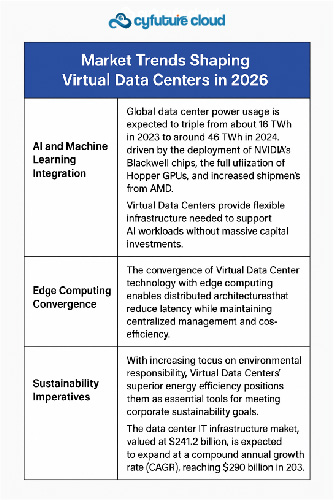
As enterprises navigate increasing data demands, AI workloads, and sustainability imperatives, Virtual Data Centers provide the infrastructure foundation needed to compete effectively while controlling costs.
Your infrastructure should be an accelerator, not an anchor.
FAQs: Virtual Data Center Cost Optimization
How quickly can we realize cost savings from Virtual Data Center migration?
Initial hardware consolidation savings appear immediately, typically within 30-60 days of migration. Full operational cost benefits materialize over 6-12 months as organizations optimize resource allocation and automate processes. Most enterprises report breaking even on migration investments within 12-18 months, with ongoing savings continuing indefinitely.
What’s the difference between Virtual Data Centers and traditional cloud computing?
Virtual Data Centers represent a comprehensive infrastructure approach that virtualizes all data center components (compute, storage, networking, security). Traditional cloud computing often focuses on specific services (IaaS, PaaS, SaaS). Virtual Data Centers can be deployed on-premises, in the cloud, or as hybrid cloud solutions, offering greater flexibility and control than standard cloud services.
Can we maintain the same performance levels with fewer physical resources?
Yes, and often performance improves. Resource utilization increases from 20-30% to about 70-80% in a VDC, meaning resources are used more efficiently. Advanced resource allocation, load balancer, and quality of service controls ensure critical workloads receive necessary resources while maximizing overall utilization.
What about data security and compliance in Virtual Data Centers?
Modern Virtual Data Centers often provide superior security compared to traditional infrastructure. Virtualization enables micro-segmentation, policy-based security controls, and automated compliance monitoring. Leading providers like Cyfuture Cloud maintain certifications including ISO 27001, PCI-DSS, and comply with data sovereignty regulations, ensuring enterprise-grade security.
How does Virtual Data Center pricing work compared to maintaining physical infrastructure?
Virtual Data Centers typically employ operational expenditure (OPEX) models with pay-as-you-go pricing, eliminating large capital expenditures (CAPEX). Organizations pay for actual resource consumption rather than peak capacity. This model provides cost predictability, eliminates over-provisioning waste, and enables budget flexibility as business needs change.
What happens to our existing hardware investments during migration?
Existing hardware can be repurposed or gradually phased out through natural refresh cycles. Many organizations adopt hybrid approaches, continuing to use newer physical assets while migrating older infrastructure to Virtual Data Centers. This staged approach minimizes waste while accelerating the realization of cost benefits.
How do Virtual Data Centers handle disaster recovery and business continuity?
Virtual Data Centers excel at disaster recovery through built-in replication, automated failover, and geographically distributed infrastructure. Recovery Time Objectives (RTO) and Recovery Point Objectives (RPO) improve dramatically compared to traditional solutions, often at a fraction of the cost. Virtual machines can be replicated across multiple sites and restored rapidly without physical hardware dependencies.
What’s the environmental impact of Virtual Data Center adoption?
Virtual Data Centers significantly reduce environmental impact through improved energy efficiency, reduced hardware manufacturing requirements, and optimized cooling. Energy efficiency improvements include PUE decreasing from 2.0-3.0 to 1.2-1.4, translating to substantial carbon footprint reductions while simultaneously lowering operational costs.
How do we handle legacy applications that may not virtualize well?
Modern Virtual Data Center solutions support hybrid architectures where legacy applications continue running on dedicated physical infrastructure while new workloads leverage virtualization. Application modernization can occur gradually, and containerization technologies provide additional options for running legacy applications in virtualized environments with minimal refactoring.
Recent Post







Stay Ahead of the Curve.
Join the Cloud Movement, today!
Send this to a friend