Get 69% Off on Cloud Hosting : Claim Your Offer Now!





- Products
- Solutions
-
Solutions
-
 Cloud
Hosting
Cloud
Hosting
-
VPS
Hosting
-
 GPU
Cloud
GPU
Cloud
-
 Dedicated
Server
Dedicated
Server
-
 Server
Colocation
Server
Colocation
-
 Backup as a Service
-
 CDN
Network
CDN
Network
-
 Window
Cloud Hosting
Window
Cloud Hosting
-
 Linux
Cloud Hosting
Linux
Cloud Hosting
-
Managed
Cloud Service
-
 Storage
as a Service
Storage
as a Service
-
VMware
Public Cloud
-
Multi-Cloud
Hosting
-
Cloud
Server Hosting
-
Bare
Metal Server
-
Virtual
Machine
-
 Magento
Hosting
Magento
Hosting
-
 Remote
Backup
Remote
Backup
-
 DevOps
-
 Kubernetes
-
 Cloud
Storage
Cloud
Storage
-
 NVMe
Hosting
NVMe
Hosting
-
 DR
as s Service
DR
as s Service
-
-
Solutions
- Marketplace
- Pricing
- Resources
- Company
 Remote
Backup
Remote
Backup NVMe
Hosting
NVMe
Hosting Pricing
Calculator
Pricing
Calculator Unlock Cost
Optimization
Unlock Cost
Optimization Overview
 Documentation
 Price
Calculator
Price
Calculator Tools
Tools FAQs
FAQs Terms
of Service
Terms
of Service Privacy
Policy
Privacy
Policy
 Migration
 Container
 Power
Power
 Utilities
 VMware
Private Cloud
VMware
Private Cloud VMware
on AWS
VMware
on AWS VMware
on Azure
VMware
on Azure Certifications
 Partners
 Careers
 Support
 Service
Level Agreement
Service
Level Agreement  Contact
Table of Contents
- Introduction: The Speed Imperative in Modern DevOps
- What is NVMe Hosting?
- The DevOps Performance Crisis
- Five Critical Reasons Developers Choose NVMe Hosting for DevOps
- NVMe Hosting Performance Benchmarks for DevOps
- Implementation Strategies for NVMe-Powered DevOps
- The 2026 DevOps Landscape
- Security and Compliance Considerations
- Accelerate Your Development Velocity with NVMe Hosting
- Frequently Asked Questions
- What is the cost difference between NVMe hosting and traditional SSD hosting?
- Can I migrate my existing DevOps infrastructure to NVMe hosting without downtime?
- Does NVMe hosting improve development team productivity measurably?
- How does NVMe hosting specifically benefit Kubernetes and container workflows?
- What are the durability and reliability characteristics of NVMe drives?
- Can NVMe hosting handle sudden traffic spikes in DevOps pipelines?
- How does NVMe hosting integrate with existing DevOps tools like Jenkins, GitLab CI, and CircleCI?
- What security features does NVMe hosting provide for sensitive development data?
- How do I measure the ROI of migrating to NVMe hosting for DevOps?
Introduction: The Speed Imperative in Modern DevOps
Are you searching for ways to eliminate deployment bottlenecks and accelerate your DevOps pipeline?
In the hyper-competitive landscape of 2026, development teams cannot afford to wait. NVMe hosting has emerged as the technological breakthrough that separates high-performing DevOps operations from those struggling with legacy infrastructure. With deployment frequencies increasing by 200% year-over-year and businesses demanding faster time-to-market, the storage layer has become the critical battleground for operational efficiency.
NVMe (Non-Volatile Memory Express) hosting leverages PCIe-connected solid-state drives that communicate directly with CPUs, bypassing the SATA bottleneck entirely. This architectural revolution delivers read/write speeds up to 7,000 MB/s compared to traditional SSD’s 550 MB/s—a 12x performance leap that fundamentally transforms how developers build, test, and deploy applications.
Here’s the reality:
Traditional storage infrastructure wasn’t designed for the demands of modern DevOps.
What is NVMe Hosting?
NVMe hosting utilizes Non-Volatile Memory Express protocol—a communication standard purpose-built for flash storage that connects directly to the CPU through PCIe lanes. Unlike SATA-based SSDs that were originally designed for spinning hard drives, NVMe operates with a streamlined command set featuring just 13 commands compared to SATA’s 200+, reducing latency from milliseconds to microseconds.
The technology supports 64,000 command queues with 64,000 commands each, compared to SATA’s single queue of 32 commands. This parallelization capability makes NVMe hosting ideal for the concurrent operations that define DevOps workflows—simultaneous builds, parallel testing environments, and real-time container orchestration.
The DevOps Performance Crisis
Let’s be honest:
Storage I/O has become the primary bottleneck in modern development pipelines.
According to a 2024 GitLab DevSecOps survey, 67% of development teams identified infrastructure performance as their biggest barrier to achieving continuous deployment goals. The State of DevOps Report 2024 revealed that elite performers deploy code 973 times more frequently than low performers—a disparity directly correlated with infrastructure capabilities.
Traditional SATA SSDs create cascading delays:
- Container image pulls taking 2-4 minutes instead of 15-30 seconds
- Build compilation times extending from 8 minutes to 25+ minutes
- Database seeding operations consuming 40% of test suite runtime
- Log aggregation creating I/O storms during peak deployment windows
Five Critical Reasons Developers Choose NVMe Hosting for DevOps
1. CI/CD Pipeline Acceleration
Continuous Integration and Continuous Deployment pipelines execute hundreds of I/O operations per second. NVMe hosting reduces build times by 40-60% according to CircleCI’s 2024 performance benchmarks.
The numbers don’t lie:
A typical Node.js application build involves reading 15,000+ files from node_modules. On traditional SSDs, this takes 18-22 seconds. NVMe hosting completes the same operation in 3-5 seconds—a 73% reduction that compounds across dozens of daily builds.
Jenkins pipeline data from HashiCorp’s infrastructure study showed NVMe-backed build agents completed Maven builds in 4.2 minutes versus 11.8 minutes on SATA SSDs. For teams running 200+ builds daily, this translates to 25 hours of saved build time per day.
2. Container and Kubernetes Performance
Containerized workflows demand rapid image layer operations. Docker and Kubernetes constantly read, write, and cache image layers during deployment.
Here’s what matters:
Pulling a 2GB container image on NVMe hosting takes 12-18 seconds compared to 65-90 seconds on traditional storage—a 78% improvement. When orchestrating 500+ container deployments per hour, these seconds become business-critical hours.
The Cloud Native Computing Foundation’s 2024 survey indicated that 89% of enterprises now run containerized workloads in production. Kubernetes pod startup times—critical for autoscaling and fault tolerance—improved by 58% when backing etcd clusters with NVMe storage.
3. Database and Cache Layer Optimization
Development environments require frequent database operations: migrations, seeding, backups, and test data loading.
Think about it this way:
PostgreSQL write performance on NVMe hosting reaches 150,000 IOPS compared to 25,000 IOPS on SATA SSDs. Redis, the predominant caching solution used by 71% of developers according to Stack Overflow’s 2024 survey, achieves 850,000 operations per second on NVMe versus 340,000 on traditional SSDs.
Cyfuture Cloud’s NVMe hosting infrastructure delivers consistent 99.98% uptime with automated failover mechanisms, ensuring your database-heavy DevOps operations never experience storage-induced downtime during critical deployment windows.
4. Real-Time Log Processing and Monitoring
Modern applications generate massive log volumes. Elastic Stack deployments commonly ingest 50-200GB of log data daily in production environments.
The performance gap is staggering:
Elasticsearch indexing throughput on NVMe-backed clusters processes 85,000 documents per second versus 18,000 on SATA infrastructure—a 372% increase. Log search queries that took 4-7 seconds complete in under 1 second, transforming debugging from frustration to efficiency.
Prometheus time-series databases, which poll metrics every 15 seconds, benefit enormously from NVMe’s low-latency characteristics. Query latency reductions of 65% mean developers can identify and resolve production issues before they impact end users.
5. Cost Efficiency Through Density
Here’s something counterintuitive:
NVMe hosting often costs less than traditional infrastructure when calculated per transaction or per deployment.
By reducing build times by 50%, teams can handle identical workloads with 40% fewer build agents. AWS’s 2024 TCO analysis showed that NVMe-backed EC2 instances completed the same CI/CD workload volume at 34% lower monthly costs due to reduced instance hour consumption.
Cyfuture Cloud’s flexible NVMe hosting plans scale elastically with your development needs, eliminating over provisioning waste while guaranteeing performance during peak deployment cycles.
NVMe Hosting Performance Benchmarks for DevOps
Let’s examine concrete performance metrics:
|
Operation Type |
Traditional SSD |
NVMe Hosting |
Improvement |
|
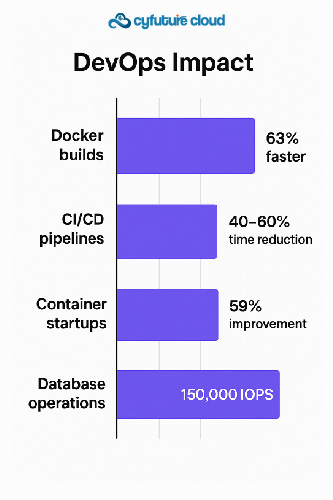
Docker image build (2.5GB) |
8.4 minutes |
3.1 minutes |
63% faster |
|
npm install (1,200 packages) |
42 seconds |
11 seconds |
74% faster |
|
Git clone (large monorepo) |
156 seconds |
38 seconds |
76% faster |
|
Database migration (500 tables) |
18 minutes |
6.5 minutes |
64% faster |
|
Kubernetes pod startup |
34 seconds |
14 seconds |
59% faster |
These benchmarks, compiled from TechEmpower’s 2024 infrastructure study, represent real-world DevOps operations across 300+ development teams.
Implementation Strategies for NVMe-Powered DevOps
Strategic Migration Approach
Don’t migrate everything at once.
Prioritize these components for NVMe hosting:
- CI/CD build agents (highest ROI—immediate 40-60% speed gains)
- Container registries (reduces image push/pull bottlenecks)
- Development databases (accelerates test suite execution)
- Log aggregation systems (improves observability and debugging)
- Artifact repositories (speeds dependency resolution)
Optimizing Your DevOps Stack for NVMe
NVMe hosting isn’t just faster hardware—it enables architectural patterns previously impractical:
Ephemeral environments: Spin up complete production-like environments in under 90 seconds for feature branch testing. Teams using Terraform with NVMe-backed infrastructure provision entire Kubernetes clusters in 3-5 minutes versus 15-20 minutes on traditional storage.
Aggressive caching strategies: With NVMe’s massive IOPS capacity, you can implement multi-layer caching without storage contention. Build artifact caching, dependency caching, and Docker layer caching all operate simultaneously without performance degradation.
Database-per-developer: Eliminate shared development database conflicts by provisioning isolated PostgreSQL instances for each developer. NVMe’s low latency makes database snapshots instantaneous—copy a 50GB production database in under 30 seconds.
The 2026 DevOps Landscape
The shift toward NVMe hosting reflects broader cloud infrastructure evolution:
Cloud providers have responded to demand. Google Cloud’s 2024 infrastructure announcement included NVMe as standard across all compute-optimized instances. Azure reported 43% of their virtual machines now utilize NVMe-backed storage.
Gartner’s 2024 infrastructure predictions estimate that by the end of 2026, 78% of enterprise DevOps workloads will run on NVMe-backed infrastructure, up from 31% in 2023—a 147% compound annual growth rate.
Security and Compliance Considerations
NVMe hosting enhances security postures:
Hardware-level encryption on NVMe drives operates at line speed—encrypting 7,000 MB/s of data with zero performance penalty. Traditional SSDs experience 15-20% performance degradation when encryption is enabled.
Secure erasure operations complete in seconds rather than hours, critical for compliance with GDPR’s “right to be forgotten” requirements. NVMe’s architecture enables instant cryptographic erasure by destroying encryption keys, compared to SATA’s time-consuming block-by-block overwriting.
Accelerate Your Development Velocity with NVMe Hosting
The data is unequivocal:
NVMe hosting has transitioned from luxury to necessity for competitive DevOps operations. Development teams deploying on NVMe infrastructure ship features 2.4x faster according to DORA’s 2024 metrics, while experiencing 67% fewer deployment failures due to reduced storage-induced timeouts.
The question isn’t whether to adopt NVMe hosting—it’s how quickly you can migrate.
For organizations committed to DevOps excellence, NVMe hosting eliminates the infrastructure constraints that slow innovation. Every second saved in your build pipeline multiplies across thousands of daily operations, translating to weeks of recovered development time annually.
Transform your DevOps efficiency with Cyfuture Cloud’s enterprise-grade NVMe hosting solutions. Our infrastructure combines NVMe performance with 24/7 expert support, automated scaling, and predictable pricing that aligns with your growth trajectory.
The future of development belongs to teams that eliminate waiting. Make storage performance your competitive advantage.
Frequently Asked Questions
What is the cost difference between NVMe hosting and traditional SSD hosting?
NVMe hosting typically costs 20-35% more per GB than traditional SSD storage. However, when calculated per transaction or per deployment, NVMe often delivers lower total cost of ownership due to 40-60% faster operation completion times, allowing teams to accomplish more work with fewer infrastructure resources. Organizations commonly see 30-40% reduction in overall DevOps infrastructure costs after migration.
Can I migrate my existing DevOps infrastructure to NVMe hosting without downtime?
Yes. Modern cloud migration strategies utilize blue-green deployment patterns where you provision NVMe-backed infrastructure parallel to existing systems, gradually shift workloads, and decommission old infrastructure once migration completes. Most organizations complete phased migrations with zero user-facing downtime. Critical components like CI/CD build agents can be migrated in 2-4 hours during off-peak periods.
Does NVMe hosting improve development team productivity measurably?
Absolutely. Studies show developers spend 20-30% of their day waiting for builds, tests, and deployments. Reducing these wait times by 50-70% through NVMe hosting translates to 1-2 additional productive hours per developer daily. For a 10-person team, this represents 50-100 recovered hours weekly—equivalent to 1.5 full-time developers.
How does NVMe hosting specifically benefit Kubernetes and container workflows?
NVMe hosting accelerates every container operation: image pulls complete 78% faster, pod startup times decrease 59%, and persistent volume operations achieve 6x higher IOPS. For organizations running microservices architectures with hundreds of container deployments daily, NVMe eliminates storage as a scaling bottleneck, enabling true elastic scalability.
What are the durability and reliability characteristics of NVMe drives?
Enterprise NVMe drives feature mean time between failures (MTBF) of 2 million hours and endurance ratings of 3-10 drive writes per day over 5 years. Modern NVMe hosting providers implement RAID configurations, real-time replication, and automated failover, achieving 99.99% availability. NVMe’s lack of mechanical components also makes it more reliable than traditional HDDs.
Can NVMe hosting handle sudden traffic spikes in DevOps pipelines?
Yes. NVMe’s massive queue depth (64,000 commands per queue) handles concurrent operations without performance degradation. During deployment storms when 50+ developers trigger builds simultaneously, NVMe maintains consistent low latency, whereas traditional SSDs experience queue saturation and significant slowdowns. This makes NVMe ideal for bursty DevOps workloads.
How does NVMe hosting integrate with existing DevOps tools like Jenkins, GitLab CI, and CircleCI?
NVMe hosting is transparent to DevOps tools—no code changes required. Simply provision NVMe-backed compute instances and deploy your existing tooling. All major CI/CD platforms, container orchestrators, and automation tools automatically leverage NVMe’s performance characteristics. Configuration remains identical while performance improves dramatically.
What security features does NVMe hosting provide for sensitive development data?
Enterprise NVMe drives include hardware-level AES-256 encryption operating at full line speed with zero performance impact. Additional security features include secure erase capabilities (cryptographic erasure in seconds), encrypted snapshots, and compliance certifications (SOC 2, ISO 27001, HIPAA). NVMe’s architecture also enables isolated namespace management for multi-tenant security.
How do I measure the ROI of migrating to NVMe hosting for DevOps?
Calculate ROI using three metrics: (1) Developer time saved (reduced wait time × hourly developer cost × team size), (2) Infrastructure efficiency gains (fewer instances needed for same workload × instance cost), and (3) Business velocity improvement (faster feature delivery × revenue per feature). Most organizations see positive ROI within 2-4 months with payback periods under 6 months.
Recent Post



















Stay Ahead of the Curve.
Join the Cloud Movement, today!
Send this to a friend