Get 69% Off on Cloud Hosting : Claim Your Offer Now!





- Products
- Solutions
-
Solutions
-
 Cloud
Hosting
Cloud
Hosting
-
VPS
Hosting
-
 GPU
Cloud
GPU
Cloud
-
 Dedicated
Server
Dedicated
Server
-
 Server
Colocation
Server
Colocation
-
 Backup as a Service
-
 CDN
Network
CDN
Network
-
 Window
Cloud Hosting
Window
Cloud Hosting
-
 Linux
Cloud Hosting
Linux
Cloud Hosting
-
Managed
Cloud Service
-
 Storage
as a Service
Storage
as a Service
-
VMware
Public Cloud
-
Multi-Cloud
Hosting
-
Cloud
Server Hosting
-
Bare
Metal Server
-
Virtual
Machine
-
 Magento
Hosting
Magento
Hosting
-
 Remote
Backup
Remote
Backup
-
 DevOps
-
 Kubernetes
-
 Cloud
Storage
Cloud
Storage
-
 NVMe
Hosting
NVMe
Hosting
-
 DR
as s Service
DR
as s Service
-
-
Solutions
- Marketplace
- Pricing
- Resources
- Company
 Remote
Backup
Remote
Backup NVMe
Hosting
NVMe
Hosting Pricing
Calculator
Pricing
Calculator Unlock Cost
Optimization
Unlock Cost
Optimization Overview
 Documentation
 Price
Calculator
Price
Calculator Tools
Tools FAQs
FAQs Terms
of Service
Terms
of Service Privacy
Policy
Privacy
Policy
 Migration
 Container
 Power
Power
 Utilities
 VMware
Private Cloud
VMware
Private Cloud VMware
on AWS
VMware
on AWS VMware
on Azure
VMware
on Azure Certifications
 Partners
 Careers
 Support
 Service
Level Agreement
Service
Level Agreement  Contact
Table of Contents
- GPU as a Service Meaning
- What Is GPU as a Service (GPUaaS) and How Does It Work?
- GPUaaS Business Model
- GPUaaS Market and Demand
- Benefits of GPU as a Service
- GPU as a Service Use Cases
- GPU as a Service Hivenet Setup Explained
- GPU as a Service Hivenet Guide (High-Level)
- GPU as a Service vs On-Premise GPUs
- GPU as a Service Companies and Providers
- GPU as a Service Providers Examples (Use-Case Driven)
- Security, Compliance, and Data Sovereignty
- GPU as a Service with Cyfuture Cloud
- Frequently Asked Questions (FAQs)
- Conclusion
As artificial intelligence, machine learning, and data-intensive applications continue to expand, traditional computing infrastructure is no longer sufficient. Organizations now require massive parallel processing power, which can efficiently be delivered through a cloud based GPU environment—but owning and managing physical GPU hardware is costly, complex, and resource-intensive. This challenge has led to the rapid adoption of GPU as a Service.
GPU as a Service enables businesses to access high-performance, cloud based GPU resources on demand, eliminating the need for upfront capital investment and ongoing infrastructure maintenance. By leveraging GPUaaS, organizations can scale compute power instantly to support AI training, deep learning, data analytics, rendering, and high-performance computing workloads.
This comprehensive guide explains the meaning of GPU as a Service, how it works, its growing market demand, cloud based GPU infrastructure design, Hivenet GPU architecture, business models, and why GPUaaS has become essential for modern enterprises seeking agility, scalability, and cost efficiency in a cloud-first world.
GPU as a Service Meaning
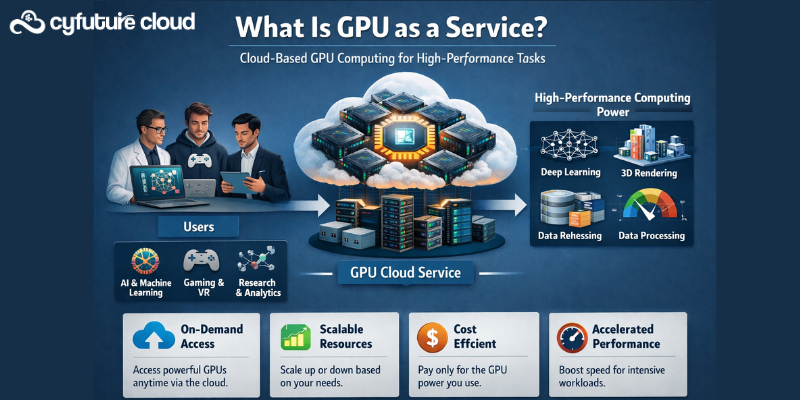
GPU as a Service (GPUaaS) is a cloud computing model that provides on-demand access to high-performance Graphics Processing Units (GPUs) over the internet. Instead of purchasing physical GPUs, organizations rent GPU compute power for workloads such as AI training, deep learning, scientific simulations, rendering, and real-time analytics.
GPUaaS is designed to remove hardware limitations, reduce infrastructure costs, and allow instant scalability based on workload demand.
What Is GPU as a Service (GPUaaS) and How Does It Work?
GPUaaS platforms host GPU hardware inside secure cloud data centers. These GPUs are virtualized and allocated dynamically to users through:
-
GPU-enabled virtual machines
-
Containerized GPU environments
-
API-based provisioning and orchestration
The provider manages hardware, cooling, drivers, updates, security, and uptime. Users deploy applications, run workloads, and scale GPU capacity as needed—paying only for actual usage.
GPUaaS Business Model
The GPUaaS business model is consumption-based and flexible. Instead of capital expenditure on hardware, organizations adopt operational expenditure models such as:
-
Pay-per-hour or pay-per-second GPU usage
-
Reserved or committed GPU capacity
-
On-demand burst workloads
This model allows businesses to align GPU spending directly with project timelines and output.
GPUaaS Market and Demand
The GPU as a Service market is growing rapidly due to:
-
Increased adoption of artificial intelligence and generative AI
-
Rising GPU hardware costs and limited availability
-
Expansion of data-driven applications
-
Need for scalable, cloud-native infrastructure
The GPUaaS market is expected to continue strong growth across industries such as healthcare, finance, manufacturing, media, and research. Demand is especially high in regions seeking secure, compliant, and sovereign GPU cloud infrastructure.
Benefits of GPU as a Service
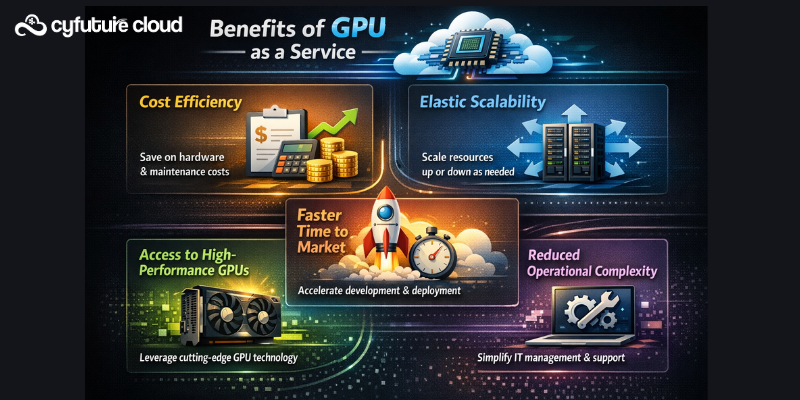
1. Cost Efficiency
GPUaaS eliminates high upfront investment in GPU hardware, cooling, and power infrastructure.
2. Elastic Scalability
Organizations can scale GPU resources instantly based on workload size and duration.
3. Faster Time to Market
AI and data science teams can deploy experiments and production workloads without procurement delays.
4. Access to High-Performance GPUs
Users gain access to modern GPU architectures without worrying about upgrades or depreciation.
5. Reduced Operational Complexity
The provider handles maintenance, updates, and infrastructure management.
GPU as a Service Use Cases
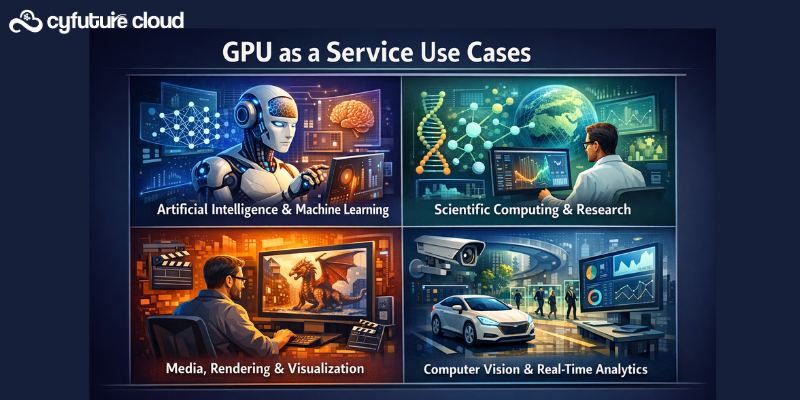
Artificial Intelligence and Machine Learning
Training large models, running inference, fine-tuning neural networks, and generative AI workloads.
Scientific Computing and Research
Simulations, genomics, climate modeling, and physics computations.
Media, Rendering, and Visualization
3D animation, VFX rendering, video encoding, and design workflows.
Computer Vision and Real-Time Analytics
Image recognition, video analytics, industrial inspection, and automation systems.
GPU as a Service Hivenet Setup Explained
A GPU as a Service hivenet setup is a distributed architecture where multiple GPU nodes operate together as a unified compute cluster.
Key Components of a GPUaaS Hivenet
-
Distributed GPU nodes
-
High-speed interconnect networking
-
Centralized orchestration layer
-
Shared storage and data pipelines
-
Fault tolerance and workload scheduling
This setup enables parallel processing, high availability, and efficient GPU utilization—essential for large AI models and enterprise workloads.
GPU as a Service Hivenet Guide (High-Level)
A typical GPUaaS hivenet guide includes:
-
Defining workload requirements (training vs inference)
-
Configuring GPU clusters and networking
-
Integrating orchestration tools
-
Optimizing data pipelines and storage access
-
Implementing security, monitoring, and scaling policies
Hivenet GPU setups are ideal for organizations requiring consistent performance at scale.
GPU as a Service vs On-Premise GPUs
| Feature | GPUaaS | On-Premise GPUs |
|---|---|---|
| Upfront Cost | Low | Very High |
| Scalability | Instant | Limited |
| Maintenance | Provider-managed | In-house |
| Deployment Time | Minutes | Weeks |
| Upgrade Cycle | Automatic | Manual |
Many enterprises now use a hybrid approach, combining on-premise resources with GPUaaS for flexibility.
GPU as a Service Companies and Providers
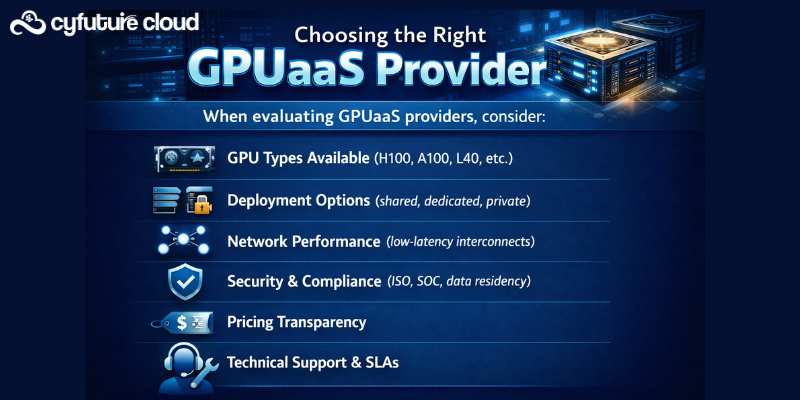
The GPUaaS ecosystem includes multiple global and regional providers. When evaluating GPU as a Service companies, businesses focus on:
-
Performance and GPU availability
-
Pricing flexibility
-
Security and compliance
-
Data residency
-
Support and reliability
In India, Cyfuture Cloud offers GPU as a Service designed for AI, enterprise, and regulated workloads, delivering scalable GPU infrastructure with strong compliance and security standards.
GPU as a Service Providers Examples (Use-Case Driven)
Examples of GPUaaS deployments include:
-
AI startups training large language models
-
Enterprises running predictive analytics
-
Research institutions performing simulations
-
Media companies rendering high-resolution visuals
GPUaaS adapts to both short-term and long-running compute needs.
Security, Compliance, and Data Sovereignty
Modern GPUaaS platforms provide:
-
Data encryption in transit and at rest
-
Secure access controls
-
Workload isolation
-
Regional data residency options
These features make GPUaaS suitable for enterprise, government, and regulated industries.
GPU as a Service with Cyfuture Cloud
Cyfuture Cloud GPU as a Service enables organizations to deploy GPU-accelerated workloads without infrastructure complexity. It supports AI, machine learning, and high-performance computing while maintaining security, scalability, and compliance.
Cyfuture Cloud focuses on:
-
High-performance GPU infrastructure
-
Flexible scaling models
-
Secure, enterprise-ready environments
-
India-based cloud and data residency support
Frequently Asked Questions (FAQs)
What are the benefits of GPU as a service?
Lower costs, instant scalability, faster AI deployment, and access to high-performance GPUs without maintenance.
What is GPU as a Service (GPUaaS)?
A cloud model that delivers GPU computing power on demand.
What is the demand for GPU as a Service?
Demand is increasing rapidly due to AI, data analytics, and compute-intensive workloads.
What is the market forecast for GPUaaS?
The GPUaaS market is projected to grow strongly over the next decade as AI adoption accelerates.
Is there any Indian GPU cloud company?
Yes, Cyfuture Cloud provides GPU as a Service in India.
Conclusion
GPU as a Service (GPUaaS) has become a foundational technology for artificial intelligence, advanced analytics, and high-performance computing. By removing traditional infrastructure barriers and providing elastic, on-demand access to GPU cloud server resources, GPUaaS enables organizations to innovate faster, scale efficiently, and optimize performance for compute-intensive workloads.
With enterprise-grade infrastructure, secure architecture, and scalable GPU cloud server capabilities, Cyfuture Cloud GPU as a Service delivers a reliable foundation for AI training, machine learning inference, data processing, and HPC applications—helping businesses accelerate growth while maintaining control, performance, and operational efficiency.
Recent Post



Stay Ahead of the Curve.
Join the Cloud Movement, today!
Send this to a friend