Get 69% Off on Cloud Hosting : Claim Your Offer Now!





- Products
- Solutions
-
Solutions
-
 Cloud
Hosting
Cloud
Hosting
-
VPS
Hosting
-
 GPU
Cloud
GPU
Cloud
-
 Dedicated
Server
Dedicated
Server
-
 Server
Colocation
Server
Colocation
-
 Backup as a Service
-
 CDN
Network
CDN
Network
-
 Window
Cloud Hosting
Window
Cloud Hosting
-
 Linux
Cloud Hosting
Linux
Cloud Hosting
-
Managed
Cloud Service
-
 Storage
as a Service
Storage
as a Service
-
VMware
Public Cloud
-
Multi-Cloud
Hosting
-
Cloud
Server Hosting
-
Bare
Metal Server
-
Virtual
Machine
-
 Magento
Hosting
Magento
Hosting
-
 Remote
Backup
Remote
Backup
-
 DevOps
-
 Kubernetes
-
 Cloud
Storage
Cloud
Storage
-
 NVMe
Hosting
NVMe
Hosting
-
 DR
as s Service
DR
as s Service
-
-
Solutions
- Marketplace
- Pricing
- Resources
- Company
 Remote
Backup
Remote
Backup NVMe
Hosting
NVMe
Hosting Pricing
Calculator
Pricing
Calculator Unlock Cost
Optimization
Unlock Cost
Optimization Overview
 Documentation
 Price
Calculator
Price
Calculator Tools
Tools FAQs
FAQs Terms
of Service
Terms
of Service Privacy
Policy
Privacy
Policy
 Migration
 Container
 Power
Power
 Utilities
 VMware
Private Cloud
VMware
Private Cloud VMware
on AWS
VMware
on AWS VMware
on Azure
VMware
on Azure Certifications
 Partners
 Careers
 Support
 Service
Level Agreement
Service
Level Agreement  Contact
Table of Contents
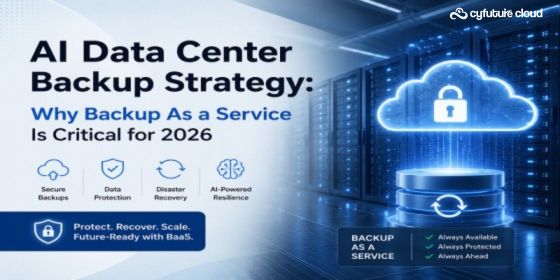
In today’s digital-first world, data is the backbone of every business—from startups to global enterprises. Yet, with cyber threats, accidental deletions, and hardware failures on the rise, safeguarding this data has never been more critical. Enter Backup as a Service (BaaS): a modern, cloud-powered solution that’s transforming how organizations protect and recover their vital information.
Understanding Backup as a Service (BaaS)
Backup as a Service (BaaS) is a cloud-based, fully managed backup and recovery service. Instead of relying on traditional, on-premises backup infrastructure, businesses use third-party providers to automatically and securely back up their data to remote, cloud-based repositories. This approach not only ensures data safety but also offloads the complexity of backup management to experts.
Key features of BaaS:
- Automated, scheduled backups of files, databases, and entire systems
- Secure, encrypted data transmission and storage
- Centralized management dashboards for monitoring and restoring data
- Scalability to match growing data volumes without hardware investments
- Disaster recovery capabilities for rapid restoration after data loss events
Why is BaaS Essential?
Data loss—whether from cyberattacks, accidental deletion, or natural disasters—can cripple business operations. For small and medium businesses (SMBs) in particular, the stakes are high: downtime means lost revenue, reputational damage, and potential legal consequences.
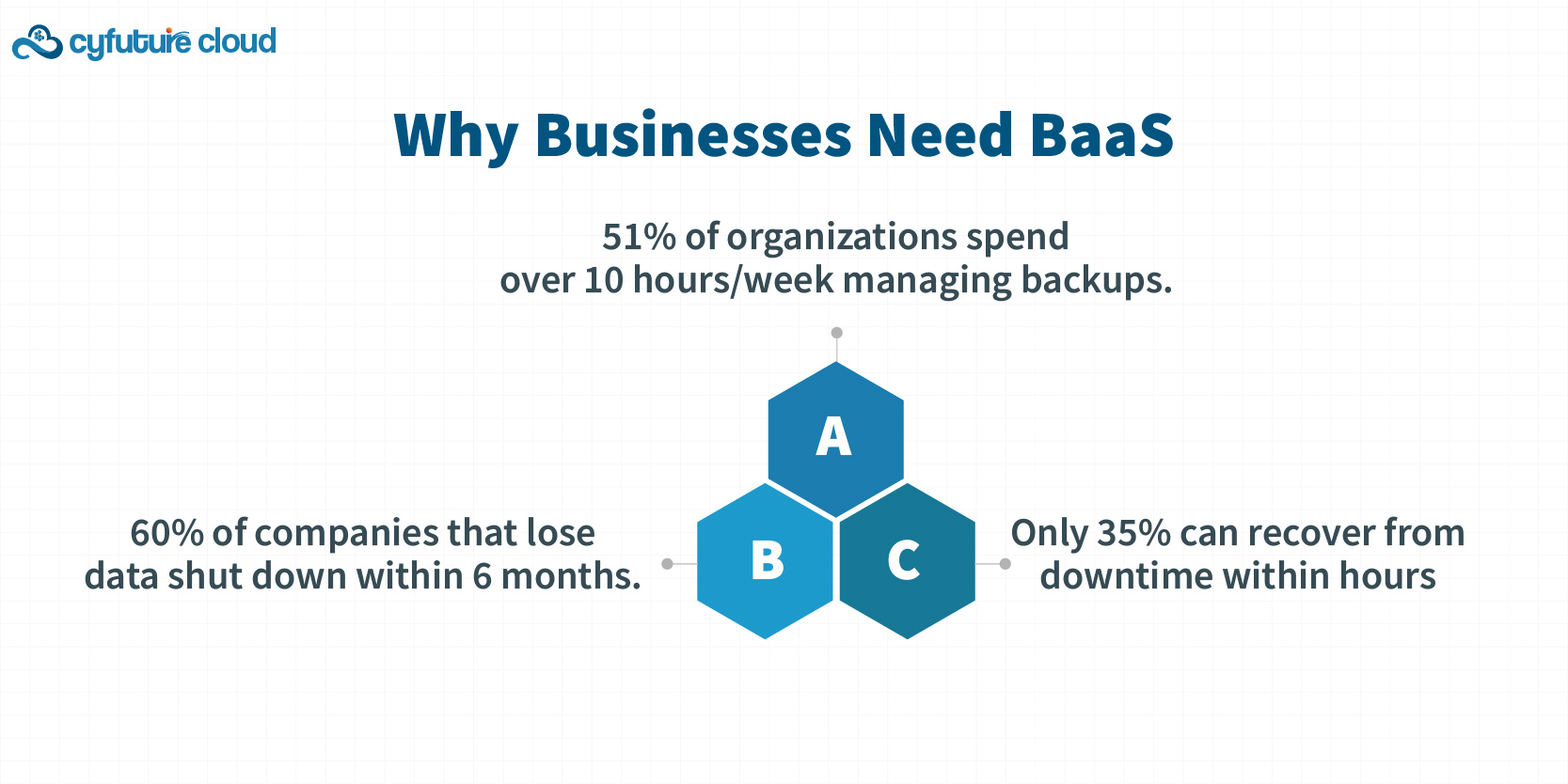
Why Businesses Need BaaS
- 51% of organizations spend over 10 hours/week managing backups.
- Only 35% can recover from downtime within hours.
- 60% of companies that lose data shut down within 6 months.
Statistics highlight the urgency:
- 51% of organizations spend over 10 hours per week managing backups—a significant drain on IT resources.
- Only 35% of organizations can recover from a downtime event within hours, despite over 60% believing they can.
- The BaaS market is booming, valued at $5.69 billion in 2024 and projected to reach $33.18 billion by 2030, growing at a staggering 31.8% CAGR.
How Does Backup as a Service (BaaS) Work?
1. Initial Setup
Businesses connect their servers, endpoints, databases, and applications to the BaaS provider’s cloud backup platform. This onboarding process is quick and requires no additional hardware, allowing organizations to begin securing data immediately.
2. Configuration & Policy Management
Through a user-friendly dashboard, IT teams define backup schedules, retention policies, encryption settings, and data categories to be protected. These customizable policies ensure compliance with industry standards and internal governance.
3. Continuous or Scheduled Backups
BaaS automatically captures data either in real time or at scheduled intervals. This automation minimizes human error, reduces administrative overhead, and ensures that the most recent version of business-critical data is always protected.
4. Secure Data Transmission
Before leaving the source system, data is encrypted using advanced security protocols, then transferred over secure channels (TLS/SSL) to the cloud. This prevents interception, tampering, or unauthorized access during transit.
5. Cloud Storage & Intelligent Management
Backups are stored in highly secure, geographically distributed cloud repositories to ensure resilience and disaster recovery readiness. The provider manages all backend operations—including maintenance, patching, scaling, and monitoring—so businesses don’t have to manage any infrastructure.
6. Fast, Flexible Data Recovery
When data loss, corruption, ransomware, or accidental deletion occurs, businesses can restore individual files, folders, databases, or entire systems within minutes. Most BaaS platforms offer point-in-time recovery, enabling organizations to revert to an earlier, clean version of their data with just a few clicks.
BaaS vs. Traditional Backup Methods
|
Feature |
BaaS (Cloud-Based) |
Traditional Backup (On-Premises) |
|
Setup Cost |
Low (subscription-based) |
High (hardware/software purchase) |
|
Management |
Provider-managed |
In-house IT required |
|
Scalability |
Instantly scalable |
Limited by hardware |
|
Disaster Recovery |
Offsite, rapid recovery |
Onsite/offsite, slower recovery |
|
Security |
Encrypted, multi-layered |
Varies, often less robust |
|
Accessibility |
Remote, anytime access |
Local/network access only |
Key Benefits of BaaS
- Cost-Effectiveness: No need for expensive hardware or dedicated backup teams; pay only for what you use.
- Automation & Reliability: Reduces risk of missed backups and human error—backups are performed consistently and automatically.
- Expert Management: Providers offer specialized expertise, ensuring optimal performance, compliance, and security.
- Disaster Resilience: Offsite, cloud storage protects data from local disasters, ransomware, and cyberattacks.
- Rapid Recovery: Quick restoration of data minimizes downtime and business impact.
How does BaaS ensure data security during transmission and storage in the cloud?
Backup as a Service (BaaS) ensures data security during transmission and storage in the cloud primarily through robust encryption and strict access controls.
How BaaS Secures Data
Encryption During Transmission
Before data leaves your systems, it is encrypted using strong encryption algorithms. This ensures that even if the data is intercepted while being sent to the cloud, it remains unreadable to unauthorized parties.
Encryption at Rest
Once the data reaches the cloud storage, it remains encrypted while stored (“at rest”). This protects it from unauthorized access, even if someone gains physical access to the storage infrastructure.
Secure Network Protocols
Data is transmitted over secure network connections, often using protocols like SSL/TLS, which further protect the data from interception or tampering during transfer.
Access Controls and Key Management
Only authorized personnel have access to decryption keys, and access to backup data is tightly controlled through user authentication and permissions. Encryption keys are managed securely, reducing the risk of unauthorized decryption.
Physical and Digital Security in Data Centers
BaaS providers store backup data in secure, often geographically distributed, data centers with strong physical and digital security measures to guard against theft, fire, or natural disasters.
Regular Monitoring and Compliance
Continuous monitoring ensures the integrity of backup data, and providers often comply with industry standards such as ISO 27001 and SOC2, which mandate strict security protocols.
Choosing the Right BaaS Provider
When evaluating BaaS solutions, consider:
- Security features: End-to-end encryption, immutability, and compliance certifications.
- Scalability: Ability to handle your current and future data needs.
- Recovery options: Granular restore capabilities and disaster recovery support.
- Cost transparency: Clear pricing models based on storage, bandwidth, and recovery frequency.
- Support and SLA: 24/7 support and guaranteed uptime.
The Future of BaaS
With the exponential growth of data and increasing cyber risks, BaaS adoption is set to accelerate. By 2030, the global BaaS market is expected to surpass $33 billion, driven by organizations seeking robust, scalable, and cost-effective data protection.
In summary
Backup as a Service (BaaS) empowers businesses to secure mission-critical data, streamline IT operations, and maintain uninterrupted business continuity in an era where cyberattacks, system failures, and accidental deletions are inevitable. With Cyfuture Cloud’s advanced BaaS platform, organizations benefit from automated, scalable, and enterprise-grade data protection without the complexity of managing traditional backup infrastructure. Cyfuture Cloud ensures fast recovery, compliance-ready storage, and future-proof resilience, enabling businesses to confidently safeguard their digital assets. For companies aiming to strengthen operational continuity and build a robust, secure IT ecosystem, BaaS from Cyfuture Cloud is not just a modern solution—it is an essential cornerstone of long-term digital strategy.
















Stay Ahead of the Curve.
Join the Cloud Movement, today!
Send this to a friend