Get 69% Off on Cloud Hosting : Claim Your Offer Now!





- Products
- Solutions
-
Solutions
-
 Cloud
Hosting
Cloud
Hosting
-
VPS
Hosting
-
 GPU
Cloud
GPU
Cloud
-
 Dedicated
Server
Dedicated
Server
-
 Server
Colocation
Server
Colocation
-
 Backup as a Service
-
 CDN
Network
CDN
Network
-
 Window
Cloud Hosting
Window
Cloud Hosting
-
 Linux
Cloud Hosting
Linux
Cloud Hosting
-
Managed
Cloud Service
-
 Storage
as a Service
Storage
as a Service
-
VMware
Public Cloud
-
Multi-Cloud
Hosting
-
Cloud
Server Hosting
-
Bare
Metal Server
-
Virtual
Machine
-
 Magento
Hosting
Magento
Hosting
-
 Remote
Backup
Remote
Backup
-
 DevOps
-
 Kubernetes
-
 Cloud
Storage
Cloud
Storage
-
 NVMe
Hosting
NVMe
Hosting
-
 DR
as s Service
DR
as s Service
-
-
Solutions
- Marketplace
- Pricing
- Resources
- Company
 Remote
Backup
Remote
Backup NVMe
Hosting
NVMe
Hosting Pricing
Calculator
Pricing
Calculator Unlock Cost
Optimization
Unlock Cost
Optimization Overview
 Documentation
 Price
Calculator
Price
Calculator Tools
Tools FAQs
FAQs Terms
of Service
Terms
of Service Privacy
Policy
Privacy
Policy
 Migration
 Container
 Power
Power
 Utilities
 VMware
Private Cloud
VMware
Private Cloud VMware
on AWS
VMware
on AWS VMware
on Azure
VMware
on Azure Certifications
 Partners
 Careers
 Support
 Service
Level Agreement
Service
Level Agreement  Contact
Table of Contents
- What Is Hybrid Cloud Colocation?
- Why Hybrid Cloud Colocation Matters Today
- How Hybrid Cloud Colocation Works: Technical Architecture
- Key Benefits of Hybrid Cloud Colocation
- Hybrid Colocation: Strategic Use Cases
- Challenges and Best Practices
- Hybrid Cloud Colocation vs. Other Models
- Conclusion: Hybrid Cloud Colocation as a Future-Ready Strategy
- Frequently Asked Questions (FAQs) – Hybrid Cloud Colocation
- What is Hybrid Cloud Colocation?
- What is hybrid cloud with an example?
- What is cloud colocation?
- What are the 4 types of cloud services?
- Is AWS a hybrid cloud?
- What are the 4 types of data centers?
- Is Netflix a hybrid cloud?
- Is Azure a hybrid cloud?
- What skills are needed for hybrid cloud?
- What is a colocation example?
- What are the top 3 cloud services?
- Does AWS use colocation?
In today’s digital era, organizations are under intense pressure to modernize their IT infrastructure to support AI, analytics, global operations, and always-on services. Traditional on-premises systems can’t keep up with these demands alone—but fully migrating to the public cloud isn’t always the right answer, either. This is where Hybrid Cloud Colocation emerges as a powerful strategic approach: it blends the control and performance of colocated infrastructure with the flexibility and scalability of cloud services.
What Is Hybrid Cloud Colocation?
Hybrid Cloud Colocation refers to an IT architecture where an organization’s hardware (servers, storage, networking) is hosted in a third-party data center in India (colocation facility), while workload execution and burst capacity leverage one or more public cloud platforms. This hybrid setup allows enterprises to control critical systems on dedicated hardware, and simultaneously tap cloud services for scalability, innovation, and flexibility.
In simple terms:
-
Colocation provides secure, carrier-neutral data center space for your equipment.
-
Hybrid Cloud links that equipment with public cloud platforms through high-speed, private connections.
-
Combined, they deliver performance, compliance, and agility.
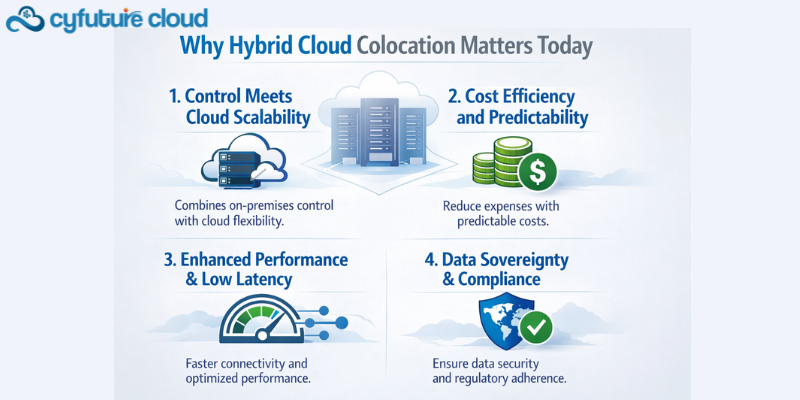
Why Hybrid Cloud Colocation Matters Today
1. Control Meets Cloud Scalability
Colocation gives enterprises full hardware control—ideal for mission-critical systems, regulatory compliance, and performance-sensitive workloads. Meanwhile, the cloud offers on-demand scalability and flexible consumption. A hybrid strategy lets you choose the optimal environment for each workload.
Example: A financial institution may host sensitive transaction systems in a colo facility for compliance and low latency, while running analytics or seasonal workloads in the cloud.
2. Cost Efficiency and Predictability
Public cloud costs are variable and tied to usage, which can lead to unpredictable bills for heavy or steady workloads. Colocation introduces stable, predictable infrastructure costs, while cloud hosting services provide elasticity during demand spikes, reducing overall total cost of ownership (TCO).
3. Enhanced Performance and Low Latency
Locating infrastructure close to major cloud provider hubs or end users significantly reduces network latency. By colocating and using direct cloud on-ramps (private connections), data transfers become faster and more reliable than traversing the public internet—critical for applications like real-time trading or immersive gaming.
4. Data Sovereignty and Compliance
Certain industries (healthcare, finance, government) must retain sensitive data within specific jurisdictions. Hybrid cloud colocation enables regulated data to remain on self-managed hardware in trusted facilities, while less sensitive workloads function in the cloud.
How Hybrid Cloud Colocation Works: Technical Architecture
A successful hybrid colocation deployment involves several key architectural elements:
1. Carrier-Neutral Colocation Facility
Choosing a colocation provider that is carrier-neutral means access to multiple network providers and direct cloud connections (e.g., AWS Direct Connect, Azure ExpressRoute). These links lower latency and improve security compared to public internet.
2. Private Connectivity Bridges
Hybrid setups rely on secure, high-speed links between server colocation hardware and cloud platforms, often via SD-WAN, MPLS, or dedicated fiber. These connections ensure predictable packet flow and robust performance.
3. Orchestration and Management Layers
Unified platforms or orchestration tools are essential to manage workloads across colo and cloud environments. These tools help allocate resources, monitor performance, and enforce security policies consistently.
4. Workload Placement Strategy
Identifying which applications belong in the colo portion or cloud side is vital. Typically:
-
Stable, highly regulated, or latency-sensitive workloads stay in colocation.
-
Variable, bursty, or global services leverage the public cloud.
Key Benefits of Hybrid Cloud Colocation
Cost Control & Optimization
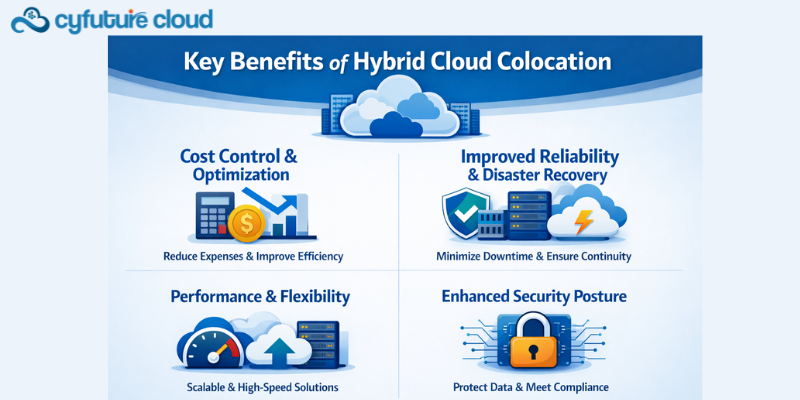
Hybrid cloud models help organizations avoid over provisioning and reduce unnecessary cloud spend by hosting predictable workloads on colocated hardware while using cloud resources for peak loads.
Improved Reliability & Disaster Recovery
Colo facilities often provide redundant power, networking paths, and advanced physical security. When paired with cloud-based backup and disaster recovery (DR) services, enterprises benefit from multi-layered resilience.
Performance & Flexibility
Hybrid deployments let businesses run performance-sensitive workloads close to users or key data stores, while geographically distributed cloud resources serve global traffic efficiently.
Enhanced Security Posture
Colocation gives you physical hardware control and isolation, while cloud environments offer advanced analytics and security automation. Combined, they support zero-trust models and strong access governance.
Hybrid Colocation: Strategic Use Cases
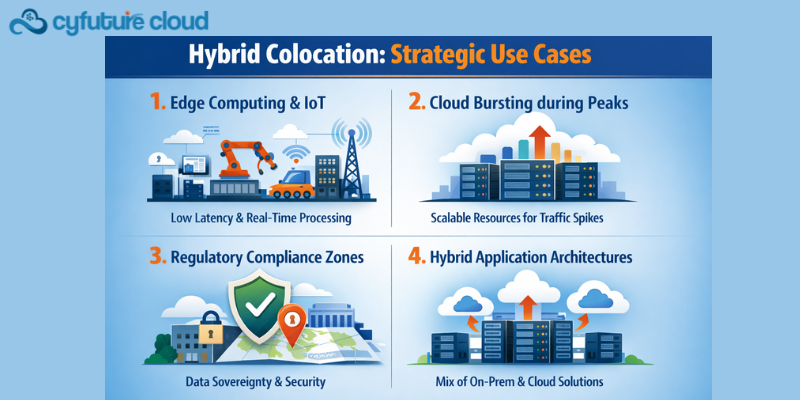
Here are real-world scenarios where hybrid cloud colocation delivers tangible value:
1. Edge Computing & IoT
Edge workloads benefit from colocated servers near users or devices, enabling faster processing before syncing with cloud systems.
2. Cloud Bursting during Peaks
Colo handles baseline workloads, while burst capacity in public cloud absorbs traffic spikes, such as during seasonal sales or product launches.
3. Regulatory Compliance Zones
Healthcare or financial sectors can keep sensitive data on proprietary hardware while employing cloud tools for analytics or user interfaces.
4. Hybrid Application Architectures
Teams can split a system into performance-critical backend services running in colocation and flexible frontend applications in the cloud.
Challenges and Best Practices
Challenge: Network Complexity
Managing connectivity across hybrid environments risks fragmentation. Best practice is to use centralized SD-WAN or unified network management tools for visibility and performance.
Challenge: Security Gaps
Traffic between colocation and cloud must be secured with encrypted tunnels, strict identity policies, and unified threat monitoring.
Challenge: Cost Control
Without disciplined governance, cloud server costs can climb unexpectedly. Use tagging, cost alerts, and automation to manage cloud spend.
Hybrid Cloud Colocation vs. Other Models
| Feature | Hybrid Cloud Colocation | Public Cloud | On-Premises |
|---|---|---|---|
| Control | High | Medium | High |
| Scalability | High | Very High | Low |
| Cost Predictability | High | Variable | High |
| Compliance Support | Strong | Varies | Strong |
| Performance (Latency) | Excellent | Good | Excellent |
| Operational Overhead | Moderate | Low | High |
Conclusion: Hybrid Cloud Colocation as a Future-Ready Strategy
Hybrid cloud colocation offers a balanced path for enterprises looking to modernize without sacrificing control, security, or performance. It combines the best aspects of dedicated infrastructure with cloud agility, enabling smarter workload placement, predictable costs, and global reach. Whether you’re optimizing latency-sensitive services, meeting regulatory compliance, or seeking a scalable disaster recovery strategy, hybrid cloud colocation Jaipur is one of the most compelling IT architecture models available today.
Frequently Asked Questions (FAQs) – Hybrid Cloud Colocation
What is Hybrid Cloud Colocation?
Hybrid Cloud Colocation is an IT model that combines on-premise infrastructure hosted in a colocation data center with public or private cloud services. It allows businesses to keep critical workloads on dedicated hardware while using the cloud for scalability, backups, and high availability.
What is hybrid cloud with an example?
A hybrid cloud combines private infrastructure and public cloud platforms.
Example: A company runs sensitive customer data on private servers in a colocation facility while using AWS or Azure for application hosting and traffic spikes.
What is cloud colocation?
Cloud colocation refers to hosting physical servers in a third-party data center and connecting them directly to cloud providers. This setup improves performance, security, and connectivity while reducing infrastructure management overhead.
What are the 4 types of cloud services?
The four main cloud service models are:
-
IaaS (Infrastructure as a Service)
-
PaaS (Platform as a Service)
-
SaaS (Software as a Service)
-
FaaS (Function as a Service / Serverless Computing)
Is AWS a hybrid cloud?
AWS itself is a public cloud, but it supports hybrid cloud deployments through services like AWS Outposts, AWS Direct Connect, and Storage Gateway, making it compatible with Hybrid Cloud Colocation strategies.
What are the 4 types of data centers?
The four common types of data centers are:
-
Enterprise Data Centers
-
Colocation Data Centers
-
Cloud Data Centers
-
Edge Data Centers
Is Netflix a hybrid cloud?
Netflix primarily operates on the public cloud (AWS) but uses a hybrid approach for content delivery by combining cloud infrastructure with on-premise and edge systems for caching and streaming efficiency.
Is Azure a hybrid cloud?
Azure is a public cloud platform, but it strongly supports hybrid cloud through Azure Arc, Azure Stack, and seamless integration with on-premise and colocation environments.
What skills are needed for hybrid cloud?
Key skills required for managing Hybrid Cloud Colocation include:
-
Cloud platform expertise (AWS, Azure, Google Cloud)
-
Networking and connectivity management
-
Cybersecurity and compliance
-
Virtualization and containerization
-
DevOps and automation tools
What is a colocation example?
A typical colocation example is a business renting rack space in a Tier III or Tier IV data center, installing its own servers, and connecting them to cloud providers for backup, disaster recovery, or hybrid workloads.
What are the top 3 cloud services?
The top three cloud service providers globally are:
-
Amazon Web Services (AWS)
-
Microsoft Azure
-
Google Cloud Platform (GCP)
Does AWS use colocation?
AWS does not publicly disclose all facility details, but it does use colocation and partner data centers in various regions. Many enterprises also connect AWS to their own colocation infrastructure as part of a Hybrid Cloud Colocation deployment.
Recent Post











Stay Ahead of the Curve.
Join the Cloud Movement, today!
Send this to a friend