Get 69% Off on Cloud Hosting : Claim Your Offer Now!





- Products
- Solutions
-
Solutions
-
 Cloud
Hosting
Cloud
Hosting
-
VPS
Hosting
-
 GPU
Cloud
GPU
Cloud
-
 Dedicated
Server
Dedicated
Server
-
 Server
Colocation
Server
Colocation
-
 Backup as a Service
-
 CDN
Network
CDN
Network
-
 Window
Cloud Hosting
Window
Cloud Hosting
-
 Linux
Cloud Hosting
Linux
Cloud Hosting
-
Managed
Cloud Service
-
 Storage
as a Service
Storage
as a Service
-
VMware
Public Cloud
-
Multi-Cloud
Hosting
-
Cloud
Server Hosting
-
Bare
Metal Server
-
Virtual
Machine
-
 Magento
Hosting
Magento
Hosting
-
 Remote
Backup
Remote
Backup
-
 DevOps
-
 Kubernetes
-
 Cloud
Storage
Cloud
Storage
-
 NVMe
Hosting
NVMe
Hosting
-
 DR
as s Service
DR
as s Service
-
-
Solutions
- Marketplace
- Pricing
- Resources
- Company
 Remote
Backup
Remote
Backup NVMe
Hosting
NVMe
Hosting Pricing
Calculator
Pricing
Calculator Unlock Cost
Optimization
Unlock Cost
Optimization Overview
 Documentation
 Price
Calculator
Price
Calculator Tools
Tools FAQs
FAQs Terms
of Service
Terms
of Service Privacy
Policy
Privacy
Policy
 Migration
 Container
 Power
Power
 Utilities
 VMware
Private Cloud
VMware
Private Cloud VMware
on AWS
VMware
on AWS VMware
on Azure
VMware
on Azure Certifications
 Partners
 Careers
 Support
 Service
Level Agreement
Service
Level Agreement  Contact
Table of Contents
- What Is Cloud Hosting Price?
- Understanding the 2026 Pricing Landscape
- The Real Cost Architecture: Beyond the Hourly Rate
- Use Case Economics: When Each Model Makes Sense
- 2026 Market Dynamics and Pricing Trends
- Total Cost of Ownership: The Decision Framework
- Optimization Strategies That Actually Work
- The 2026 Reality Check
- Architect Your Infrastructure Economics with Cyfuture Cloud’s Intelligent Platform
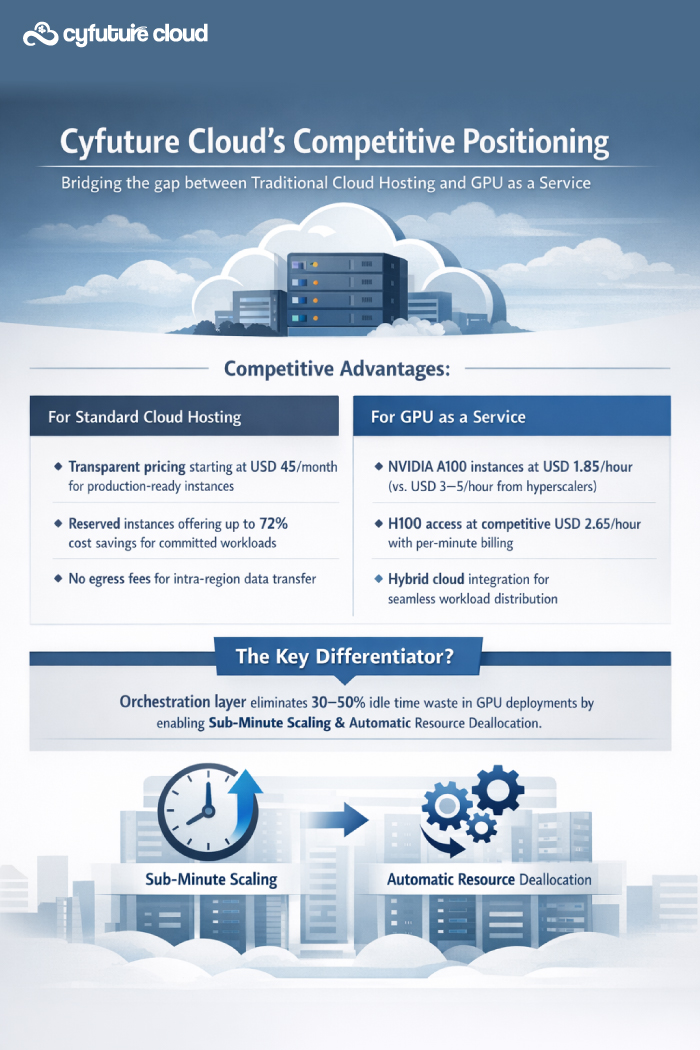
Cloud Hosting Price structures and GPU as a Service cost models represent fundamentally different value propositions in 2026’s infrastructure landscape. While standard cloud hosting averages USD 50-500 monthly for typical web applications, GPU as a Service commands USD 0.50-8.00 per GPU hour—a difference that confuses many technical decision-makers. Understanding these pricing architectures isn’t just about comparing numbers; it’s about aligning infrastructure costs with computational requirements, performance expectations, and business outcomes.
Here’s what’s changed:
The pricing gap between general-purpose compute and specialized GPU infrastructure has actually narrowed by 35% since 2024, driven by increased GPU availability and competitive pressure from providers like Cyfuture Cloud, AWS, Google Cloud, and specialized GPU vendors.

What Is Cloud Hosting Price?
Cloud Hosting Price refers to the cost structure for renting virtualized computing resources—including CPU, RAM, storage, and bandwidth—from providers who operate distributed server infrastructure. Standard pricing ranges from USD 5-20 monthly for entry-level shared hosting to USD 50-500+ for scalable cloud instances, depending on resource allocation and service level agreements.
Understanding the 2026 Pricing Landscape
Let’s cut through the noise:
More than one-third of organizations report cloud budget overruns of 20-40%, primarily because they misunderstand the fundamental cost differences between general-purpose hosting and specialized GPU compute.
Cloud Hosting Price in 2026:
Basic cloud configurations start at USD 27-50 monthly, while enterprise-grade setups reach USD 1,000+ monthly. The median for production workloads sits around USD 200-400 monthly.
Breaking down typical costs:
- Compute (vCPU/RAM): 60-70% of total spend
- Storage: 15-20%
- Bandwidth/Egress: 10-15%
- Support/SLA premiums: 5-10%
GPU as a Service Pricing:
This is where things diverge dramatically.
H100 GPU pricing spans a 4.7x range—from USD 1.49 per hour for marketplace spot instances to USD 6.98 per hour for hyperscaler on-demand access. For a single H100 GPU running 24/7, monthly costs range from USD 1,080 to USD 5,090.
The median on-demand H100 price in March 2026 is approximately USD 2.99 per hour, translating to USD 2,152 monthly for continuous usage.
Here’s what surprised technical leaders in 2026:
GPU rental prices have actually become more competitive, with H100 prices dropping 44% between June 2024 and June 2025 due to expanding supply and marketplace competition. Meanwhile, traditional cloud hosting prices have increased 10-15% due to memory component shortages and infrastructure expansion costs.
The Real Cost Architecture: Beyond the Hourly Rate
What most pricing comparisons miss:
Hidden costs including egress fees, storage, networking, API calls, and minimum commitments can add 20-40% on top of advertised GPU hourly rates.
For traditional cloud hosting, these hidden costs manifest differently:
- Data Transfer (Egress): USD 0.01-0.09 per GB, varying by region and usage tier
- IOPS Charges: Premium storage performance adds USD 50-200 monthly
- Support Tiers: Enterprise support can add 10-30% to base costs
GPU as a Service hidden expenses:
For AI startups, GPU compute consumes 40-60% of technical budgets in the first two years, but the sticker price tells only part of the story. Factors that amplify costs:
- Idle Time Waste: Organizations waste 30-50% of GPU budgets on provisioned but unused instances
- Storage Requirements: Model checkpoints and datasets cost USD 0.10-0.30 per GB monthly
- Networking Overhead: High-speed interconnects for multi-GPU training add premium charges
Use Case Economics: When Each Model Makes Sense
Traditional Cloud Hosting Price structures excel for:
- Web Applications: E-commerce, SaaS platforms, content management systems
- Database Hosting: Transactional workloads with predictable resource consumption
- API Services: RESTful backends serving mobile/web clients
- Development/Staging: Non-production environments
Cost profile: USD 100-500 monthly for typical mid-market deployments.
GPU as a Service dominates for:
- AI Model Training: Deep learning, computer vision, NLP model development
- Inference Workloads: Real-time ML predictions at scale
- Scientific Computing: Molecular dynamics, climate modeling, genomics
- Rendering: 3D visualization, video processing, CGI production
Cost profile: USD 500-10,000+ monthly depending on GPU count and utilization.
2026 Market Dynamics and Pricing Trends
What’s changing:
The GPU rental market is characterized by greater availability, more predictable pricing, and broader user choice in 2026. Supply constraints that plagued 2023-2024 have substantially eased.
Google Cloud’s committed use contracts provide up to 57% discounts for 1-3 year commitments, making long-term GPU access increasingly affordable for established workloads.
Emerging pricing models:
- Per-Second Billing: Providers offering per-second billing save users 15-30% for bursty workloads compared to hourly billing with idle time
- Spot Instance Maturity: More reliable spot markets with 40-60% discounts over on-demand
- Marketplace Aggregation: GPU marketplaces pooling capacity offer 3-6x lower prices than hyperscalers
“The 2026 GPU rental landscape is characterized by a wide range of available hardware and more mature pricing patterns across both established and next-generation models.” – Silicon Data GPU Market Report, 2026
Total Cost of Ownership: The Decision Framework
Cloud Hosting Price TCO (36-month horizon):
For a typical production application requiring 8 vCPU, 32GB RAM, 500GB storage:
- Monthly recurring: USD 280
- 36-month total: USD 10,080
- Bandwidth overages: +15-20%
- Support contracts: +10-15%
- True TCO: ~USD 12,600-13,800
GPU as a Service TCO (same period):
For ML development requiring 1x H100 GPU at 50% utilization:
- Compute (720 hours/month at USD 2.65/hour): USD 1,908
- Storage (5TB datasets): USD 750
- Bandwidth: USD 200
- 36-month total: USD 102,888
The 8-10x cost differential explains why workload optimization matters critically for GPU deployments.
Optimization Strategies That Actually Work
For traditional cloud hosting:
- Right-sizing: Automated Kubernetes services reduce operational overhead and enable efficient resource scaling
- Reserved Capacity: 30-70% savings for predictable workloads
- Multi-cloud Arbitrage: Leverage pricing variations across providers
For GPU as a Service:
Five strategies can reduce cloud GPU spending by 40%: spot instances, right-sizing, scheduling, marketplace migration, and reserved capacity. Cyfuture Cloud’s orchestration platform automates most of these optimizations.
Practical implementation:
- Development/Testing: Use CPU instances or budget GPU tiers (T4, A100)
- Training: Leverage spot instances with checkpoint-based recovery
- Inference: Right-size GPU selection to actual throughput requirements
- Hybrid Approach: Run inference on CPUs for low-volume predictions, GPUs for batch processing
The 2026 Reality Check
Here’s what technical leaders need to understand:
Cloud Hosting Price and GPU as a Service serve fundamentally different computational paradigms. The pricing gap—typically 5-15x higher for GPU infrastructure—reflects hardware economics, not vendor markup.
Decision heuristics:
- If your workload is CPU-bound (web apps, APIs, databases): Traditional cloud hosting at USD 100-500/month delivers optimal economics
- If you’re processing matrices (neural networks, scientific computing): GPU as a Service at USD 1,000-5,000/month is unavoidable for competitive performance
- If you have mixed requirements: Hybrid architectures utilizing both tiers provide the best TCO
Cyfuture Cloud’s integrated platform allows organizations to deploy both infrastructure types under unified management, billing, and orchestration—eliminating the architectural complexity that typically accompanies multi-tier deployments.
Architect Your Infrastructure Economics with Cyfuture Cloud’s Intelligent Platform
Understanding Cloud Hosting Price versus GPU as a Service costs isn’t academic—it’s fundamental to sustainable infrastructure economics.
The data reveals clear patterns:
Traditional cloud hosting at USD 100-500 monthly serves general-purpose compute admirably. GPU as a Service, commanding USD 1,000-5,000+ monthly, delivers unavoidable advantages for parallel processing workloads.
What separates winning strategies from budget overruns?
Precise workload-to-infrastructure matching. Organizations that deploy CPUs for CPU-bound tasks and reserve GPUs exclusively for GPU-accelerated workloads achieve 40-60% better unit economics than those making arbitrary technology selections.
Cyfuture Cloud’s platform intelligence automates these optimization decisions—routing workloads to optimal infrastructure tiers, eliminating idle resource waste, and providing unified visibility across your entire compute estate.















Stay Ahead of the Curve.
Join the Cloud Movement, today!
Send this to a friend