Get 69% Off on Cloud Hosting : Claim Your Offer Now!





- Products
- Solutions
-
Solutions
-
 Cloud
Hosting
Cloud
Hosting
-
VPS
Hosting
-
 GPU
Cloud
GPU
Cloud
-
 Dedicated
Server
Dedicated
Server
-
 Server
Colocation
Server
Colocation
-
 Backup as a Service
-
 CDN
Network
CDN
Network
-
 Window
Cloud Hosting
Window
Cloud Hosting
-
 Linux
Cloud Hosting
Linux
Cloud Hosting
-
Managed
Cloud Service
-
 Storage
as a Service
Storage
as a Service
-
VMware
Public Cloud
-
Multi-Cloud
Hosting
-
Cloud
Server Hosting
-
Bare
Metal Server
-
Virtual
Machine
-
 Magento
Hosting
Magento
Hosting
-
 Remote
Backup
Remote
Backup
-
 DevOps
-
 Kubernetes
-
 Cloud
Storage
Cloud
Storage
-
 NVMe
Hosting
NVMe
Hosting
-
 DR
as s Service
DR
as s Service
-
-
Solutions
- Marketplace
- Pricing
- Resources
- Company
 Remote
Backup
Remote
Backup NVMe
Hosting
NVMe
Hosting Pricing
Calculator
Pricing
Calculator Unlock Cost
Optimization
Unlock Cost
Optimization Overview
 Documentation
 Price
Calculator
Price
Calculator Tools
Tools FAQs
FAQs Terms
of Service
Terms
of Service Privacy
Policy
Privacy
Policy
 Migration
 Container
 Power
Power
 Utilities
 VMware
Private Cloud
VMware
Private Cloud VMware
on AWS
VMware
on AWS VMware
on Azure
VMware
on Azure Certifications
 Partners
 Careers
 Support
 Service
Level Agreement
Service
Level Agreement  Contact
Table of Contents
- 1. Dramatic Cost Efficiency Without CapEx Bloat
- 2. Seamless Hybrid and Multi-Cloud Integration
- 3. On-Demand Scalability with Zero Disruption
- 4. Enterprise-Grade Security and Compliance
- 5. Carrier-Neutral Connectivity and Low Latency
- 6. Energy Efficiency and Sustainability Mandates
- 7. Future-Proofing Against Technological Obsolescence
- The Bottom Line
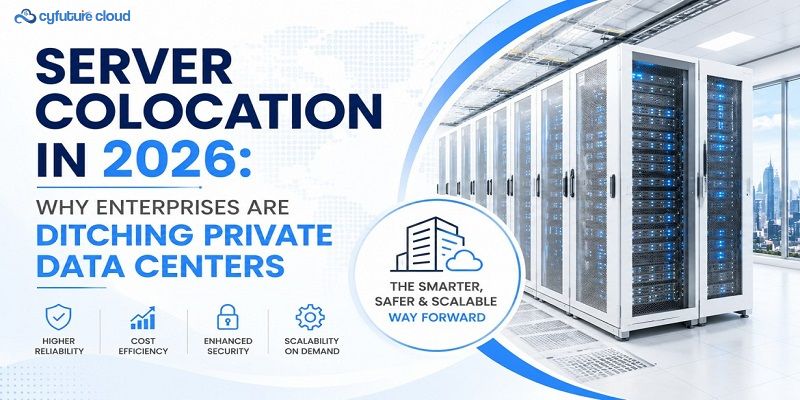
Imagine your enterprise data center suddenly needs to scale 3x overnight to support a new AI workload—but building a new facility would cost $15 million and take 18 months. Now imagine doing it in weeks, for a fraction of the cost, without sacrificing control over your hardware. This is no longer a hypothetical scenario. Cloud colocation is rapidly becoming the strategic backbone of modern enterprise infrastructure, blending the control of on-premises hardware with the flexibility of cloud architecture.
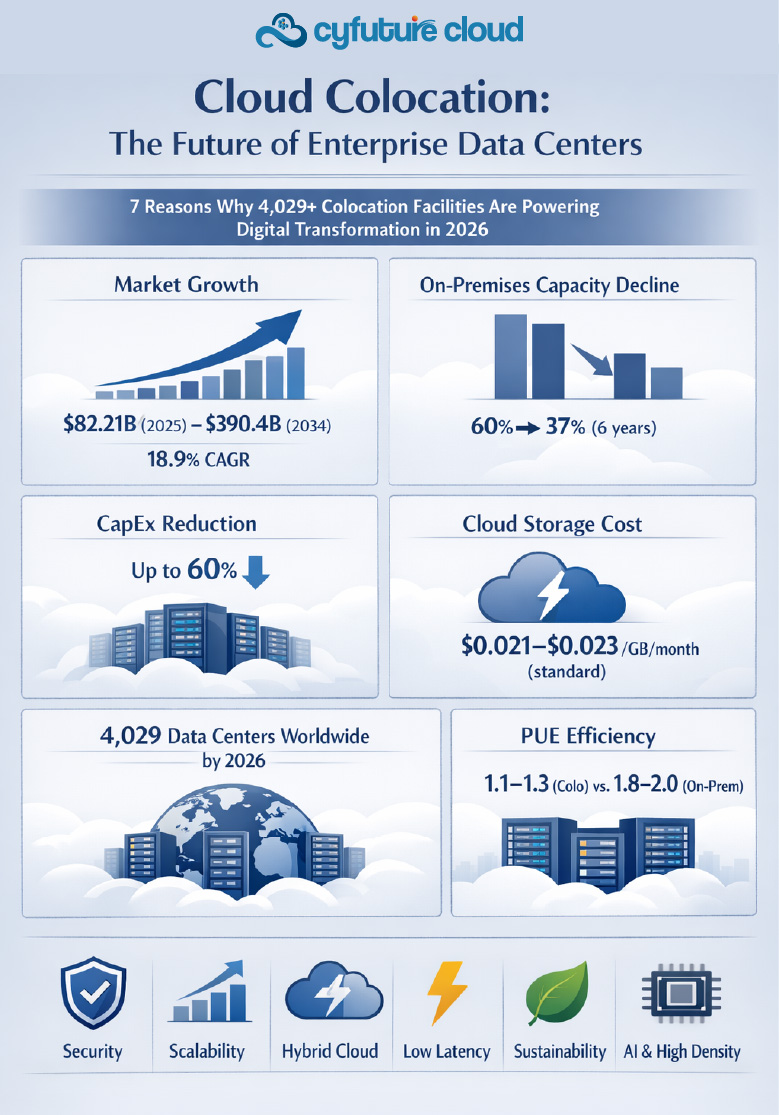
In 2026, the data center landscape has shifted dramatically. According to ABI Research, there will be 4,029 colocation data centers worldwide by end of 2026, growing at a 2.8% CAGR to reach 5,157 by 2035. Meanwhile, the global Data Center Colocation Market, valued at USD 82.21 billion in 2025, is projected to surge to USD 390.4 billion by 2034—an astounding 18.9% CAGR.
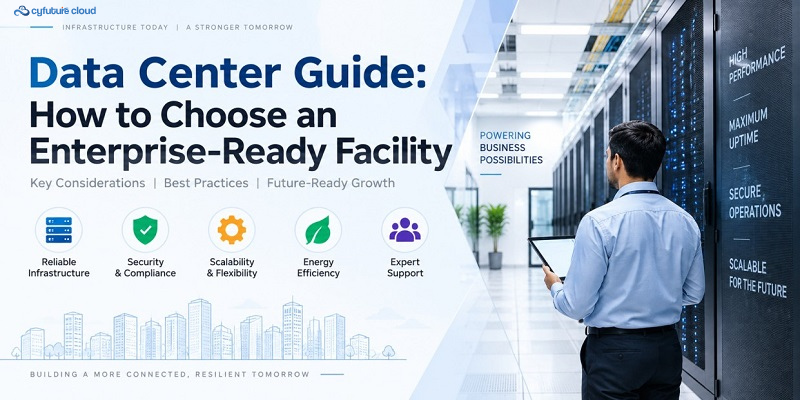
Here are the seven core technical reasons why cloud colocation is the future of enterprise data centers.
1. Dramatic Cost Efficiency Without CapEx Bloat
Building a private data center costs $10–20 million upfront, plus ongoing expenses for energy, cooling, and maintenance . Cloud colocation eliminates this burden. Businesses pay only for the space, power, and bandwidth they use, reducing capital expenditure (CapEx) by up to 60%.
This pay-as-you-grow model is especially critical in 2026, where enterprises must balance massive AI infrastructure spend with tight margins. Unlike public cloud, where cloud storage price can escalate unpredictably (standard tiers at $0.021–$0.023/GB/month, with cold vaults at $0.006–$0.009/GB/month), colocation offers predictable usage-based pricing without egress fees or vendor lock-in.
2. Seamless Hybrid and Multi-Cloud Integration
Modern enterprises rarely rely on a single infrastructure model. Colocation acts as the stabilizing foundation for hybrid and multi-cloud architectures. You can keep latency-sensitive or data-sovereign workloads in colocation while using public cloud for burst capacity, backups, or global distribution.
This approach reduces vendor lock-in, improves resilience, and enables cloud on-ramp capabilities with private direct connections to AWS, Azure, and Google Cloud. For tech leaders managing complex stacks, colocation is the intelligent hub that unifies disparate environments.
3. On-Demand Scalability with Zero Disruption
When your business grows, your IT requirements shift instantly. Colocation enables enterprises to scale from a single rack to multiple suites without capital delays or operational downtime. Advanced providers like Cyfuture Cloud can quickly deploy new servers, storage, and network infrastructure to match evolving needs.
Compare this to on-premises data centers, which are often constrained by limited capacity and lack the footprint to support growth plans. In 2026, with AI workloads demanding high-density halls and liquid cooling, colocation facilities are already equipped with high-density computing infrastructure that would take years to build privately.
4. Enterprise-Grade Security and Compliance
Colocation facilities provide physical security far beyond what most enterprises can afford on their own: 24/7 surveillance, biometric access, multi-layer perimeter security, and armed guards. They also offer compliance certifications (ISO 27001, SOC 2, GDPR, HIPAA) that are expensive and complex to maintain internally.
For industries like finance, healthcare, and government, data sovereignty is non-negotiable. Colocation lets you keep data within specific geographic boundaries while still enjoying cloud-like agility—a critical advantage as data regulations tighten globally in 2026.
5. Carrier-Neutral Connectivity and Low Latency
Colocation data centers are carrier-neutral, meaning you can choose from multiple ISPs, cloud on-ramps, and peering partners in the same facility. This diversity reduces single points of failure and enables low-latency interconnection to cloud providers, SaaS platforms, and business partners.
For developers running real-time applications (AI inference, fintech trading, gaming), latency of even a few milliseconds matters. Colocation facilities often host internet exchange points (IXPs), enabling direct, high-speed connections that public cloud alone cannot match.
6. Energy Efficiency and Sustainability Mandates
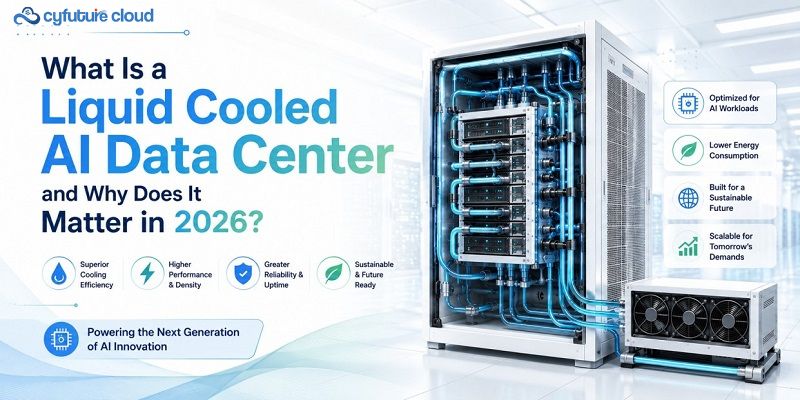
In 2026, sustainability is not a nice-to-have—it’s a board-level priority. Colocation providers invest in renewable-backed power procurement, advanced cooling (liquid and hybrid), and energy-efficient designs that most enterprises cannot replicate independently.
Traditional on-premises data centers operate at much lower Power Usage Effectiveness (PUE) ratios. Colocation facilities typically achieve PUE as low as 1.1–1.3, compared to 1.8–2.0 for older on-premise setups. This translates to 30–40% lower energy costs and a significantly smaller carbon footprint.
7. Future-Proofing Against Technological Obsolescence
Technology evolves faster than most enterprises can upgrade. Colocation providers deliver constant technological advancement, including regular infrastructure upgrades, access to cutting-edge hardware, and expertise in emerging technologies like AI, 5G, and edge computing.
Instead of refreshing hardware every 3–5 years at massive cost, you leverage the provider’s infrastructure investments. This is critical in 2026, where trillion-dollar AI infrastructure spend is reshaping requirements for high-performance computing, GPU density, and liquid cooling.
The Bottom Line
Cloud colocation is not just an alternative to traditional data centers—it’s the evolution of enterprise infrastructure. It delivers the control of on-premises hardware, the flexibility of cloud, and the efficiency of centralized, specialized facilities. With the colocation market growing at 18.9% CAGR and enterprises shifting away from on-prem (which dropped from 60% of capacity six years ago to just 37% in 2024), the direction is clear.
For tech leaders, developers, students, and enterprises: the future isn’t all-cloud or all-on-premises. It’s cloud colocation—the intelligent middle ground that powers scalable, secure, and sustainable digital transformation.


Stay Ahead of the Curve.
Join the Cloud Movement, today!
Send this to a friend