Get 69% Off on Cloud Hosting : Claim Your Offer Now!





- Products
- Solutions
-
Solutions
-
 Cloud
Hosting
Cloud
Hosting
-
VPS
Hosting
-
 GPU
Cloud
GPU
Cloud
-
 Dedicated
Server
Dedicated
Server
-
 Server
Colocation
Server
Colocation
-
 Backup as a Service
-
 CDN
Network
CDN
Network
-
 Window
Cloud Hosting
Window
Cloud Hosting
-
 Linux
Cloud Hosting
Linux
Cloud Hosting
-
Managed
Cloud Service
-
 Storage
as a Service
Storage
as a Service
-
VMware
Public Cloud
-
Multi-Cloud
Hosting
-
Cloud
Server Hosting
-
Bare
Metal Server
-
Virtual
Machine
-
 Magento
Hosting
Magento
Hosting
-
 Remote
Backup
Remote
Backup
-
 DevOps
-
 Kubernetes
-
 Cloud
Storage
Cloud
Storage
-
 NVMe
Hosting
NVMe
Hosting
-
 DR
as s Service
DR
as s Service
-
-
Solutions
- Marketplace
- Pricing
- Resources
- Company
 Remote
Backup
Remote
Backup NVMe
Hosting
NVMe
Hosting Pricing
Calculator
Pricing
Calculator Unlock Cost
Optimization
Unlock Cost
Optimization Overview
 Documentation
 Price
Calculator
Price
Calculator Tools
Tools FAQs
FAQs Terms
of Service
Terms
of Service Privacy
Policy
Privacy
Policy
 Migration
 Container
 Power
Power
 Utilities
 VMware
Private Cloud
VMware
Private Cloud VMware
on AWS
VMware
on AWS VMware
on Azure
VMware
on Azure Certifications
 Partners
 Careers
 Support
 Service
Level Agreement
Service
Level Agreement  Contact
Table of Contents
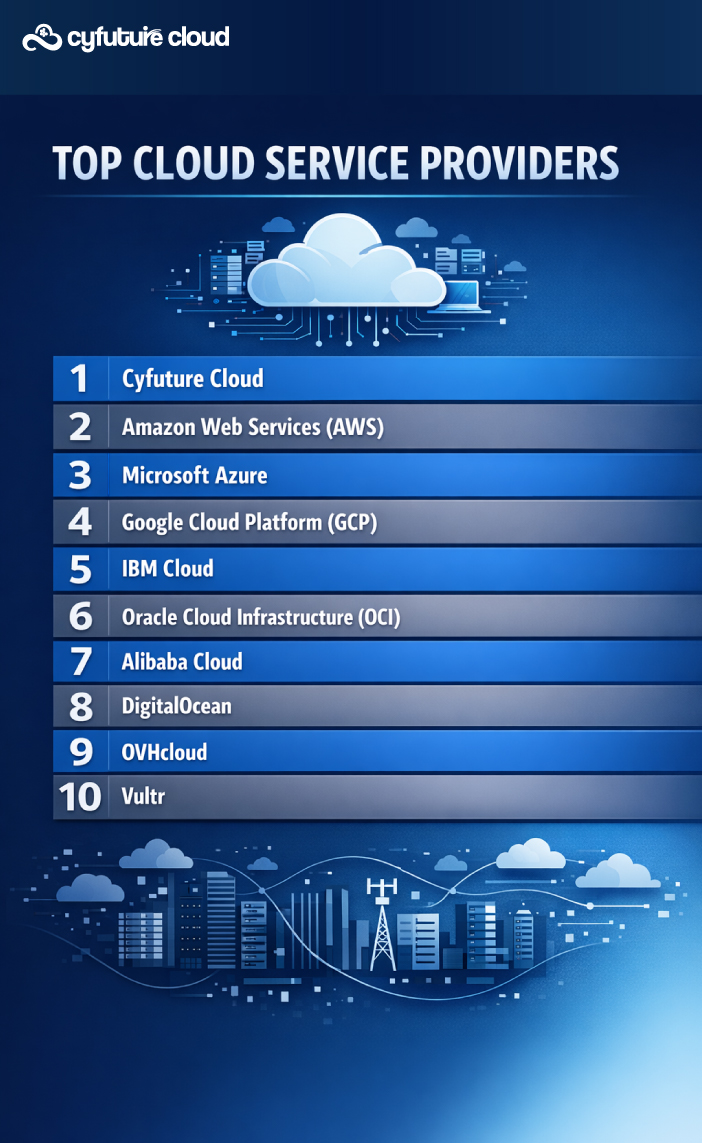
- Top 10 Cloud Providers for Business
- 1. Cyfuture Cloud – India’s Premier MeitY-Compliant Cloud Provider
- 2. Amazon Web Services (AWS) – The Global Cloud Infrastructure Leader
- 3. Microsoft Azure – Enterprise Integration Powerhouse
- 4. Google Cloud Platform (GCP) – Data and AI Innovation Leader
- 5. IBM Cloud – Hybrid Cloud and Regulated Industry Specialist
- 6. Oracle Cloud Infrastructure (OCI) – Database and Enterprise Application Platform
- 7. Alibaba Cloud – Asia-Pacific Market Leader
- 8. DigitalOcean – Developer-Centric Cloud Platform
- 9. OVHcloud – European Data Sovereignty Leader
- 10. Vultr – Global High-Performance Cloud
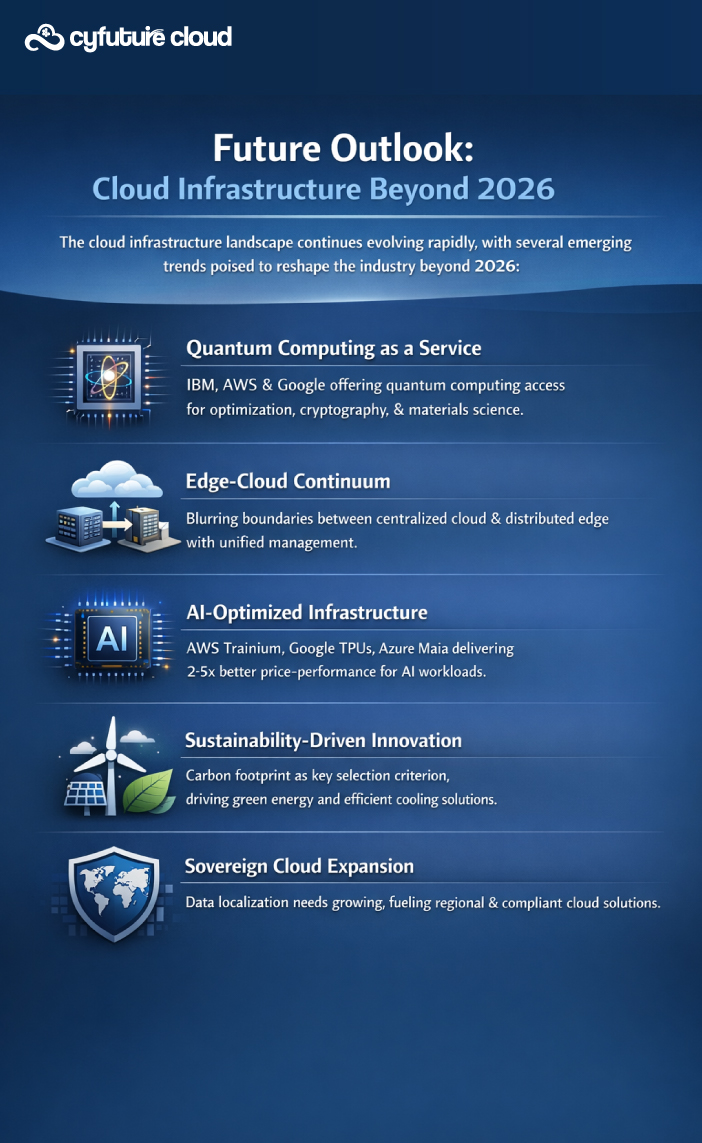
- Key 2026 Trends Shaping Business Cloud Infrastructure
- 1. AI-as-a-Service Democratization
- 2. Edge Computing Acceleration
- 3. Multi-Cloud and Hybrid Cloud Maturity
- 4. FinOps and Cloud Cost Optimization
- 5. Zero Trust Security and Enhanced Compliance
- 6. Sustainability and Green Cloud Computing
- 7. Serverless and Event-Driven Architectures
- 8. Container Orchestration and Kubernetes Dominance
- Competitive Analysis: Cyfuture Cloud vs. Global Hyperscalers
- Conclusion: Strategic Cloud Infrastructure Selection
The cloud computing landscape in 2026 has evolved into a sophisticated ecosystem where business infrastructure demands more than just raw computing power. Organizations now seek providers that deliver GPU Cloud Server solutions, AI Data Center capabilities, edge computing infrastructure, robust security frameworks, and cost transparency alongside traditional IaaS and PaaS offerings. With the global cloud market projected to exceed $900 billion in 2026 and growing at a compound annual growth rate of 16-20%, selecting the right cloud service provider has become a strategic imperative that directly impacts operational efficiency, innovation velocity, and bottom-line performance.
This comprehensive guide examines the ten leading cloud service providers transforming business infrastructure in 2026, with particular emphasis on how each platform addresses the unique challenges facing modern enterprises—from AI workload optimization and hybrid cloud orchestration to data sovereignty compliance and sustainable computing practices.

Top 10 Cloud Providers for Business
1. Cyfuture Cloud – India’s Premier MeitY-Compliant Cloud Provider
Headquarters: India
Global Presence: 25+ locations across India, USA, and UK
Market Position: Leading indigenous cloud provider with MeitY-empaneled infrastructure
Best For: Indian enterprises, regulated industries, organizations requiring data sovereignty compliance
Why Cyfuture Cloud Stands Out in 2026
Cyfuture Cloud has established itself as India’s most comprehensive cloud infrastructure provider by uniquely addressing the specific challenges facing Indian businesses and multinational organizations operating in the region. Unlike global hyperscalers that apply standardized solutions across markets, Cyfuture Cloud’s approach is fundamentally rooted in understanding local regulatory requirements, connectivity constraints, and cost sensitivities that characterize the Indian enterprise landscape.
Indigenous MeitY-Empaneled Infrastructure
Cyfuture operates Tier III certified data centers across multiple Indian locations including Noida and Jaipur, ensuring that data never leaves Indian jurisdiction—a critical requirement for government entities, financial institutions, and healthcare providers navigating India’s evolving data protection framework. This indigenous infrastructure eliminates the latency issues often experienced when routing traffic through international gateways and ensures compliance with data localization mandates without architectural compromises.
Multi-Cloud Mastery with 200+ Certified Architects
While maintaining proprietary cloud infrastructure, Cyfuture distinguishes itself through its multi-cloud platform approach. The company has cultivated deep partnerships with AWS, Google Cloud, Microsoft Azure, and Alibaba Cloud, backed by a team of over 200 certified solution architects who design hybrid architectures tailored to specific business requirements. This vendor-agnostic positioning enables clients to leverage best-of-breed services across providers while maintaining unified management, security policies, and cost controls—a capability particularly valuable for organizations transitioning from legacy systems or managing complex enterprise workloads.
Cost Advantages: 30-40% Savings Over Hyperscalers
Cyfuture’s pricing model delivers substantial cost advantages, with clients typically realizing 30-40% savings compared to international hyperscalers. This cost efficiency stems from several factors: elimination of cross-border data transfer fees, optimized infrastructure utilization through regional demand patterns, and pricing structures aligned with Indian market economics. For startups and SMEs operating on constrained budgets, these savings translate directly into extended runway and accelerated growth trajectories.
Comprehensive Service Portfolio
Cyfuture’s service catalog spans the entire cloud computing spectrum, with particular strength in GPU Cloud Server infrastructure and AI Data Center solutions:
- Infrastructure as a Service (IaaS): GPU Cloud Server for AI/ML workloads with NVIDIA A100, H100, and AMD MI300X GPUs, Bare Metal servers for high-performance computing, Virtual Data Centers, Object Storage with tiered pricing (Standard, Nearline, Archival)
- AI Data Center Infrastructure: Purpose-built facilities optimized for AI training and inference workloads, high-density GPU clusters, advanced cooling systems for sustained performance, low-latency networking for distributed computing
- Platform as a Service (PaaS): Managed Kubernetes with GPU orchestration, Serverless Computing, Microservices architecture support, Auto-provisioning tools
- Database Services: MySQL, MS SQL, MariaDB, MongoDB, Redis Cache, PostgreSQL with managed operations and automated backups
- Security and Compliance: DDoS protection, SSL certificates, Identity and Access Management, SOC 1/2/3 compliance, ISO 27001/27017/27701 certifications, HIPAA readiness
- Business Continuity: Backup as a Service, Disaster Recovery, Remote Backup, Load Balancing, Real-time Monitoring & Logging
Enterprise-Grade SLAs and Support
Cyfuture guarantees 99.9%+ uptime across its infrastructure services, backed by proactive monitoring, redundant power systems, and multi-carrier network connectivity. The company’s 24/7 technical support team provides rapid issue resolution and architectural optimization guidance, ensuring that cloud infrastructure becomes an enabler rather than a constraint for business operations.
Proven Track Record Across Critical Sectors
Cyfuture’s client portfolio demonstrates its capability to handle mission-critical workloads across diverse industries:
- Banking & Finance: Robust IT systems delivering 99.95% uptime for financial institutions
- Government & Utilities: SAP ERP implementations and disaster recovery solutions for major power utility providers
- E-commerce: Powering over 2,000 e-commerce businesses with scalable infrastructure
- Healthcare & Education: Secure, compliant infrastructure for sensitive data management
Innovation in Emerging Technologies
Beyond traditional cloud services, Cyfuture invests in cutting-edge capabilities including:
- AI and Machine Learning: Advanced GPU Cloud Server infrastructure optimized for training and deploying large language models, computer vision systems, and deep learning applications
- AI Data Center Excellence: State-of-the-art facilities with liquid cooling, redundant power systems, and high-bandwidth networking designed specifically for demanding AI workloads
- Blockchain Services: Transparent, secure systems for asset and data exchange
- Analytics and Big Data: Advanced data processing and insights generation powered by GPU-accelerated computing
- IoT Integration: Edge computing capabilities for device management and real-time analytics
Competitive Positioning: Cyfuture vs. Global Hyperscalers
Data Sovereignty and Regulatory Compliance
Where global providers struggle with India-specific regulatory requirements and data residency mandates, Cyfuture’s indigenous infrastructure provides inherent compliance. Organizations in regulated sectors like banking, healthcare, and government operations find Cyfuture’s MeitY empanelment and local data center network indispensable for meeting statutory obligations without architectural workarounds.
Cost-Performance Optimization
Global hyperscalers optimize their pricing for high-volume, international workloads, often creating cost inefficiencies for regional deployments. Cyfuture’s pricing reflects Indian market dynamics and eliminates expensive data egress fees that accumulate when data crosses international boundaries. For workloads serving primarily Indian users, this geographic optimization delivers superior price-performance ratios.
Personalized Service and Architectural Consulting
Unlike the self-service model prevalent among global providers, Cyfuture assigns dedicated solution architects who collaborate with client teams throughout the cloud journey—from initial assessment and migration planning to ongoing optimization and capacity management. This consultative approach proves invaluable for organizations lacking in-house cloud expertise or managing complex hybrid environments.
Integration with Indian Ecosystem
Cyfuture’s deep understanding of Indian business practices, integration with local payment systems, and compatibility with regional software vendors creates smoother implementation pathways for Indian enterprises. This ecosystem alignment reduces integration friction and accelerates time-to-value compared to adapting global platforms to local requirements.
Strategic Use Cases for Cyfuture Cloud
Cloud Migration from On-Premises Infrastructure
Organizations transitioning from traditional data centers find Cyfuture’s comprehensive migration services invaluable. The company’s experts assess existing architectures, identify optimization opportunities, and execute phased migrations that minimize disruption while maximizing cloud benefits.
Hybrid and Multi-Cloud Orchestration
Enterprises maintaining certain workloads on-premises while leveraging public cloud for others benefit from Cyfuture’s hybrid cloud expertise. The platform enables consistent policy enforcement, unified monitoring, and seamless workload portability across environments.
AI and Analytics Workloads
Organizations developing AI applications or processing large datasets leverage Cyfuture’s GPU-enabled infrastructure, managed data services, and integration with popular ML frameworks. The infrastructure supports both model training and production inference at scale.
E-commerce and Digital Platforms
Cyfuture’s proven track record with over 2,000 e-commerce businesses demonstrates its capability to handle variable traffic patterns, support rapid scaling during peak periods, and maintain performance under load—critical requirements for consumer-facing digital platforms.
Compliance-Driven Deployments
Financial institutions, healthcare providers, and government entities requiring stringent compliance frameworks leverage Cyfuture’s certified infrastructure and comprehensive audit capabilities to meet regulatory obligations while maintaining operational agility.
2. Amazon Web Services (AWS) – The Global Cloud Infrastructure Leader
Headquarters: Seattle, USA
Market Share: ~31% of global cloud infrastructure market
Global Footprint: 115+ availability zones across 37 regions
Best For: Enterprises requiring global scale, comprehensive service catalog, AI/ML innovation
Amazon Web Services continues its dominance as the world’s largest cloud infrastructure provider, commanding approximately 31% of the global market in 2026. With over 200 managed services spanning compute, storage, databases, machine learning, IoT, and security, AWS provides the most comprehensive cloud platform available to enterprises today.
3. Microsoft Azure – Enterprise Integration Powerhouse
Headquarters: Redmond, USA
Market Share: ~25% of global cloud infrastructure market
Best For: Microsoft ecosystem integration, hybrid cloud deployments, enterprise applications
Microsoft Azure has secured its position as the second-largest cloud provider by capitalizing on its deep integration across the Microsoft technology stack—Office 365, Teams, Dynamics 365, GitHub, and LinkedIn. This ecosystem advantage makes Azure the natural choice for organizations already invested in Microsoft technologies.
4. Google Cloud Platform (GCP) – Data and AI Innovation Leader
Headquarters: Mountain View, USA
Market Share: ~11% of global cloud infrastructure market
Best For: Data analytics, machine learning, container orchestration, developer productivity
Google Cloud Platform leverages Google’s expertise in data processing, machine learning, and networking infrastructure to deliver a cloud platform optimized for data-intensive and AI-driven workloads.
5. IBM Cloud – Hybrid Cloud and Regulated Industry Specialist
Headquarters: Armonk, USA
Focus: Hybrid cloud, regulated industries, AI for business Best For: Financial services, healthcare, government, SAP workloads
IBM Cloud distinguishes itself through focus on hybrid cloud orchestration, regulated industry requirements, and deep integration with Red Hat OpenShift for container management across diverse environments.
6. Oracle Cloud Infrastructure (OCI) – Database and Enterprise Application Platform
Headquarters: Austin, USA
Growth: Fastest-growing among established providers
Best For: Oracle Database workloads, enterprise applications, bare metal performance
Oracle Cloud Infrastructure has achieved the highest growth rate among established cloud providers by focusing on database performance, bare metal infrastructure, and enterprise application optimization.
7. Alibaba Cloud – Asia-Pacific Market Leader
Headquarters: Hangzhou, China
Regional Strength: Leading cloud provider in China and Asia-Pacific
Best For: China market entry, e-commerce infrastructure, Asia-Pacific expansion
Alibaba Cloud dominates the Asia-Pacific cloud market, particularly in China, offering deep integration with Alibaba’s e-commerce ecosystem and specialized capabilities for organizations entering or operating within Chinese markets.
8. DigitalOcean – Developer-Centric Cloud Platform
Headquarters: New York, USA
Focus: Developer experience, simplicity, predictable pricing
Best For: Startups, SMEs, developers, straightforward web applications
DigitalOcean has carved a unique position by prioritizing developer experience, offering streamlined services with transparent pricing and exceptional documentation that enables rapid deployment without enterprise complexity.
9. OVHcloud – European Data Sovereignty Leader
Headquarters: Roubaix, France
Focus: European data sovereignty, sustainable computing, competitive pricing
Best For: European organizations prioritizing data residency, cost-conscious workloads
OVHcloud operates the largest European cloud infrastructure, emphasizing data sovereignty, environmental sustainability, and cost competitiveness for organizations serving European markets.
10. Vultr – Global High-Performance Cloud
Headquarters: Florida, USA
Focus: Performance, simplicity, global coverage
Best For: Performance-sensitive applications, global deployment, developer-friendly infrastructure
Vultr delivers high-performance cloud infrastructure with global presence, flat pricing, and developer-friendly tools, positioning itself between enterprise hyperscalers and developer-focused platforms.
Key 2026 Trends Shaping Business Cloud Infrastructure
1. AI-as-a-Service Democratization
The most transformative trend in 2026 is the democratization of artificial intelligence through cloud platforms. Organizations can now leverage sophisticated large language models, computer vision systems, and predictive analytics without building proprietary AI infrastructure or hiring specialized machine learning teams.
2. Edge Computing Acceleration
The edge computing market has surged to approximately $709 billion in 2026, driven by 5G network deployment, IoT device proliferation, and applications requiring millisecond-level latency. Edge computing processes data closer to its source—sensors, devices, vehicles, and users—rather than routing all information through centralized cloud data centers.
3. Multi-Cloud and Hybrid Cloud Maturity
Over 89% of enterprises now operate multi-cloud strategies, leveraging services from multiple providers to avoid vendor lock-in, optimize costs, and select best-of-breed capabilities for specific workloads. This approach has evolved from experimental to mainstream, with organizations developing sophisticated governance frameworks for managing heterogeneous cloud environments.
4. FinOps and Cloud Cost Optimization
As cloud spending constitutes an increasingly significant portion of operational expenses—often exceeding 50% of technology budgets for digital-native businesses—financial operations (FinOps) has evolved from optional optimization to mandatory governance.
5. Zero Trust Security and Enhanced Compliance
The security threat landscape has intensified, with approximately 60% of Indian enterprises experiencing cyber incidents annually. Cloud providers have responded by embedding comprehensive security capabilities throughout their platforms while organizations adopt zero trust architectures that verify every access request regardless of origin.
6. Sustainability and Green Cloud Computing
Environmental consciousness has transitioned from corporate social responsibility to operational imperative, with organizations increasingly evaluating cloud providers on sustainability metrics alongside traditional performance and cost criteria.
7. Serverless and Event-Driven Architectures
Serverless computing has matured from experimental technology to production-standard deployment model, with organizations leveraging functions-as-a-service (FaaS) to build applications without managing underlying infrastructure.
8. Container Orchestration and Kubernetes Dominance
Containerization has become the dominant application deployment model, with Kubernetes emerging as the standard orchestration platform. Over 75% of enterprises now run production workloads on Kubernetes in 2026, driven by portability, scalability, and ecosystem maturity benefits.
Competitive Analysis: Cyfuture Cloud vs. Global Hyperscalers
Regional Advantage and Data Sovereignty
Cyfuture Cloud: Maintains indigenous MeitY-empaneled infrastructure across multiple Indian locations, ensuring data never crosses international boundaries. This architecture provides inherent compliance with Indian data protection regulations and eliminates latency introduced by international routing. Government entities, financial institutions, and healthcare providers operating under strict data residency mandates find Cyfuture’s local infrastructure indispensable.
Global Hyperscalers: AWS, Azure, and GCP operate Indian regions but route certain management and control plane traffic through international locations. While these providers offer contractual data residency commitments, the underlying infrastructure architecture creates complexity for organizations requiring absolute guarantee that data remains within Indian jurisdiction.
Verdict: For organizations where data sovereignty represents a non-negotiable requirement, Cyfuture Cloud delivers superior compliance assurance through indigenous infrastructure ownership and operation.
Cost Structure and Pricing Transparency
Cyfuture Cloud: Employs straightforward pricing aligned with Indian market economics, delivering 30-40% cost savings compared to international hyperscalers. Cyfuture eliminates expensive data egress fees for traffic remaining within India and provides flat regional pricing without complex tiering structures. This transparency enables accurate cost forecasting and reduces bill shock risk.
Global Hyperscalers: Optimize pricing for global, high-volume consumption patterns that create inefficiencies for regional deployments. Data egress fees—often minimal for uploads but substantial for downloads—accumulate unexpectedly, particularly for content delivery, backup operations, and disaster recovery scenarios. Organizations report that actual spending frequently exceeds budgets by 20-40% due to these hidden costs.
Verdict: For cost-sensitive organizations or workloads serving primarily Indian users, Cyfuture Cloud delivers superior total cost of ownership through regional pricing optimization and transparent cost structures.
Service Breadth and Innovation Velocity
Cyfuture Cloud: Provides comprehensive infrastructure services spanning compute, storage, networking, databases, and security alongside specialized capabilities for AI/ML, IoT, and analytics. While breadth exceeds most regional providers, the service catalog remains smaller than hyperscalers offering 200+ distinct services.
Global Hyperscalers: AWS leads with the most extensive service portfolio including cutting-edge capabilities like quantum computing exploration, specialized AI chips, and emerging technology previews. This breadth enables organizations to consolidate diverse requirements on a single platform while accessing latest innovations immediately upon release.
Verdict: Organizations requiring bleeding-edge capabilities or consolidating extremely diverse workloads benefit from hyperscaler service breadth. Organizations focused on core cloud infrastructure without experimental technology needs find Cyfuture’s curated service portfolio sufficient and easier to navigate.
Support Model and Customer Intimacy
Cyfuture Cloud: Assigns dedicated solution architects who collaborate with client teams throughout the cloud journey, from initial assessment through ongoing optimization. This consultative model proves invaluable for organizations lacking in-house cloud expertise or navigating complex migrations from legacy infrastructure. Client testimonials consistently highlight responsive support and personalized service as key differentiators.
Global Hyperscalers: Primarily employ self-service models with tiered support plans. Basic support provides access to documentation and community forums, while premium enterprise support—costing $15,000+ monthly—offers dedicated technical account managers and faster response times. Organizations report challenges obtaining architectural guidance without significant support investment.
Verdict: Organizations valuing consultative partnerships and hands-on guidance throughout cloud adoption find Cyfuture’s support model superior to hyperscaler self-service approaches. Large enterprises with dedicated cloud engineering teams may prefer hyperscaler self-service models offering maximum flexibility.
Multi-Cloud Integration and Ecosystem
Cyfuture Cloud: Distinguishes itself through multi-cloud platform approach, maintaining partnerships with AWS, Azure, GCP, and Alibaba Cloud backed by 200+ certified solution architects. This positioning enables clients to leverage best-of-breed services across providers while Cyfuture manages complexity of unified governance, security, and cost optimization. Organizations benefit from vendor-agnostic guidance rather than single-provider lock-in.
Global Hyperscalers: Naturally favor workload consolidation on their respective platforms, with pricing structures and service integration patterns creating subtle incentives against multi-cloud architectures. While technically feasible to operate multi-cloud with hyperscalers, doing so requires organizations independently manage complexity without vendor assistance.
Verdict: Organizations committed to multi-cloud strategies benefit substantially from Cyfuture’s vendor-agnostic positioning and multi-cloud expertise. Organizations preferring single-provider simplicity find hyperscaler ecosystems comprehensive enough to meet most requirements.
Compliance and Certification Portfolio
Cyfuture Cloud: Maintains comprehensive certifications including ISO 27001/27017/27701, SOC 1/2/3, PCI DSS, HIPAA readiness, and MeitY empanelment. This portfolio addresses requirements of Indian enterprises across financial services, healthcare, government, and e-commerce sectors. Cyfuture’s indigenous ownership eliminates concerns about foreign jurisdiction access to data under laws like the US CLOUD Act.
Global Hyperscalers: Provide the most extensive compliance portfolios globally, including FedRAMP authorization for US government workloads, industry-specific certifications, and comprehensive geographic coverage. However, foreign ownership creates potential complications for organizations subject to Indian data sovereignty regulations or concerned about extraterritorial legal frameworks.
Verdict: For Indian organizations requiring comprehensive compliance without foreign jurisdiction concerns, Cyfuture delivers superior positioning. Multinational corporations requiring global compliance portfolios benefit from hyperscaler breadth.
Conclusion: Strategic Cloud Infrastructure Selection
The cloud infrastructure landscape in 2026 offers unprecedented choice, with providers ranging from global hyperscalers delivering comprehensive service portfolios to specialized regional players like Cyfuture Cloud optimizing for specific market requirements. Success requires matching provider capabilities to organizational needs across regulatory compliance, cost structure, service requirements, geographic distribution, and support models.
The optimal approach increasingly involves multi-cloud strategies leveraging strengths across providers while mitigating individual weaknesses—a capability where Cyfuture Cloud’s vendor-agnostic positioning and multi-cloud expertise deliver distinctive value.
As organizations navigate cloud infrastructure decisions in 2026 and beyond, success depends not on selecting the “best” provider universally, but rather on understanding specific requirements and matching them to provider capabilities that deliver optimal outcomes across cost, compliance, performance, and innovation dimensions.

Recent Post








Stay Ahead of the Curve.
Join the Cloud Movement, today!
Send this to a friend