Get 69% Off on Cloud Hosting : Claim Your Offer Now!





- Products
- Solutions
-
Solutions
-
 Cloud
Hosting
Cloud
Hosting
-
VPS
Hosting
-
 GPU
Cloud
GPU
Cloud
-
 Dedicated
Server
Dedicated
Server
-
 Server
Colocation
Server
Colocation
-
 Backup as a Service
-
 CDN
Network
CDN
Network
-
 Window
Cloud Hosting
Window
Cloud Hosting
-
 Linux
Cloud Hosting
Linux
Cloud Hosting
-
Managed
Cloud Service
-
 Storage
as a Service
Storage
as a Service
-
VMware
Public Cloud
-
Multi-Cloud
Hosting
-
Cloud
Server Hosting
-
Bare
Metal Server
-
Virtual
Machine
-
 Magento
Hosting
Magento
Hosting
-
 Remote
Backup
Remote
Backup
-
 DevOps
-
 Kubernetes
-
 Cloud
Storage
Cloud
Storage
-
 NVMe
Hosting
NVMe
Hosting
-
 DR
as s Service
DR
as s Service
-
-
Solutions
- Marketplace
- Pricing
- Resources
- Company
 Remote
Backup
Remote
Backup NVMe
Hosting
NVMe
Hosting Pricing
Calculator
Pricing
Calculator Unlock Cost
Optimization
Unlock Cost
Optimization Overview
 Documentation
 Price
Calculator
Price
Calculator Tools
Tools FAQs
FAQs Terms
of Service
Terms
of Service Privacy
Policy
Privacy
Policy
 Migration
 Container
 Power
Power
 Utilities
 VMware
Private Cloud
VMware
Private Cloud VMware
on AWS
VMware
on AWS VMware
on Azure
VMware
on Azure Certifications
 Partners
 Careers
 Support
 Service
Level Agreement
Service
Level Agreement  Contact
Table of Contents
- 1. Multi-Tenant Resource Isolation Vulnerabilities
- 2. Supply Chain Attacks on Container Images
- 3. API Authentication and Authorization Gaps
- 4. Data Encryption in Transit and at Rest
- 5. Inadequate Logging and Security Monitoring
- 6. Insecure Configuration Management
- 7. Insider Threats and Privileged Access Abuse
- Conclusion
- 7%20OpenClaw%20Security%20Challenges%20to%20Watch%20for%20in%202026<%2Fstrong>%20https%3A%2F%2Fcyfuture.cloud%2Fblog%2F7-openclaw-security-challenges-to-watch-for-in-2026%2F" title="" onclick="essb.tracking_only('', 'whatsapp', '1725434005', true);" target="_self" rel="nofollow" >WhatsApp
As organizations worldwide accelerate their digital transformation journeys, the convergence of edge computing, AI workloads, and distributed cloud architectures has given rise to unprecedented security complexities. OpenClaw, an emerging open-source framework designed for orchestrating AI and machine learning workloads across distributed infrastructure, is rapidly gaining traction among enterprises seeking flexible, cost-effective solutions. However, with innovation comes vulnerability.
For businesses leveraging GPU servers India and advanced cloud infrastructure, understanding the security landscape of OpenClaw isn’t just recommended—it’s essential. At Cyfuture Cloud, we’ve observed firsthand how the intersection of powerful computing resources and distributed frameworks creates unique security challenges that demand proactive strategies.
In this comprehensive guide, we’ll explore seven critical OpenClaw security challenges that organizations must prepare for in 2026, along with practical mitigation strategies to protect your infrastructure and data.

1. Multi-Tenant Resource Isolation Vulnerabilities
The Challenge
OpenClaw’s ability to orchestrate workloads across multiple tenants and infrastructure layers introduces significant isolation challenges. When multiple organizations or departments share the same physical infrastructure—particularly high-performance GPU servers India—the risk of resource bleed and side-channel attacks increases exponentially.
In 2026, we anticipate sophisticated attackers exploiting hypervisor vulnerabilities and shared memory spaces to extract sensitive information from adjacent workloads. The computational intensity of AI training models amplifies these risks, as GPU memory operations can inadvertently expose data patterns to malicious neighboring processes.
Cyfuture Cloud’s Approach
At Cyfuture Cloud, we implement hardware-level isolation mechanisms combined with software-defined security policies. Our cloud colocation services provide dedicated resource pools with cryptographic verification of isolation boundaries, ensuring that your GPU-intensive workloads remain completely segregated from other tenants.
2. Supply Chain Attacks on Container Images
The Challenge
OpenClaw relies heavily on containerized workloads, with organizations pulling images from public and private registries. The supply chain for these container images has become a prime target for sophisticated threat actors who inject malicious code into seemingly legitimate images.
By 2026, we expect to see an increase in “sleeper” malware embedded in popular OpenClaw container images—dormant code that activates only under specific conditions or after a predetermined time delay, making detection significantly more challenging.
The Vulnerability Cascade
A compromised container image can establish backdoors, exfiltrate sensitive data, hijack GPU resources for cryptocurrency mining, or serve as a pivot point for lateral movement across your network.
Security Best Practices
Cyfuture Cloud recommends a zero-trust approach including automated image scanning, cryptographically signed registries, runtime monitoring, and immutable infrastructure. Our managed GPU servers India infrastructure includes integrated container security scanning and runtime protection, ensuring your OpenClaw workloads execute only trusted code.
3. API Authentication and Authorization Gaps
The Challenge
OpenClaw exposes numerous APIs for workload orchestration, resource management, and monitoring. Inadequate authentication and authorization controls on these APIs create opportunities for unauthorized access and privilege escalation.
The complexity of managing API keys, OAuth tokens, and service account credentials across distributed OpenClaw deployments often leads to misconfigurations. In 2026, we anticipate that attackers will increasingly target these weak points, leveraging automated tools to discover and exploit exposed APIs.
Common Vulnerability Patterns
- Hardcoded credentials in configuration files or source code repositories
- Overly permissive role-based access control (RBAC) policies
- Lack of API rate limiting enabling brute force attacks
- Insufficient logging and monitoring of API access patterns
- Exposed management endpoints without proper network segmentation
Cyfuture Cloud’s Defense Strategy
Our cloud colocation infrastructure incorporates enterprise-grade API security measures:
- Multi-factor authentication (MFA) for all administrative access
- Fine-grained RBAC with principle of least privilege
- Automated credential rotation every 24-48 hours
- API gateway with intelligent rate limiting and threat detection
- Comprehensive audit logging with real-time alerting
When you deploy OpenClaw on Cyfuture Cloud’s infrastructure, these security controls are applied by default, significantly reducing your attack surface.
4. Data Encryption in Transit and at Rest
The Challenge
OpenClaw workloads frequently involve transferring massive datasets between storage systems, compute nodes, and GPU servers. The volume and velocity of this data movement create opportunities for interception if proper encryption isn’t enforced end-to-end.
Moreover, AI training datasets often contain sensitive personal information, proprietary business data, or regulated content. Inadequate encryption at rest leaves this valuable data vulnerable to physical theft, insider threats, and unauthorized access.
2026 Threat Landscape
Advanced persistent threats (APTs) are developing increasingly sophisticated capabilities for:
- Man-in-the-middle attacks on internal network traffic
- Exploiting unencrypted data in GPU memory during processing
- Extracting information from improperly sanitized storage media
- Leveraging quantum computing to break traditional encryption schemes
Encryption Strategy for OpenClaw
Cyfuture Cloud implements a defense-in-depth encryption strategy:
Data in Transit:
- TLS 1.3 for all network communications
- Encrypted tunnels between distributed OpenClaw components
- Mutual TLS authentication for service-to-service communication
Data at Rest:
- AES-256 encryption for all storage volumes
- Hardware security modules (HSMs) for key management
- Encrypted backups with geographically distributed key storage
- Secure deletion protocols for decommissioned storage
Our GPU servers India come with hardware-accelerated encryption capabilities, ensuring that security doesn’t compromise the performance of your compute-intensive workloads.
5. Inadequate Logging and Security Monitoring
The Challenge
The distributed nature of OpenClaw deployments generates enormous volumes of log data across multiple infrastructure layers. Without proper centralization, correlation, and analysis, critical security events can easily go unnoticed until significant damage occurs.
Many organizations struggle with:
- Log data scattered across disparate systems
- Insufficient retention periods for forensic analysis
- Lack of real-time alerting on suspicious activities
- Overwhelming alert fatigue leading to missed threats
- Compliance gaps in audit trail documentation
The Visibility Gap
By 2026, threat actors are expected to exploit this visibility gap by:
- Operating “low and slow” to avoid detection thresholds
- Deliberately generating log noise to obscure malicious activities
- Targeting logging infrastructure itself to erase evidence
- Exploiting blind spots in monitoring coverage
Cyfuture Cloud’s Monitoring Excellence
Our security operations center (SOC) provides comprehensive monitoring for OpenClaw deployments:
- Centralized Log Management: Aggregation of logs from all infrastructure components
- AI-Powered Threat Detection: Machine learning algorithms identify anomalous patterns
- Real-Time Alerting: Immediate notification of critical security events
- Long-Term Retention: Multi-year log retention for compliance and forensics
- Automated Response: Playbook-driven remediation for common threat scenarios
When you choose Cyfuture Cloud’s cloud colocation services, you gain access to enterprise-grade security monitoring without the overhead of building and maintaining it yourself.
6. Insecure Configuration Management
The Challenge
OpenClaw’s flexibility comes with configuration complexity. Default settings optimized for ease of deployment often sacrifice security, and organizations frequently go into production without hardening their configurations.
Common misconfigurations include:
- Exposed debugging endpoints and development tools in production
- Default passwords and credentials left unchanged
- Unnecessary services and ports left open
- Insecure network policies allowing unrestricted traffic
- Missing security patches and outdated component versions
Configuration Drift and Shadow IT
As teams make incremental changes to address immediate needs, configuration drift occurs—the gradual divergence from secure baseline configurations. Combined with shadow IT deployments that bypass central security teams, this creates an expanding attack surface that’s difficult to inventory and protect.
Cyfuture Cloud’s Configuration Management
We apply infrastructure-as-code (IaC) principles to OpenClaw deployments:
- Security-Hardened Baselines: CIS benchmark-compliant default configurations
- Automated Compliance Scanning: Continuous verification against security policies
- Version Control: All configuration changes tracked and auditable
- Automated Remediation: Policy violations automatically corrected
- Change Management: Formal approval processes for security-impacting changes
Our managed GPU servers India services ensure your OpenClaw infrastructure maintains secure configurations throughout its lifecycle.
7. Insider Threats and Privileged Access Abuse
The Challenge
Not all threats originate from external actors. Insider threats—whether malicious employees, negligent users, or compromised accounts with elevated privileges—pose one of the most difficult security challenges for OpenClaw deployments.
Privileged users with administrative access to OpenClaw infrastructure can:
- Bypass security controls and audit mechanisms
- Exfiltrate valuable AI models and training datasets
- Sabotage critical workloads causing business disruption
- Create backdoors for future unauthorized access
The 2026 Insider Threat Landscape
As remote work continues and contractor relationships become more fluid, distinguishing between legitimate and malicious insider activity becomes increasingly complex. Social engineering attacks targeting employees with privileged access will become more sophisticated, potentially compromising even well-intentioned users.
Cyfuture Cloud’s Insider Threat Mitigation
Our comprehensive approach to insider threat protection includes:
Access Controls:
- Just-in-time privileged access (limited duration, purpose-specific)
- Separation of duties preventing any single individual from having complete control
- Regular access reviews and automated deprovisioning
Monitoring and Detection:
- User and entity behavior analytics (UEBA) identifying anomalous activities
- Session recording for privileged access activities
- Data loss prevention (DLP) monitoring for unauthorized exfiltration attempts
Policy and Culture:
- Security awareness training emphasizing insider threat indicators
- Clear policies on acceptable use and consequences of violations
- Anonymous reporting channels for suspicious activities
When you partner with Cyfuture Cloud for your cloud colocation needs, you benefit from these enterprise-grade insider threat protections without building the capabilities in-house.
Conclusion
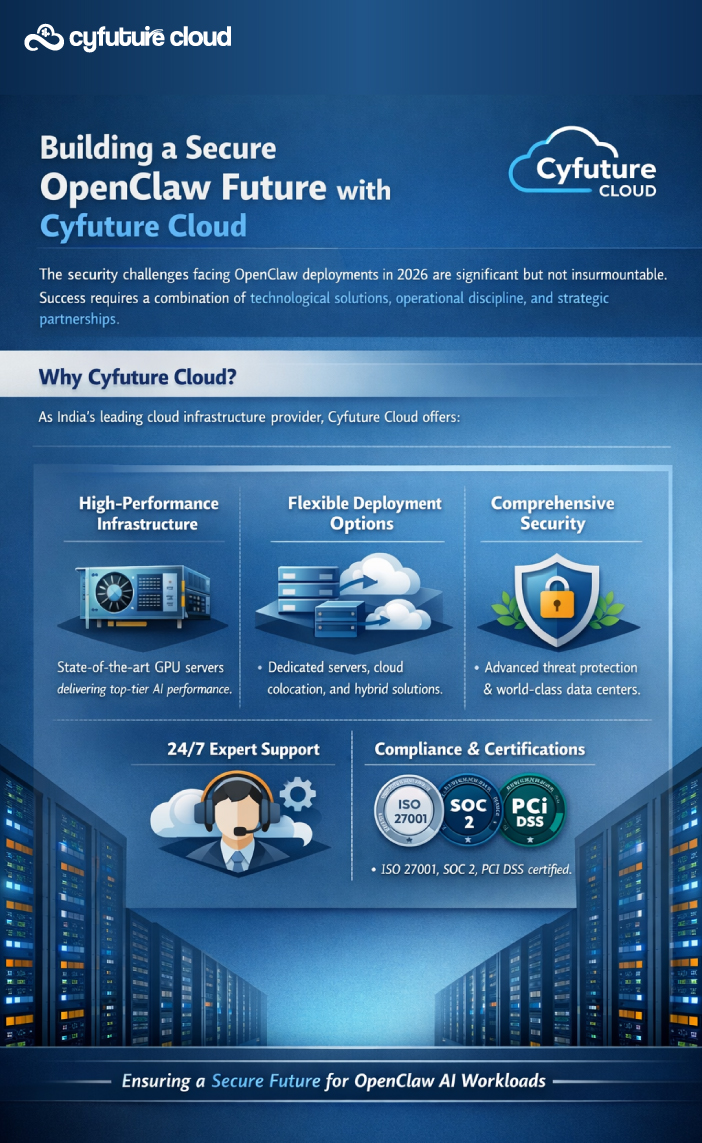
As OpenClaw adoption accelerates throughout 2026, the security challenges we’ve explored will only grow in significance. Organizations that prioritize security from the outset—choosing the right infrastructure partners, implementing robust controls, and maintaining vigilant monitoring—will be best positioned to harness OpenClaw’s power while protecting their most valuable assets.
Don’t wait for a security incident to prompt action. Partner with Cyfuture Cloud today and build your OpenClaw infrastructure on a foundation of security, performance, and reliability.
Cyfuture Cloud—Powering India’s Digital Future, Securely.

Recent Post




















Stay Ahead of the Curve.
Join the Cloud Movement, today!
Send this to a friend